
Key Takeaways
- MediaTek is making a stronger push into the flagship segment, with the Dimensity 9600 Pro giving the company an important technology lead in Android smartphone space through its 2nm process and all-big-core architecture.
- The Dimensity 9600 Pro is technically competitive across key areas, including on-device AI, gaming, imaging, memory, storage and connectivity, but technology alone will not guarantee premium-market success.
- Commercial execution will be critical, as OEM optimization around sustained performance, thermal management and battery life will determine how effectively the chipset translates into the real-world user experience.
- Vivo and OPPO provide an important starting point for MediaTek’s premium ambitions, but the company still lacks exposure to the two most important premium player, Samsung and Apple while Huawei relies on its own Kirin chipsets.
- Rising smartphone prices and higher memory costs could limit the opportunity, particularly as consumers become more sensitive to flagship pricing and early checks indicate weaker-than-expected performance for some Chinese premium launches.
While Qualcomm continues to lead the Android flagship smartphone chipset market, MediaTek is making steady progress toward closing the gap in the premium segment.
If we look at the global Android smartphone chipset market, MediaTek already leads in overall volume. However, the premium and ultra-premium segments remain much more challenging. Qualcomm has a strong position among Android flagship smartphones, while Apple continues to dominate the premium ecosystem with its in-house silicon.
The Dimensity 9600 Pro is the company’s latest attempt to move further up the value chain, but the chipset arrives at a challenging time when the memory prices are soaring.
MediaTek launched the Dimensity 9600 Pro a week ahead of Qualcomm’s latest flagship chipset launch. The company also introduced the Dimensity 9600M, following a strategy similar to Qualcomm’s approach of offering different versions of its flagship platform.
Exhibit 1: MediaTek Dimensity 9600 Pro
MediaTek Dimensity 9600 Pro
The 9600 Pro is clearly the more important product of the two Dimensity chipsets for MediaTek’s premium ambitions. But the bigger question is not simply how powerful the chipset is. The question is whether MediaTek and its smartphone OEM partners can translate that technology into meaningful premium-market share at a time when flagship smartphone prices are rising and demand is becoming more mixed. Also on the smartphone vendor part, Apple and Samsung dominate the premium segment and none is powered or to be powered by MediaTek. In addition, Huawei purely relies on own Kirin chipsets and achieved solid performance in home market.
What’s Good?
1, 2nm Technology Gives MediaTek an Important Technology Lead
One of the biggest talking points around the Dimensity 9600 Pro is its move to a 2nm manufacturing process of TSMC and became industry first to launch a 2nm based Android smartphone chipset.
2. All-Big-Core CPU Architecture Remains a Key Highlight
The Dimensity 9600 Pro continues MediaTek’s focus on an all-big-core 2+3+3 CPU architecture.
The configuration includes two Arm C2-Ultra prime cores clocked at up to 4.55GHz, alongside six additional performance cores at 4.35GHz for first three and 3.10GHz for the other three. MediaTek claims a 17% improvement in single-core performance and a 15% improvement in multi-core performance compared with the predecessor Dimensity 9500.
3. On-Device AI Becomes a Bigger Part of the Chipset Competition
The Dimensity 9600 Pro uses a dual-NPU architecture, combining the high-performance NPU 1090 with the NPU 2.0 for different AI workloads. They claim the platform is capable of supporting local language models with multi-billion-plus parameters and claims improvements in LLM prefill performance and token-generation efficiency.
As more generative AI workloads move directly onto smartphones, performance cannot simply be measured by how many tokens a chipset can generate but by number of tokens per watt.
4. Faster Memory and Storage
The Dimensity 9600 Pro also supports newer memory and storage technologies, including LPDDR6 and UFS 5.0 enabling faster data transfer.
5. Gaming and Imaging Features
The company claims an improvement in hardware ray-tracing performance, while the platform is designed to support very high frame-rate gaming of 185+ FPS.
The Dimensity 9600 Pro also supports high-end imaging capabilities, including camera sensors of up to 200MP and 8K video recording.
6. Connectivity Features
The Dimensity 9600 Pro also supports modern connectivity standards, including Wi-Fi 7, Bluetooth 6.2 and 3GPP Release 17 5G. MediaTek claims Wi-Fi 7 speeds of up to 7.3Gbps.
Hurdles
Above were some of the great points about the processor. Now let’s pick a commercial lens and analyse below.
1. Process Technology Alone Does Not Guarantee Commercial Success
The premium smartphone market is becoming even more expensive, and OEMs are also facing higher component costs. Therefore, the ability of MediaTek and its partners to balance chipset performance with the overall cost of the smartphone will be just as important as the technology itself considering its brand equity is lesser than Qualcomm and Apple in the premium category.
2. OEM Optimization Will Determine Real-World Performance
The real-world impact will depend on how smartphone manufacturers optimize the chipset, particularly in areas such as sustained performance, thermal management and battery life.
3. Connectivity Is Becoming Less of a Differentiator
Connectivity is another area where flagship chipsets from MediaTek and Qualcomm are increasingly converging. Therefore, it is unlikely to become the primary reason consumers choose one premium smartphone over another.
Vivo and OPPO Have Already Put the Dimensity 9600 Pro Into Flagship Smartphones
The most important development from a commercial perspective is that MediaTek does not have to wait for OEM adoption to begin.
Vivo launched the X500 series in China on September 21. The X500 Pro and X500 Pro Max use the Dimensity 9600 Pro, while the standard X500 uses the Dimensity 9600M. Vivo positioned the X500 Pro Max as a high-end imaging flagship, with the Dimensity 9600 Pro combined with Vivo’s own imaging technologies.
OPPO followed on September 22 with the Find X10 series. The Find X10 Pro Max uses the Dimensity 9600 Pro and starts at RMB 6,799 in China, with the top configuration reaching RMB 8,999. OPPO has also confirmed plans for international availability, making this particularly important for MediaTek’s global premium ambitions.
This makes Vivo and OPPO important early partners for MediaTek. But it also highlights one of the biggest challenges facing the Dimensity 9600 Pro.
The Biggest Challenge May Not Be the Chipset
The Dimensity 9600 Pro is technically strong, but MediaTek’s bigger challenge is the premium smartphone market itself.
Chinese smartphone manufacturers are increasingly facing pressure from higher component costs, particularly memory, while consumers are becoming more sensitive to smartphone pricing. Also, in this segment their share share is tiny compared to Apple and Samsung. It may have grown last year but this year the early checks indicate weak sales performance for both Vivo and Oppo flagships launched already in China.
The latest Vivo and OPPO flagship launches illustrate this challenge. The Vivo X500 Pro Max starts at RMB 6,999, while the OPPO Find X10 Pro Max starts at RMB 6,799. These are substantial price points for Chinese consumers.
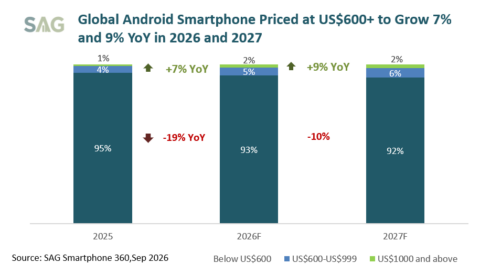
Early sales indications also suggest that the broader Android premium smartphone market in China is facing pressure following price increases. iPhone 18 Pro series demand on the other hand remained strong. Our checks have pointed to weaker-than-expected initial performance across several flagship launches, although the available figures are early and should not be treated as a definitive measure of long-term demand. At SAG, we forecasted 7% YoY growth of global Android smartphone above $600+ but a majority of it is coming from a non Chinese player Samsung whom MediaTek does not serve in the premium segment.
Exhibit 2: Global Android Smartphone Priced at US$600+ to Grow 7% and 9% YoY in 2026 and 2027
Hence, a better chipset does not automatically translate into stronger premium smartphone market share. MediaTek needs its OEM partners to sell premium smartphones at prices that consumers are willing to pay. If smartphone prices continue to rise because of higher component costs, both MediaTek and Qualcomm could face a difficult environment in the premium segment. Other way for MediaTek is to go after smartphone vendors that are already selling well in the premium segment and Samsung looks like the feasible option but difficult to crack as they have been with Qualcomm and are also pushing their in house Exynos.