
Qualcomm opened Snapdragon Summit 2026 today in Maui with an important change to its flagship mobile SoC strategy: Qualcomm introduced two SoCs, Snapdragon 8 Elite Extreme Gen 6 and Snapdragon 8 Elite Gen 6.
For Smart Analytics Global (SAG), the dual-chip strategy was one of the biggest takeaways from Day 1.
Executive Summary
- Two flagship SoCs, more choices: Qualcomm launched Snapdragon 8 Elite Extreme Gen 6 and 8 Elite Gen 6, giving Android OEMs more flexibility amid rising component and SoC costs.
- Clear price-tier positioning: SAG sees 8 Elite Gen 6 as a strong fit for US$600+ wholesale flagship smartphones, while Extreme is better positioned for the US$1,000+ ultra-premium segment.
- Premium is the bright spot: Excluding Apple and Huawei, SAG forecasts Android smartphone shipments to decline 17% YoY in 2026, while the US$600+ segment will grow 7%.
- Extreme brings more differentiation: SAG’s Day 1 demos showed stronger capabilities from Extreme in on-device AI, gaming and advanced camera features, helping OEMs further differentiate ultra-premium devices.
- Agentic AI is the bigger story: “Trust” and “effortless” were two key messages SAG heard throughout Day 1. Qualcomm is building the hardware foundation, but broad consumer adoption will require the whole ecosystem and will take time.
It comes at an important time for the smartphone industry. Component costs are rising, smartphone demand is under pressure, and OEMs need to balance performance, features, product positioning and BOM costs more carefully than ever.
SAG believes Qualcomm’s answer is clear: give smartphone OEMs more choices at the top of the market.
Chris Patrick, SVP & GM of Handsets, Qualcomm, Introduces the Dual-SoC Strategy at Snapdragon Summit 2026
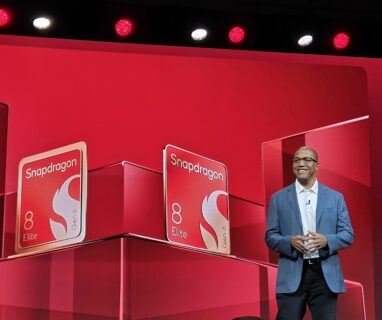
Source: SAG proprietary photo, taken at Snapdragon Summit 2026 in Maui, Hawaii.
Two Elite Chips for Two Different Premium Markets
Qualcomm describes its new approach as a “multi-flagship strategy,” designed to give OEMs greater choice while expanding its latest AI innovations across more premium devices.
SAG believes the strategy also fits very well with the growing segmentation of the premium smartphone market.
We expect the Snapdragon 8 Elite Gen 6 to be a strong choice for flagship smartphones with wholesale prices of US$600 and above.
The more powerful Snapdragon 8 Elite Extreme Gen 6, meanwhile, is better positioned for the ultra-premium segment, which SAG defines as smartphones with wholesale prices of US$1,000 and above.
The two platforms share many core technologies, but Extreme pushes further in AI, gaming, imaging and performance.
From SAG’s discussions and observations at Snapdragon Summit, we expect the chipset price gap between the two solutions to be roughly US$100. However, the eventual price difference between smartphones using the two platforms could be significantly larger.
That gives Android OEMs more room to differentiate their flagship portfolios.
Why Two Chips Make Sense in a Down Smartphone Market
Excluding Apple and Huawei, SAG forecasts global Android smartphone shipments to decline 17% YoY in 2026 and another 8% YoY in 2027.
But the market is moving in very different directions by price tier.
SAG forecasts smartphones with wholesale prices of US$600 and above to grow 7% YoY in 2026 and 9% YoY in 2027.
In contrast, the combined below-US$600 segments are expected to decline 19% in 2026 and another 10% in 2027.
Exhibit 2: SAG Global Android Smartphone by Price Tier Forecast : 2025-2027F
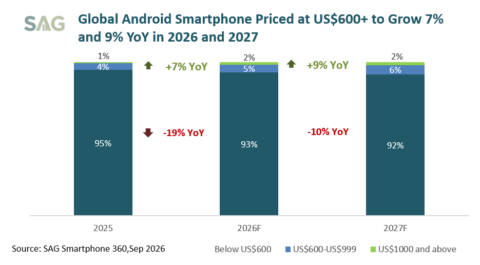
The overall smartphone market is shrinking, but the premium market is still growing.
This makes Qualcomm’s dual-flagship strategy particularly timely.
Instead of asking every premium Android OEM to adopt the same top-end platform, Qualcomm can now offer two solutions covering different parts of the premium market.
Extreme Is More Than Just a Faster Version
Both new platforms are built on advanced 2nm technology and bring upgrades across CPU, GPU, NPU, camera and connectivity.
But during SAG’s hands-on experience in the demo area today, the difference between the two platforms became clearer.
Some of the most advanced demonstrations were focused on Snapdragon 8 Elite Extreme Gen 6, particularly around on-device AI, gaming and advanced imaging.
Exhibit 3: Snapdragon 8 Elite Extreme Gen 6
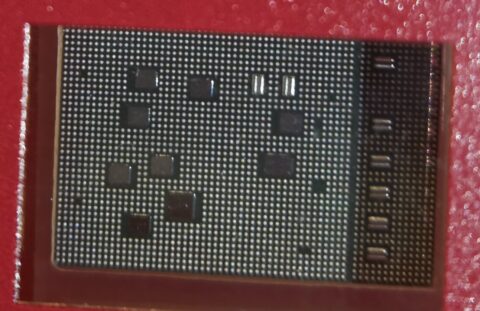
Source: SAG proprietary photo, taken at Snapdragon Summit 2026 in Maui, Hawaii
The Extreme platform supports larger and more complex on-device AI workloads, including models above 30 billion parameters. It also brings additional gaming capabilities such as Adreno Neural Fusion and more advanced AI-assisted graphics.
Camera and video are another area of differentiation, with Extreme adding capabilities targeted at more demanding flagship imaging and content-creation use cases.
This matters because the difference between premium and ultra-premium smartphones increasingly needs to be visible to consumers.
Xiaomi Shows How the Two-Chip Strategy Can Work
Xiaomi provides the first example of how Qualcomm’s dual-platform strategy can translate into actual products.
The Xiaomi 18 Pro and Xiaomi 18 Pro Max are scheduled to launch in China on September 23 and will be among the first smartphones based on Qualcomm’s new flagship platforms. Xiaomi’s Senior Vice President and President of International Business, Adam Zeng, took the stage today to showcase the upcoming Xiaomi 18 Pro and 18 Pro Max.
Exhibit 4: Xiaomi’s Adam Zeng Showcases the Upcoming Xiaomi 18 Pro and 18 Pro Max at Snapdragon Summit 2026
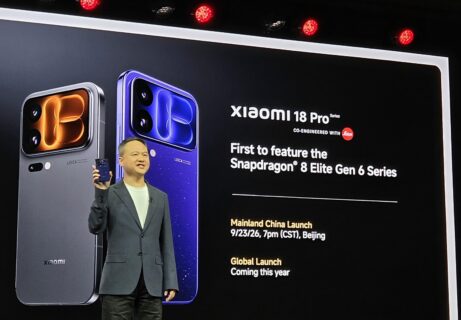
Source: SAG proprietary photo, taken at Snapdragon Summit 2026 in Maui, Hawaii
SAG expects the two chips to help Xiaomi create clearer differentiation between its Pro and Pro Max products, particularly as it continues pushing further into the premium market.
Pricing has not yet been announced.
For comparison, Xiaomi 17 Pro launched in 2025 starting at RMB 4,999 (US$720), while Xiaomi 17 Pro Max started at RMB 5,999 (US$860).
Given the rising memory, chipset and other component costs, SAG expects meaningful pricing hikes on the new generation.
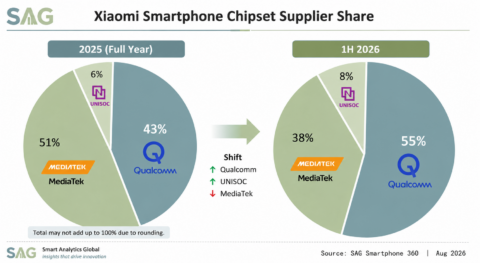
Xiaomi is also strategically important to Qualcomm.
SAG estimates Xiaomi alone accounted for nearly 30% of Qualcomm Snapdragon smartphone SoC volume worldwide in 2025 and 1H 2026, making it Qualcomm’s largest smartphone SoC customer by volume in our estimates.
Exhibit 5: Xiaomi Smartphone SoC Providers: 2025- 1H 2026
Leonovo-Motorola Moves Further Upmarket
Lenovo-Motorola delivered another interesting announcement on Day 1.
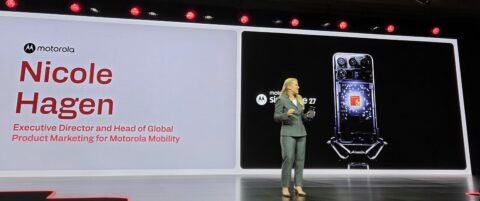
The company unveiled the Motorola Signature 27, powered by Snapdragon 8 Elite Extreme Gen 6. The device is expected to become available later in 2026.
Exhibit 6: Motorola’s Nicole Hagen Showcases the Upcoming Signature 27 at Snapdragon Summit 2026
Source: SAG proprietary photo, taken at Snapdragon Summit 2026 in Maui, Hawaii
Pricing has not yet been announced, but SAG expects the new model to be positioned materially above the previous Signature device as Motorola continues to strengthen its premium product portfolio.
The timing is also interesting from another perspective.
Qualcomm recently appointed former Motorola Devices President Sergio Buniac as Executive Vice President and Group General Manager overseeing Mobile, Compute and XR. Buniac spent more than three decades at Motorola and had served as President of Motorola Devices since 2018.
His move to Qualcomm does not imply a change in the commercial relationship between the two companies. However, his deep experience building and scaling Motorola’s smartphone business gives Qualcomm additional OEM-side expertise as it develops its mobile and personal AI strategy.
Motorola’s adoption of Extreme for Signature 27 also fits its broader ambition to move its brand and product portfolio further into premium smartphones.
Qualcomm has confirmed that devices using the two new platforms will come from Honor, iQOO, Motorola, Nubia, OnePlus, OPPO, REDMI, RedMagic, vivo, Xiaomi and ZTE etc.
“Trust” and “Effortless” Define Qualcomm’s Agentic AI Message
The hardware was only half of Qualcomm’s Day 1 story. The bigger message was agentic AI.
Two words SAG heard repeatedly during today’s keynote and breakout sessions were “trust” and “effortless.”
The idea is simple: AI agents need to become useful enough that consumers start using them regularly, trustworthy enough that consumers allow them to access personal information, and effortless enough that they eventually become part of everyday life.
That puts on-device AI at the center of Qualcomm’s strategy.
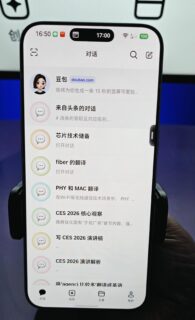
Keeping more personal information and AI processing on the device can improve responsiveness while giving the industry more options to protect user data. Qualcomm demonstrated several such use cases, including the second generation of Doubao phone, on the show floor today, and SAG tested some of them firsthand.
Exhibit 7: ZTE (Nubia)’s Doubao Phone (2nd Gen)
Source: SAG proprietary photo, taken at Snapdragon Summit 2026 in Maui, Hawaii
But moving from impressive demonstrations to mass consumer adoption is a much bigger challenge.
Agentic AI Will Not Happen Overnight
SAG believes Qualcomm is providing one of the most advanced hardware foundations for the agentic AI era.
But hardware alone cannot create that market.
Smartphone OEMs, OS and software companies, AI model developers, app developers, financial institutions and other ecosystem partners all need to participate.
The presence of companies such as Google and Mastercard at Snapdragon Summit deliveres that message: agentic AI will require an ecosystem, not simply a faster chipset.
The direction is positive, but SAG believes mass adoption of agentic AI will take time.
Consumers first need to understand it. Then they need to trust it. Then they need to use it. Only after that will they start to rely on it.
There is still a long road ahead.
Stay tuned for SAG’s Snapdragon Summit 2026 Day 2 coverage, with a deeper focus on Personal AI and wearables / hearable.