
Apple’s launch event today (Sep 9) marked an important change for the iPhone portfolio. While the iPhone 18 Pro and iPhone 18 Pro Max received the expected annual upgrades, the real highlight was Apple’s first foldable smartphone, the iPhone Duo.
Smart Analytics Global (SAG) believes the importance of iPhone Duo goes beyond Apple entering the foldable market. Apple spent a lot of time showing how consumers can actually use the new form factor, including folded, unfolded, half-folded and Flex-style scenarios. This suggests foldable competition is gradually moving beyond hardware specifications toward user experience, apps, ecosystem and how well consumers can use the larger inner display.
Key Takeaways
- iPhone Duo was the clear highlight. Apple emphasized folded, unfolded and half-folded/Flex use cases, showing that foldable competition is moving from hardware toward user experience, apps and ecosystem.
- A20 Pro and C2 are the key technology upgrades. Apple is expanding its in-house C2 modem globally, another important step toward greater control of its core iPhone silicon and connectivity platform.
- iPhone 18 Pro and Pro Max may underperform the 17 Pro generation. Overall hardware upgrades are relatively limited, while some premium demand will shift toward iPhone Duo.
- US$1,999.99 is a smart psychological price point for Duo. Apple keeps the starting price technically below the important US$2,000 threshold, while positioning Duo firmly in the ultra-premium market.
- Camera is a bigger Duo compromise than weight or thickness. At around 254g and thicker than Galaxy Z Fold8, Duo still feels manageable. But the 12MP front camera versus 18MP on iPhone 18 Pro/Pro Max, plus no telephoto camera, is a more meaningful compromise at this price.
- The U.S. should remain Duo’s largest market. The initial rollout focuses mainly on mature premium markets. In the U.S., financing, the iPhone Upgrade Program and trade-in values of up to US$1,200 should help address affordability.
- China is a major opportunity, but eSIM-only creates challenges. As the world’s largest foldable smartphone market, China is strategically important, but regulatory approval, carrier support and consumer behavior could slow Duo’s rollout.
iPhone 18 Pro and Pro Max: Solid Upgrades, but Limited Replacement Catalyst
The iPhone 18 Pro and iPhone 18 Pro Max bring several important upgrades, including the new A20 Pro chipset, C2 modem, stronger Apple Intelligence capabilities, Burgundy hero color and a new 2TB storage option for iPhone 18 Pro.
Image 1: iPhone 18 Pro Max


However, many of the other changes are relatively minor. The iPhone 17 Pro and Pro Max were already a strong generation, making the year-over-year comparison more difficult.
The higher prices for all configurations, especially for 1TB and 2TB variants also show the growing pressure from higher memory costs. Apple continues to protect the starting price while charging more for consumers moving to higher storage tiers.
SAG expects combined global shipments of the iPhone 18 Pro and iPhone 18 Pro Max to decline by double digits compared with the iPhone 17 Pro and iPhone 17 Pro Max.
Part of the high-end demand will also move toward iPhone Duo, especially among existing Pro and Pro Max users looking for something new.
iPhone Duo Was the Real Highlight
Apple spent significant time during the event demonstrating different ways to use iPhone Duo.
Instead of simply showing a phone that can fold, Apple demonstrated folded, unfolded, half-folded and Flex-style use cases. It also showed how apps and content can take advantage of different screen positions.
The Duo name makes sense. It is simple and clearly communicates that the device can provide two different experiences in one product.
This is important because foldable smartphones have spent many years competing mainly on hardware. Vendors have focused on making devices thinner and lighter, reducing the crease, improving the hinge and increasing battery capacity.
Those areas remain important, but the hardware gap is becoming smaller.
What can consumers actually do with a foldable phone that they cannot do as well with a regular smartphone?
This could become one of Apple’s biggest advantages.
Apple controls the hardware, operating system, chipset, apps, AI platform and broader ecosystem. Android foldables, by comparison, remain more fragmented across different brands, display sizes, aspect ratios and software designs.
As a result, Apple could have an advantage in app optimization and in making better use of both the external and inner displays.
Apple does not necessarily need to build the thinnest or lightest foldable phone. It needs to give consumers more reasons to open and use the device.
Hands-On: Weight and Thickness Are Acceptable
During my hands-on experience at Apple Park, the iPhone Duo at around 254 grams felt slightly heavy, but still acceptable for a foldable device.
It is also thicker than Samsung’s Galaxy Z Fold8.
Image 2: iPhone Duo


However, SAG does not see weight or thickness as major barriers for the first-generation Duo. Consumers buying a foldable smartphone already understand that there will be some trade-offs.
The more important question is whether the larger display and different ways of using the device provide enough value to justify those compromises.
Camera Is a Bigger Compromise
The camera could be a more important weakness for iPhone Duo.
The front camera is only 12MP, compared with 18MP on both the iPhone 18 Pro and iPhone 18 Pro Max. This is a noticeable downgrade for a device starting at almost US$2,000.
The overall camera system also faces the physical limitations of a foldable design. For consumers moving from a Pro Max, camera performance could therefore become a more meaningful concern than a few additional grams of weight or extra thickness.
SAG believes consumers are more likely to accept a slightly heavier or thicker foldable than a noticeable camera compromise, particularly at this price level.
This is one area Apple will need to improve in future Duo generations.
US$1,999.99 Keeps Duo Just Below an Important Price Barrier
Apple’s US$1,999.99 starting price is wisely positioned.
SAG has viewed US$2,000 as an important psychological price barrier for the first foldable iPhone. Apple has technically kept Duo below that level, although consumers will effectively see it as a US$2,000 smartphone.
Affordability will still be a challenge, but the actual purchase decision in markets such as the U.S. is increasingly based on monthly payments rather than the full retail price.
Apple’s iPhone Upgrade Program, carrier financing and the higher trade-in value of up to US$1,200 can help reduce the upfront cost and make Duo more affordable for existing premium iPhone users in the USA. While SAG believes mobile operators will remain as the dominating role in iPhone Duo sales in the USA.
This is particularly important because many potential Duo buyers are likely to already own relatively new Pro or Pro Max devices with high trade-in values.
Initial Rollout Will Focus on Premium Smartphone Markets
The initial geographic rollout also tells us a lot about Apple’s strategy.
Based on the announced availability, North America, Western Europe, Japan, South Korea, India, Southeast Asia, Central and Latin America, and several mature Middle Eastern markets appear likely to form the first major group of markets for iPhone Duo.
These markets generally have strong premium smartphone demand, developed financing programs, established Apple channels or relatively high consumer purchasing power.
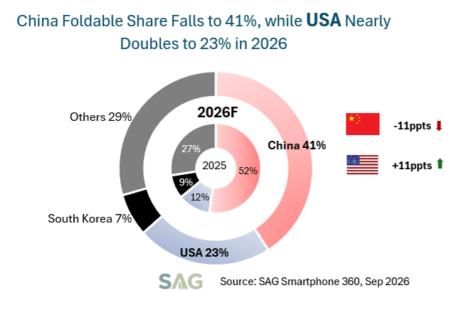
SAG expects the United States to play a major role and remain the world’s largest individual market for iPhone Duo. The U.S. has a large premium iPhone installed base, strong carrier financing and trade-in programs, and a large group of Pro and Pro Max users who could become early Duo adopters.
Exhibit 3: Foldable Smartphone Vendor Share by Country: 2025-2026F
China Faces a Different Challenge
China is particularly important because it is already the world’s largest foldable smartphone market and Chinese consumers are much more familiar with foldable devices than consumers in many other countries.
However, iPhone Duo’s eSIM-only design could create additional challenges in China.
The issue is not only regulatory approval. China has traditionally relied heavily on physical SIM cards, so a move toward an eSIM-only flagship device also requires changes in carrier support and consumer behavior.
This could make the China launch more complicated than in markets such as the U.S.
At the same time, China remains too important for Apple to ignore. Huawei, Honor, vivo, Xiaomi, and other Chinese vendors have already developed a relatively mature foldable user base. Once the regulatory and carrier issues are addressed, China could become one of the most important long-term markets for iPhone Duo.
October Availability Broadly Matches SAG Expectations
The October commercial launch broadly matches SAG’s previous expectations.
A foldable smartphone is more difficult to manufacture than a regular iPhone because of the flexible display, hinge, mechanical design and more complicated assembly process. Apple therefore does not need extremely high first-generation volumes.
The first Duo is mainly about establishing the product category, learning how consumers use the device and building the software and app ecosystem around it.
SAG expects much stronger volumes in 2027 as production increases and availability expands.
Apple Could Accelerate the Entire Foldable Market
Apple’s entry should benefit the broader foldable smartphone industry.
SAG forecasts the global foldable smartphone market will grow approximately 24% year over year in 2026, with growth accelerating to around 40% in 2027.
Exhibit 4: Global Foldable Smartphone Forecast: 2025-2027F

Apple will bring more consumer attention to foldables and encourage developers to improve apps for larger and flexible displays.
This does not mean Samsung or other Android foldable vendors will automatically lose.
Samsung has spent many years building the foldable category and improving the hardware. Apple’s entry further validates that market.
The bigger challenge for Samsung and other Android vendors is to encourage more existing Android smartphone users to move to foldables, while keeping current Android foldable users within the Android foldable ecosystem when they replace their devices.
Foldables Are Moving Into the User-Experience Stage
The foldable hardware race is not over. Weight, thickness, battery, hinge, crease and camera performance will continue to improve.
But these factors alone will become less important as the hardware gap between leading vendors narrows.
The next stage of competition will be about how people actually use foldable smartphones.
How often do consumers open the inner display? How well do apps use the additional screen space? How smoothly do apps move between the external and inner displays? Can half-folded modes create useful new experiences? And can AI make better use of a larger and more flexible screen?
Apple spent a surprising amount of time addressing these questions during the iPhone Duo launch.
That may ultimately be the most important message from the event.
The foldable smartphone market is moving from a hardware-driven race toward a competition around user experience, apps and ecosystem. With iPhone Duo, Apple has officially entered that race.