
Key Takeaways
- Apple officially launched the new Apple Upgrade in the U.S. today, replacing the previous iPhone Upgrade Program with a Klarna-backed hardware leasing model.
- As we expected in the previously blog, the program expands beyond the iPhone to include Apple Watch, iPad and Mac, marking Apple’s transition from single-device financing to ecosystem-wide hardware financing and leasing program.
- Mandatory AppleCare+ is no longer bundled, lowering the advertised monthly payment and reducing the entry barrier for consumers.
- Apple generally offers more competitive trade-in values than major U.S. carriers for many recent iPhone models, resulting in a significantly lower monthly payment during the initial lease term.
- For an iPhone 17 Pro Max (256GB), Apple Upgrade costs around US$35/month—approximately US$15 lower than T-Mobile’s 24-month EIP (US$50/month). Verizon and AT&T have largely shifted to 36-month EIPs, where monthly payments are generally slightly lower than Apple Upgrade (24 months) but require a much longer commitment.
- According to SAG, around 95% of new iPhone purchases in the U.S. already use monthly payment programs, while more than 80% of buyers trade in their previous devices to lower monthly costs.
- SAG estimates the average U.S. smartphone replacement cycle remains around 34 months in 2026, making consumer behavior the biggest challenge for Apple.
- SAG believes Apple Upgrade is highly attractive for technology enthusiasts and frequent upgraders. Whether mainstream consumers remain in the program after the first lease cycle will determine its long-term success.
- SAG’s view: Apple upgrade program represents Apple’s continued shift toward Hardware-as-a-Service (HaaS), integrating financing, trade-in, refurbished devices, AI hardware and ecosystem services to increase customer lifetime value and stickiness.
Apple officially launched its new Apple Upgrade in the United States today, replacing the previous iPhone Upgrade Program that was introduced back to 2015.
Exhibit 1: Apple Upgrade
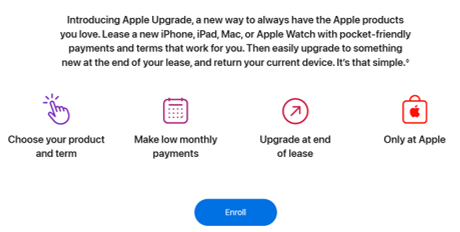
As what we expected in the previous blog, the new program introduces several important changes. It expands beyond the iPhone to include Apple Watch, iPad and Mac, removes the mandatory bundled AppleCare+ subscription to lower the advertised monthly payment, and transitions from a traditional Equipment Installment Plan (EIP) to a hardware leasing model.
From Smart Analytics Global (SAG)’s perspective, this is much more than a financing refresh. It represents Apple’s continued evolution toward Hardware-as-a-Service (HaaS), where financing, trade-in, refurbishment and ecosystem integration become increasingly important drivers of customer retention and long-term revenue growth.
Financing Has Already Become the Default Purchasing Model
Monthly financing is already the dominant purchasing method for iPhones in the U.S.
According to SAG’s consumer research:
- Around 95% of new iPhone purchases in the U.S. are completed through monthly payment or financing programs.
- More than 80% of iPhone buyers trade in their previous devices, primarily to reduce monthly payments rather than maximize resale value.
Exhibit 2: USA iPhone Payment Plan in 2026
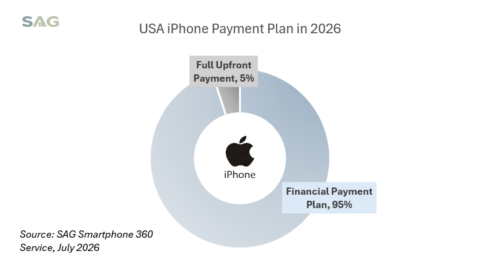
Apple Upgrade simplifies this experience further by integrating financing, trade-in and future upgrades into a single purchasing journey.
The Real Math for U.S. Consumers
Ultimately, the success of Apple Upgrade comes down to one simple question: Which payment model offers consumers the best overall value?
For the iPhone 17 Pro Max (256GB), Apple Upgrade costs approximately US$35 per month, around US$15 lower than T-Mobile’s 24-month Equipment Installment Plan, which is roughly US$50 per month.
Meanwhile, Verizon and AT&T have largely transitioned to 36-month Equipment Installment Plans. Their monthly payments are generally slightly lower than Apple Upgrade because the device cost is spread across a longer repayment period (36 months), but customers remain committed for three years before fully owning the device.
In other words, U.S. consumers are now choosing between three different models:
- Apple Upgrade: Lower initial monthly payment, stronger trade-in value, upgrade flexibility after 12 or 24 months, but no ownership.
- T-Mobile 24-month EIP: Higher monthly payment, eventual ownership after two years.
- Verizon & AT&T 36-month EIP: Lower monthly payment through a longer repayment period, eventual ownership, but a slower upgrade cycle.
A Strategy to Accelerate Upgrade Frequency
SAG believes Apple intentionally designed Apple Upgrade to make the first lease cycle exceptionally attractive, particularly since most participants are expected to trade in their existing devices to offset the monthly payment.
For example, a good-condition iPhone 14 Pro Max currently receives a trade-in value of approximately US$375. Spread across a 12-month lease, this reduces the effective monthly payment for an iPhone 17 Pro Max (256GB) to as little as US$18.74 per month during the initial lease term, significantly lower than comparable carrier financing plans.
Exhibit 3: Apple Upgrade Program Monthly Payment Sample:
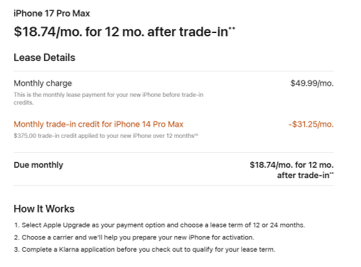
However, the economics change once the initial 12- or 24-month lease period ends. Customers can no longer apply another device trade-in to offset the monthly payment, resulting in a substantially higher monthly cost for the renewal period.
If customers choose not to upgrade at the end of the initial lease, they enter a six-month transition period, during which they continue paying higher monthly lease payments before either upgrading to a new device or paying the predetermined buyout amount to purchase the existing device. Importantly, those six-monthly lease payments do not reduce or count toward the buyout price, meaning they function purely as rental payments rather than equity-building installments.
From SAG’s perspective, this financial structure is deliberately designed to encourage consumers to upgrade every 12 or 24 months instead of extending their lease or keeping the same device for three years or longer. Ultimately, Apple’s objective is not only to improve affordability during the initial purchase, but also to accelerate upgrade frequency, strengthen ecosystem stickiness, and increase customer lifetime value.
Can Apple Change Consumer Behavior?
SAG estimates the average smartphone replacement cycle in the U.S. remains around 34 months in 2026, substantially longer than Apple’s preferred annual or biannual upgrade cadence.
Historically, carrier leasing programs—including Sprint’s former Flex Lease—had limited success in changing long-term consumer behavior.
Apple’s ecosystem strength, premium customer base and attractive trade-in values undoubtedly improve its chances. However, convincing mainstream consumers to replace their smartphones every 12 or 24 months remains a significant challenge.
More Than Financing: Building a Stronger Ecosystem
Apple Upgrade should not be viewed simply as another financing program.
By extending the program beyond the iPhone to Apple Watch, iPad and Mac, Apple is creating a unified purchasing experience across its hardware portfolio.
Combined with financing, trade-in, refurbishment, AI services and future AI-native devices, Apple is building a tighter ecosystem while increasing customer lifetime value.
Competition is therefore evolving beyond hardware specifications. Increasingly, smartphone vendors will compete through financing, trade-in programs, financial services, customer experience and ecosystem integration.
SAG Perspective
From SAG’s perspective, Apple Upgrade is particularly attractive for technology enthusiasts and frequent upgraders. They gain access to the latest hardware with lower initial monthly payments while avoiding sticking with longer commitment with carriers.
For mainstream consumers, the significantly lower out-of-pocket monthly payment during the first lease cycle will undoubtedly attract many users, especially as smartphone prices continue to rise.
The real test, however, comes after the initial 12- or 24-month term.
Will consumers continue renewing once they realize the monthly payments become substantially higher? Or will they prefer the transparency and eventual ownership offered by traditional Equipment Installment Plans?
Ultimately, consumers will decide which matters more: lower monthly payments and continuous upgrades, or long-term ownership and payment transparency.
SAG believes Apple Upgrade program is a strategic ecosystem initiative intended to accelerate upgrade frequency, strengthen customer retention, secure a steady supply of refurbished devices, and prepare Apple’s installed base for future AI-driven hardware and services.
Time will tell whether Apple can successfully shorten the current 34-month smartphone replacement cycle in the U.S. market.