
Key Takeaways
- It is reportedly that Apple will launch a new Upgrade Program expands beyond the iPhone to include Apple Watch, iPad and Mac, creating a broader ecosystem financing strategy.
- Removing the mandatory AppleCare+ bundle lowers monthly payments, helping offset rising device prices and making upgrades more affordable.
- The program would be initially limited to the U.S., where mature consumer financing infrastructure and financial partners make nationwide deployment easier.
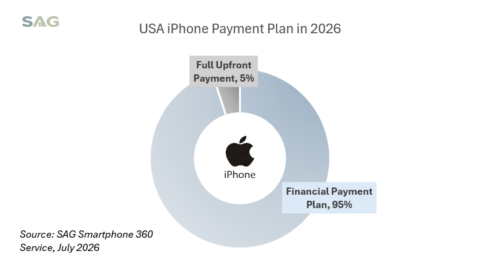
- SAG estimates that approximately 95% of U.S. iPhone users purchase their devices through financing programs in 2026, making monthly affordability more important than upfront pricing.
- While the new program will strengthen Apple’s direct relationship with consumers, it is unlikely to materially shift sales away from U.S. mobile operators, which continue to dominate smartphone distribution.
- More importantly, the program highlights a broader industry shift: competition is moving beyond hardware innovation toward customer experience, financial services, ecosystem integration and long-term consumer engagement. As replacement cycles lengthen and flagship prices continue to rise, these capabilities will become increasingly important differentiators for premium smartphone brands.
Apple is reportedly going to announce a new Apple Upgrade Program, effective July 28 in the U.S., represents much more than a refresh of its financing strategy. It reflects how competition in the premium smartphone market is increasingly shifting from hardware specifications to consumer financing, ecosystem integration and long-term customer relationships.
Apple has been experimenting with upgrade programs for nearly a decade. Its original iPhone Upgrade Program, introduced in 2015, helped stimulate demand through Apple’s own online and retail stores while encouraging other smartphone vendors to introduce similar financing models. However, its momentum gradually faded as major U.S. mobile operators strengthened their Equipment Installment Plan (EIP) offerings with longer payment terms, greater flexibility and no mandatory insurance bundle.
The new Apple Upgrade Program addresses two of the biggest limitations of its predecessor.
First, Apple is extending financing beyond the iPhone to include Apple Watch, iPad and Mac, allowing consumers to manage upgrades across multiple Apple products under a unified program. This reinforces Apple’s ecosystem strategy by making it easier for customers to remain within the Apple family of devices.
Second, Apple is removing the mandatory AppleCare+ requirement, reducing monthly payments by roughly US$10, depending on the product and insurance configuration. This is particularly meaningful as Apple prepares for another cycle of premium product pricing for upcoming iPhone 18 series and new Apple watch products. Following earlier price increases for iPads and Macs, SAG expects the upcoming iPhone 18 series and new Apple Watch models to also carry higher price points later this year. Lower monthly payments help soften the impact of these increases while preserving consumer affordability.
The program’s initial launch in the United States is also unsurprising. Consumer financing requires well-established banking partners, credit infrastructure and risk management capabilities, all of which are highly mature in the U.S. Expanding the program internationally will likely require Apple to establish similar local financial partnerships market by market.
Will the new program benefit Apple? Absolutely. It provides consumers with another financing option while strengthening Apple’s direct relationship with its installed base.
However, it is unlikely to significantly shift smartphone sales away from U.S. mobile operators. SAG estimates that more than 95% of U.S. iPhone users already purchase their devices through financing programs, while carriers continue to account for over 90% of smartphone sales in the country. Their advantages remain substantial, including nationwide retail presence, extensive marketing, multi-brand portfolios, attractive promotional offers and carrier-optimized devices and services. In addition, more than 90% of smartphones sold in the U.S. remain carrier locked, further reinforcing operator influence over device distribution.
Exhibit 1: USA iPhone Payment Plan in 2026F
Interestingly, Samsung also introduced its own branded credit card in the U.S. this week, underscoring a broader industry trend. Smartphone vendors are increasingly leveraging financial services to deepen customer engagement, encourage repeat purchases and strengthen ecosystem loyalty.
For the U.S. smartphone market, the competitive battleground is increasingly about who delivers the most compelling end-to-end consumer experience—from financing and trade-in programs to software, services and ecosystem integration. As device replacement cycles continue to lengthen and flagship prices rise, financing and fintech capabilities will become an increasingly important differentiator for premium smartphone brands.