
SAN FRANCISCO, November 23, 2026 – As per Smart Analytics Global’s Wearable 360 estimates, the global wrist wearable shipments declined 8% YoY in Q3 2026.
Key Takeaways
- Global wrist wearable market declined 8% YoY in Q3 2026, primarily driven by the basic smartwatch and band category, which declined 13% YoY.
- The true smartwatch segment declined 6% YoY, while the non-display band market grew a strong 99% YoY, albeit from a small base.
- Huawei led the global wrist wearable market with 20% market share, followed by Xiaomi at 19% and Apple at 17%.
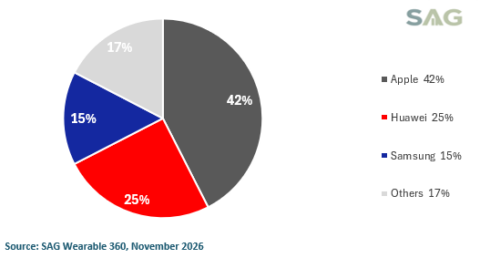
- Apple led the true smartwatch market with 42% market share, followed by Huawei at 25% and Samsung at 15%.
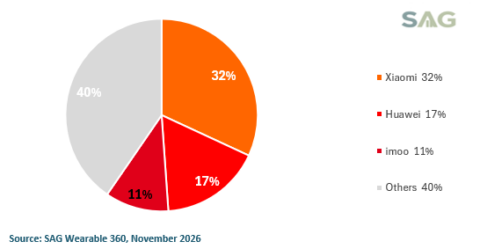
- Xiaomi led the basic smartwatch and band category with 32% market share, followed by Huawei at 17% and imoo at 11%.
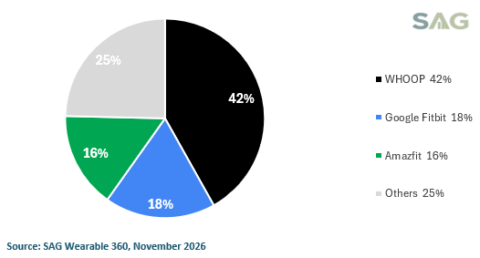
- WHOOP continued to dominate the non-display band market with 42% market share, followed by Google/Fitbit at 18% and Amazfit at 16%.
- We forecast the global wrist wearable market to decline 5% YoY in 2026. The true smartwatch segment is expected to decline 2%, while basic smartwatch and band will decline 10% and non-display band will grow 101%.
Global wrist wearable shipments declined 8% YoY in Q3 2026. The decline was primarily driven by the basic smartwatch and band category, which declined 13% YoY during the quarter. The true smartwatch also declined 6% YoY while the non display band grew 99% YoY for the quarter.
Exhibit 1: Global Wrist Wearables Vendor Share by Product Type: Q3 2026
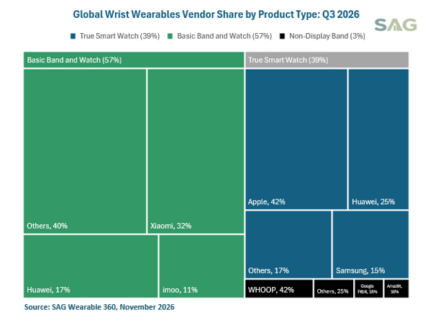
The strong growth in non-display bands was on a small base and was primarily driven by the launch of Google Fitbit Air during the tail end of Q2 2026.
Exhibit 2: Global Wrist Wearable Market Share by Vendor Q3 2026
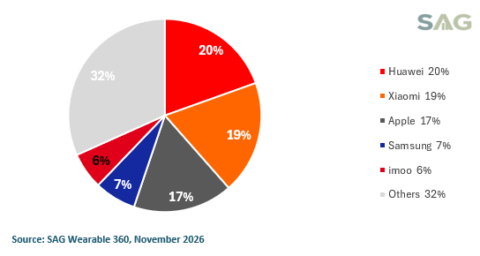
Huawei led the global wrist wearable market in Q3 2026 with 20% market share. Its shipment grew 2% YoY during the quarter driven by new launches and its presence among both true and basic watch and band category.
Xiaomi followed closely with 19% market share, although its shipments declined 4% YoY. Apple was the second runner-up with 17% market share and it also declined 13% YoY for the quarter in volume terms.
Samsung and Imoo rounded off the top five with 7% and 6% market share, respectively.
True Smartwatch Market Continues to Grow
The true smartwatch segment, which SAG defines as smartwatches running a dedicated smart OS with third-party app installation capability, declined 6% YoY in Q3 2026.
Apple led the segment with 42% market share, with its shipments declining 13% YoY during the quarter.
Huawei was the second-largest true smartwatch player with 25% market share. Huawei’s true smartwatch shipments grew 16% YoY in Q3 2026.
Samsung surpassed Garmin and ranked third with 15% market share but declined 19% YoY.
Unlike Q2 2026, the true smartwatch market declined this time as per our estimates driven by indirect impact of the memory price hike.
Exhibit 3: Global True Smartwatch Market Share by Vendor Q3 2026
Basic Smartwatch and Band Category Remains Under Pressure
The basic smartwatch and band category continued its decline in Q3 2026, fell 13% YoY.
Xiaomi led the category with 32% market share, followed by Huawei and imoo with 17% and 11% market share, respectively.
The basic smartwatch category is currently on a decline streak as many consumers increasingly look toward more capable true smartwatches and newer screen-free wearable formats or analog watches.
Exhibit 4: Global Basic Smartwatch and Band Market Share by Vendor Q3 2026
Non-Display Band Market Keeps Roaring Louder
The non-display band category was once again the fastest-growing segment of the global wrist wearable market, grew 99% YoY in Q3 2026.
As already highlighted in Smart Analytics Global’s recent research, WHOOP led the market with 42% market share, followed by Google/Fitbit at 18% surpassing Amazfit which this time stood at 16%.
The category remains relatively small compared with traditional wrist wearable categories, but the rapid growth shows increasing consumer interest in screen-free health and fitness tracking. In Q3 we saw two more key players entering the segment which are Noise and Garmin. They were able to gain 8% and 7% share respectively in their debut quarter. Polar also had 8% share in the quarter slightly below Noise to round off for top 5 spots.
The launch of Google Fitbit Air during the tail end of Q2 helped accelerate the category.
Exhibit 5: Global Non-Display Band Market Share by Vendor Q3 2026
Divergence Across Wrist Wearable Categories
Commenting on the overall wrist wearable market, Abhilash Kumar, Lead Research Advisor at Smart Analytics Global, said, “The wrist wearable market is increasingly showing a divergence across categories. The basic smartwatch and band segment is on a decline streak, true smartwatch also suffered for the quarter while non-display bands continue to roar louder.
The non-display band market is still relatively small, but the strong growth we are seeing indicates that consumers are increasingly looking for health and fitness tracking without adding another screen to their daily lives.”
Global Wrist Wearable Market Outlook
For the full year 2026, Smart Analytics Global forecasts the global wrist wearable market to decline 5% YoY.
At the category level, the true smartwatch segment is forecasted to decline 2% YoY, while the basic smartwatch and band category is forecast to decline 10% YoY.
The non-display band segment is forecasted to grow 101% YoY in 2026. While this growth is coming from a relatively small base, the category is believed to remain the fastest-growing segment of the wrist wearable market.
The contrasting performance across categories highlights the changing dynamics of the wrist wearable market. Basic smartwatches and bands continue to lose momentum, true smartwatches is also suffering, and non-display bands are emerging as a rapidly growing new category.
Smart Analytics Global’s Wrist Wearable Tracking Report provides extensive market analysis, including detailed regional insights, vendor performance, competitive dynamics, and forecasts across key wrist wearable categories. Below is a snapshot of our Western Europe market outlook, with similar regional highlights and detailed analysis available for other regions in the report for subscribers.
In the Western European non-display wearable segment, WHOOP is forecast to maintain its leadership position in 2026, mirroring its performance in Q3 2026. We expect WHOOP to retain its leadership in 2027 as well, although competition from Google Fitbit is expected to intensify significantly, narrowing the gap between the market leader and the runner-up.
Meanwhile, the overall Western European wrist wearable market is expected to face a volume slowdown, with shipments forecast to decline 4% year-on-year in 2026. Despite the decline in volumes, market revenue is forecast to grow 5% year-on-year, driven primarily by rising average selling prices (ASPs), according to SAG estimates.
This reflects a broader shift in consumer preferences, with consumers increasingly moving away from basic bands toward more feature-rich true smartwatches and non-display wearables. This transition toward higher-value product categories is expected to support market revenue growth despite the contraction in overall shipments.
Note:
As per SAG definition, wrist wearable includes true smartwatches, basic smartwatches and bands, and non-display bands.
Analyst Contact:
Abhilash Kumar, Lead Research Advisor (Director)
abhilash.kumar@smartanalyticsglobal.com
Linda Sui, Founder and Principal
lsui@smartanalyticsglobal.com