
Key Takeaways:
- Redmi Note 17 marks Xiaomi’s second Note refresh in 2026 in India.
- As per Smart Analytics Global (SAG), Xiaomi’s India smartphone shipments declined 10% YoY in Q2 2026.
- 8,000mAh battery and AMOLED display are key strengths.
- Camera and processor remain the biggest compromises and this combined with memory price increase can impact sales. Still the device is better priced than some competitor models.
- Xiaomi India is diversifying to large appliances, a smart move to maximize revenue.
Xiaomi Refreshes the Redmi Note Series Again
In India, Xiaomi has launched the Redmi Note 17, marking the second refresh of the Note series this year. In the first half, Xiaomi launched the Redmi Note 15 and has now introduced the Redmi Note 17, skipping the 16 series.
The Note series has historically been an important volume driver for Xiaomi’s Redmi portfolio. Between 2014 and 2019, it was also one of the most hyped smartphone series in the mid-segment.
Xiaomi is once again leveraging the Note brand as it looks to reverse the decline it has experienced over the past couple of years.
Xiaomi’s India Shipments Decline 10% YoY in Q2 2026
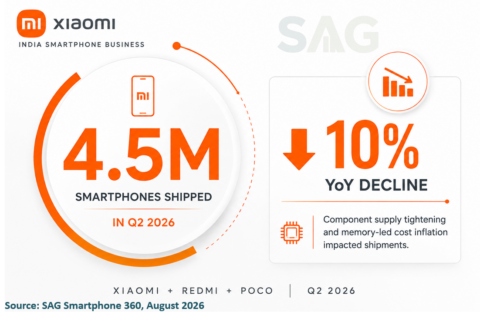
Xiaomi, including Redmi and POCO brands, shipped around 4.5 million smartphones in India in Q2 2026, down 10% YoY.
The decline was relatively modest and was primarily driven by tightening component supply and memory-led cost inflation during the quarter. The memory situation has become an important factor for smartphone vendors in 2026.
Xiaomi is also accumulating inventory ahead of the festive season to hedge against further memory price increases. This could help the company secure supply and manage cost pressure during one of the most important selling periods in India.
Exhibit 1: Xiaomi India Smartphone Shipment Q2 2026
Gradual Product Launches Could Work Better
Another interesting part of Xiaomi’s strategy is its gradual approach to product launches.
Rather than releasing a large number of models at once, Xiaomi is bringing products to the market in a more controlled manner. For example, it is introducing models such as the Xiaomi 17T across offline and online channels, while the Redmi Turbo 5, a rebranded and slightly modified version of the POCO X8 Pro, is being sold through Amazon, Mi.com and Mi Stores.
We believe this approach could work better in the current environment.
With component supply still tight and memory prices elevated, a bulk product launch could increase pressure on inventory and working capital. A gradual rollout gives Xiaomi more flexibility to manage inventory, pricing and specifications as component costs change.
Redmi Note 17: Good Design, Colors, Battery and Display
Coming to the device, the Redmi Note 17 is a good-looking smartphone with attractive color options.
The 8,000mAh battery is another strong point. Xiaomi calls it the “mAhster Edition”—a cool name—and it is the highest-capacity battery available in this segment, which could be a meaningful selling point for consumers.
The display is also a positive. Kudos to Xiaomi for using an AMOLED panel instead of LCD, as seen on some competing devices.
Overall, the design, display and battery make the Redmi Note 17 a well-balanced device.
Exhibit 2: Xiaomi Redmi Note 17

Camera Is the Key Compromise
The biggest compromise is the camera.
The Redmi Note 17 comes with a single 50MP camera, although Xiaomi refers to it as a dual-camera setup because the sensor can be used for normal and zoom shots. However, there is no optical zoom. The selfie camera is 16MP.
SAG believes the camera has become one of the key specifications consumers consider when buying or upgrading a smartphone. Therefore, this camera setup could limit the appeal of the Redmi Note 17 for some consumers.
Processor Downgrade but Lower Price
The second compromise is the processor. Xiaomi has moved down from the Snapdragon 6 series to the Snapdragon 4 series which is Snapdragon 4 Gen 4.
However, Xiaomi has also reduced the price to compensate for the downgrade.
While several smartphones from other vendors which compete with Note series are now priced around INR 30,000–40,000, the Redmi Note 17 is positioned at INR 27,999, roughly USD 293 for 6GB and 128GB variant and INR 30,999, roughly USD 325 for 8GB and 128GB variant. For the exact same configuration at which Note 15 was launched which was 8GB and 128GB, the price increase is 24%, however for the entry model comparison which is 6GB and 128GB for Note 17 and 8GB and 128GB for Note 15, the price increase is 12%.
The lower price makes the device more competitive and partly offsets concerns around the processor.
Xiaomi Is Diversifying Beyond Smartphones
Xiaomi is also gradually diversifying beyond smartphones, particularly into large appliances.
We believe this is important as it gives Xiaomi additional revenue streams and reduces its dependence on smartphones at a time when memory and component costs are rising.
The broader ecosystem strategy also fits Xiaomi’s approach of building a connected-device portfolio rather than relying only on smartphones for growth.
Smart Analytics Global (SAG)’s Analyst View
Overall, the Redmi Note 17 is a good-looking device with attractive colors, a strong 8,000mAh battery and a good AMOLED display. At around INR 27,999, the pricing also makes it an interesting proposition.
However, the camera and processor are the two key compromises.
The processor downgrade is partly addressed through the lower price, but the camera could be a bigger concern. Camera has become increasingly important for consumers when upgrading their smartphones, and the single-camera setup may limit the device’s appeal. This combined with memory price increase could negatively impact the sales.
From a broader market perspective, Xiaomi’s strategy appears more measured in 2026. With India shipments declining 10% YoY in Q2 amid component supply constraints and memory-led cost inflation, Xiaomi is not simply relying on aggressive smartphone product launches to drive volumes. Instead, the company is accumulating inventory ahead of the festive season, gradually releasing products, managing production and diversifying into categories such as large appliances.
We believe this approach is better suited to the current market environment. A gradual portfolio refresh gives Xiaomi better control over inventory, pricing and component costs.
The Redmi Note series remains an important part of this strategy. Given its historical importance as a volume driver. Xiaomi is once again leveraging the Note brand to strengthen its position and potentially help the smartphone business reverse the decline it has experienced over the past couple of years.