
Key Takeaways
- Global eye wearable shipments exceeded 3 million units in Q1 2026, growing 54% YoY.
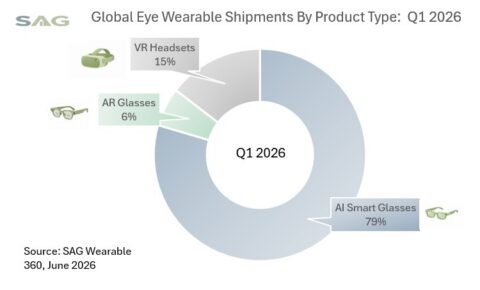
- AI smart glasses accounted for 79% of all eye wearable shipments, firmly establishing themselves as the industry’s dominant category.
- North America remained the largest regional market, followed by Greater China and Western Europe.
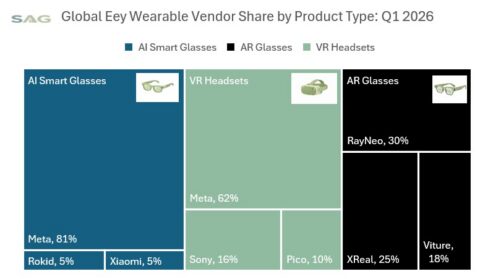
- Meta led both AI smart glasses and VR headsets, while RayNeo ranked No.1 in AR glasses.
- SAG forecasts the global eye wearable market to exceed 22 million units in 2026 and 40+ million units in 2027, driven primarily by continued expansion of AI smart glasses.
Global eye wearable shipments reached 3.35 million units in Q1 2026, growing 54% year-over-year, according to the latest Smart Analytics Global (SAG) Wearable 360 Service. The market continues to be driven by AI smart glasses, while AR glasses remained an emerging category and VR headsets experienced another challenging quarter.
“AI smart glasses have rapidly become the primary growth engine of the eye wearable industry. We believe the market is entering an important commercialization phase as AI capabilities improve, product portfolios expand, and more consumer electronics vendors enter the category,” said Linda Sui, Founder of Smart Analytics Global (SAG).
Exhibit 1: SAG Global Eye Wearable Shipment Mix by Product Type: Q1 2026
AI Smart Glasses Dominated the Market
AI smart glasses shipments grew over seven-fold annually during Q1 2026, accounting for 79% of total global eye wearable shipments.
Meta remained the clear market leader with 81% global shipment share, followed by Xiaomi and Rokid, each holding approximately 5%. Meta also continued to lead the market by revenue, supported by its premium product portfolio and strong demand in North America and Western Europe.
SAG believes AI smart glasses will remain the fastest-growing segment of the wearable industry over the next several years as more ecosystem players accelerate investments in AI-native hardware.
AR Glasses Continued Steady Expansion
Global AR glasses shipments grew 53% YoY during Q1 2026, representing approximately 6% of the overall eye wearable market.
RayNeo ranked first with 30% market share, followed by XReal (25%) and Viture (18%). While shipment volumes remain relatively modest, SAG continues to see improving momentum as display technology matures and enterprise adoption gradually expands.
VR Headsets Faced Another Weak Quarter
Global VR headset shipments declined double digit instead during Q1 2026, accounting for 15% of the eye wearable market.
Meta maintained its leadership position with 62% shipment share, followed by Sony (16%) and Pico (10%). Consumer demand remained soft, although enterprise and commercial deployments continued to provide support for the segment.
Exhibit 2: Global Eye Wearable Vendor Share by Product Type: Q1 2026
North America Remained the Largest Regional Market
North America continued to dominate the global eye wearable market during Q1 2026, with 60%+ volume share, driven primarily by strong AI smart glasses adoption and Meta’s ecosystem leadership.
Greater China ranked as the second-largest market, benefiting from rapid expansion by domestic vendors including Xiaomi, RayNeo, Rokid and Huawei. Western Europe remained another important growth region, while Japan and South Korea are expected to accelerate as additional AI-enabled products become available.
Outlook
SAG expects AI smart glasses to remain the primary growth engine of the eye wearable industry throughout 2026 and beyond, supported by continuous AI innovation, broader product portfolios, expanding retail availability, and new market entrants including Samsung/Google, Apple, and other leading consumer electronics vendors.
Meanwhile, we believe Qualcomm‘s Snapdragon Reality Elite chipset will act as a vital catalyst for the eye-wearable market by delivering the high-performance, on-device AI, and power-efficient processing necessary to transform bulky headsets into sleek, everyday AI smart glasses in the foreseeable future.
Meanwhile, AR glasses are expected to continue gradual commercialization, driven by advances in optical display technologies and increasing enterprise deployments.
The VR headset market is forecast to remain the downturn track in 2026 before rebounding in 2027, supported by the anticipated refresh of the Meta Quest product lineup and renewed ecosystem innovation.
Clients please click here to check out the full report, which tracks and forecasts global eye wearable products, including AI smart glasses, AR glasses and VR headsets shipments, trade wholesale ASP, and revenue by major vendors across sub-categories covering 14 regions and countries from Q1 2024 through Q4 2027.