
Key Takeaways
• SAG believes Apple’s reported 2027 AI audio smart glasses roadmap makes strategic sense.
• Audio-first AI glasses remain the fastest path to mass-market adoption in the next few years.
• WWDC 2026 may reveal the AI foundation powering future Apple wearables.
• SAG forecasts AI smart glasses shipments to exceed 70 million units globally by 2030.
• SAG believes solving vision correction could unlock the industry’s next major growth wave.
Recent reports from Bloomberg suggest Apple is targeting late 2027 for its first AI smart glasses product. While some investors may focus on the timing, Smart Analytics Global (SAG) believes the reported roadmap makes strategic sense and echoes Apple’s long-term vision for AI hardware.
Winning User Experience Matters
Apple appears to be pursuing an audio-first AI smart glasses experience powered by cameras, microphones, speakers, Visual Intelligence, and Siri, rather than rushing into a full augmented reality (AR) product.
SAG believes this is the right approach. Today’s barriers to mass-market adoption are not display technology, but cost, battery life, weight, privacy concerns, and consumer acceptance. A lightweight, display-free product directly addresses these challenges while creating a foundation for broader AI wearable adoption.
In many ways, Apple appears to be following the same strategy that helped make Apple Watch successful: start with a practical product, build user habits, and expand capabilities over time.
WWDC 2026 Could Reveal More Than Software Upgrades
The reported timeline also highlights a critical reality: the success of AI smart glasses will depend more on the maturity of Apple’s AI platform.
As WWDC 2026 approaches, industry attention is expected to focus on Siri improvements and Apple Intelligence enhancements. SAG believes these developments are likely to be more important than any near-term hardware announcement, as they will ultimately form the intelligence layer powering future AI wearables.
A smarter Siri may become the common AI engine connecting iPhone, AirPods, Apple Watch, and future AI smart glasses.
AI Glasses Are Part of a Much Bigger Apple AI Story
AI smart glasses should not be viewed as a standalone product.
Instead, SAG expects them to become a key component of a broader Apple AI hardware ecosystem that includes iPhone, Apple Watch, AirPods, Mac, and iPad. The long-term opportunity lies in creating a seamless AI experience across multiple devices rather than relying on a single hardware category.
The future AI race is increasingly about ecosystems rather than individual products.
A Market Ready for Explosive Growth
Exhibit 1: Global AI Smart Glasses Volume (M) and YoY %: 2026F-2028F
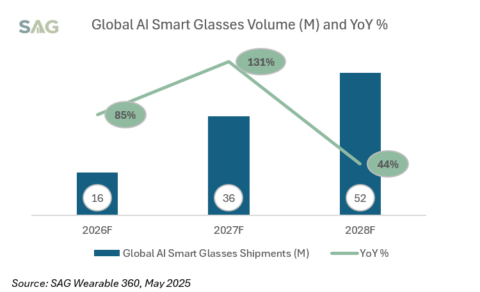
Apple’s eventual entry is expected to further accelerate category adoption and help move AI smart glasses from an early-adopter market into the mainstream.
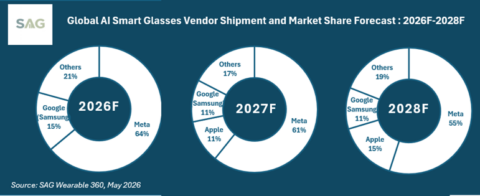
SAG expects Apple to quickly emerge as one of the industry’s leading vendors, competing closely with Google and Samsung for the No. 2 position globally in 2027. By 2028, assuming regular product refreshes and meaningful Siri and Apple Intelligence improvements, SAG expects Apple to overtake Google/Samsung and become the second-largest AI smart glasses vendor worldwide, behind only Meta, with approximately 15% global market share.
Exhibit 2: Global AI Smart Glasses Vendor Share Forecast: 2026F-2028F
However, we do not expect AI smart glasses to replace smartphones in the foreseeable future. Instead, they will serve as a new AI interface layer, enabling contextual awareness, voice interaction, navigation, translation, notifications, and real-time assistance throughout the day.
The Billion-Person Opportunity Nobody Is Talking About
One potential game changer remains largely overlooked: adaptive prescription lenses.
Today, billions of people worldwide require vision correction. If future AI smart glasses can automatically adjust lens prescriptions based on individual vision profiles, adoption barriers could fall dramatically.
Such a breakthrough would significantly expand the addressable market beyond current industry expectations and could reshape the long-term growth trajectory of the entire industry.
Innovation rarely respects boundaries.
SAG Perspective
Apple’s first AI glasses are unlikely to become its largest hardware category by volume. However, they could become one of the company’s most strategic products, serving as a bridge between the iPhone, AirPods, Apple Watch, and future AI-native experiences.
As WWDC 2026 approaches, SAG will be publishing a series of research notes examining Apple’s long-term AI hardware strategy, including the role of Siri and Apple Intelligence, the future of AI smart glasses, and why AirPods could emerge as one of Apple’s most important AI wearables. Stay tuned for additional analysis next week.
The post-smartphone AI hardware era is beginning to take shape. Apple’s reported AI glasses timeline suggests the company understands that winning this market will require more than advanced technology—it will require products that consumers are willing to wear every day.