
Apple is reportedly exploring AirPods with cameras, and honestly, it sounds fresh, cool and genuinely unique. We forecast Android counterparts to replicate something similar very soon as well. But the bigger question is, what will be the actual impact?
Before this, let me breakdown the importance of Airpods in the Apple ecosystem. Per SAG, Airpods TWS (excluding headphones) revenue in 2025 and Q1 2026 accounted for 29% of the Apple’s Wearables, Home and Accessories revenue. This is like 2% of the Apple’s total revenue.
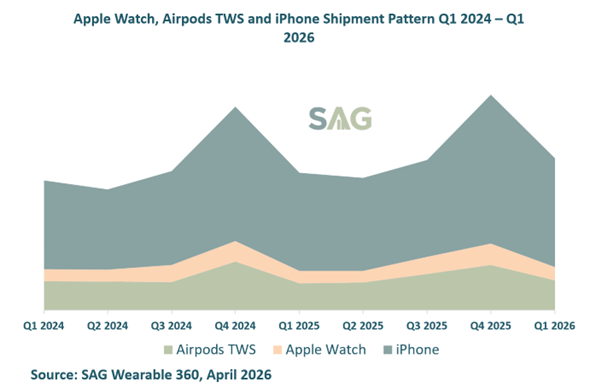
In volume terms, the picture looks bigger and better. Per SAG, Airpods TWS is lesser than 30% of the iPhone volumes in Q1 2026 (for exact estimates, reach out to us). N top of the estimates, mentioned above, Airpods TWS has slightly better margin% compared to iPhones and hence it is important.
Exhibit 1 – Apple Watch, Airpods TWS and iPhone Shipment Pattern Q1 2024-Q1 2026
Apple Watch, Airpods TWS and iPhone Shipment Pattern Q1 2024 – Q1 2026
This proves that Airpods TWS might not be as big as iPhones but still important for Apple.
While Apple has not officially confirmed Q.ai integration, the reported development of camera-equipped AirPods creates a logical hardware pathway for silent voice recognition. By combining embedded visual/optical sensors with AI models that interpret subtle mouth, jaw or facial movements, Apple could enable future AirPods to support discreet, low-friction interaction with Siri and Apple Intelligence.
Now let’s throw some light on why Apple wants to add cameras to AirPods.
- We believe this is part of Apple’s broader AI strategy. With Apple Intelligence and a revamped Siri, Apple is clearly moving toward a more context-aware and always-assistive ecosystem. AirPods with cameras could essentially act as “eyes” for Siri.
- As of now, Apple has very limited face-worn hardware, mainly AirPods and Vision Pro. While Vision Pro showcases the long-term vision, it is impractical for prolonged daily wear. Hence, integrating cameras into AirPods makes strategic sense. Going forward, we expect Apple Glasses to arrive around 2027 with integrated camera and audio functionality. This would allow users to seamlessly switch between smart glasses and AirPods, while staying connected to the same AI-driven ecosystem experience.
- Another advantage is positioning. AirPods with cameras would be a first-of-its-kind product from a major tech player, giving Apple significant mindshare and first-mover advantage. We are quite sure other tech brands will eventually replicate something similar. At the same time, it will further strengthen user stickiness within the Apple ecosystem.
- Interestingly, even consumers without eyesight issues are already buying Ray-Ban Meta glasses primarily for the camera and audio functionality. However, many users may not prefer having a lens positioned directly in front of their eyes. AirPods with cameras could potentially solve that usability and comfort challenge as well.
Now lets talk about some of the impacts.
- AirPods are likely going to get significantly more expensive.
Adding cameras, sensors and the required processing hardware will increase the BOM considerably. While this could improve ASPs for Apple, volumes may take a hit as the product moves further into the ultra-premium segment. - Camera synchronization could become a major engineering challenge.
For cameras on both AirPods to work in sync, the buds would ideally need to be worn at a particular angle. Even slight shifts in fit or positioning could distort image capture or depth perception to an extent. That said, knowing Apple, they have probably found a software-led way to compensate for this through sensor fusion, head tracking and AI-based calibration. - Battery drain will inevitably increase.
Compared to a normal TWS, continuously running cameras and additional sensors will consume substantially more power. This may require larger batteries, which could make future AirPods slightly bulkier than current-generation designs, at least initially. - Security: Airpods with camera provide a great functionality but it might make other people around it uncomfortable for privacy concerns.
Overall, this feels less like an “audio upgrade” and more like the beginning of ambient AI wearables — where earbuds evolve from passive audio devices into context-aware computing products.