
Key Takeaways
- Apple’s Services & Software revenue share increased from 24% in 2024 to 28% in Q1 2026, although Apple remains primarily a hardware-driven company.
- Siri 2.0 is expected to evolve from a voice-only assistant into a voice, text, context, and sight-based AI interface.
- SAG believes 2027–2029 will be the critical window for validating AI monetization, commercialization, and investment returns.
- Enterprise AI currently demonstrates a clearer path toward monetization than consumer AI.
- Consumer AI adoption is growing, but whether AI fundamentally changes communication, entertainment, and consumer behavior remains one of the industry’s biggest unanswered questions.
- SAG believes Apple may have more time than critics assume. AI can drive hardware upgrades, strengthen ecosystem engagement, and expand recurring Services revenue across Apple’s growing connected device ecosystem.
As WWDC 2026 approaches, investors are closely watching Siri, Apple Intelligence, and Apple’s broader AI strategy.
Unlike many AI-first companies, Apple approaches AI from a different starting point: hardware, ecosystem, and services.
SAG believes the two questions matter:
- Can Siri 2.0 evolve into a meaningful AI agent and ease concerns that Apple Intelligence is falling behind competitors?
- Can AI fundamentally change consumer behavior enough to create a sustainable long-term business model?
Apple Remains Hardware-Driven, But Services Continue to Grow
Apple is often viewed as lagging behind OpenAI, Google, Anthropic, and other AI leaders. However, Apple remains one of the world’s largest potential AI beneficiaries because its business model differs fundamentally from AI-first companies.
Exhibit 1: Apple Revenue Mix: Hardware vs. Services & Software
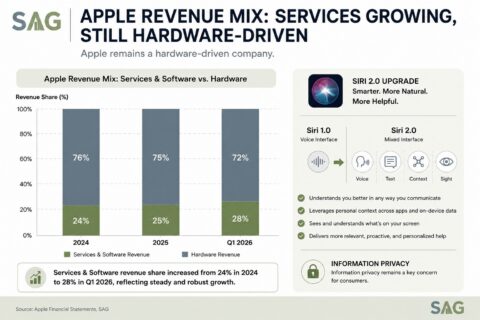
As shown in exhibit 1, hardware still represented approximately 72% of Apple’s revenue mix in Q1 2026, while Services & Software accounted for 28%, up from 24% in 2024.
Services continue to grow faster than hardware, but Apple remains primarily a hardware-driven company. Unlike AI model providers that depend heavily on subscriptions and API consumption, Apple monetizes through device sales, ecosystem engagement, and long-term customer retention.
This gives Apple a different path to AI monetization.
For Apple, AI does not necessarily need to become a standalone subscription business. Instead, AI can strengthen ecosystem engagement, improve customer retention, support premium pricing, and create new upgrade cycles across its hardware portfolio.
Siri 2.0 Could Become Apple’s Most Important AI Upgrade
SAG expects WWDC 2026 to showcase a significantly upgraded Siri experience, from Siri 1.o to 2.0.
It represents a shift from a voice-only assistant to a multimodal AI interface capable of understanding voice, text, personal context, and visual information.
Future Siri experiences are expected to leverage voice interaction, text interaction, personal context, on-screen awareness, and device ecosystem intelligence.
This evolution is particularly important as Apple expands AI capabilities across iPhone, AirPods, Apple Watch, Mac, iPad, and future AI-connected devices.
However, one issue remains critical: information privacy. Consumer trust remains one of Apple’s strongest competitive advantages and will likely remain a central pillar of its AI strategy.
The AI Investment Race Continues
The AI race is accelerating at an unprecedented pace. For many executives and investors, the perceived risk of underinvesting in AI has become greater than the risk of overinvesting.
Google recently increased its AI-related capital expenditure outlook to approximately US$80 billion, highlighting the industry’s willingness to invest aggressively despite ongoing uncertainty around returns. Similar investments continue across Microsoft, Meta, Amazon, OpenAI, Anthropic, and other major players.
Apple’s approach is somewhat different.
Rather than competing directly with hyperscale’s in large-scale AI cloud infrastructure, Apple continues investing heavily in AI talent, custom silicon, private cloud infrastructure, Apple Intelligence, Siri, and on-device AI capabilities.
The company’s AI investments are increasingly reflected in rising R&D spending as Apple accelerates development of AI software, silicon, services, and next-generation hardware experiences.
When will these investments generate meaningful returns?
SAG believes the period between 2027 and 2029 will become a critical window for validating AI monetization, commercialization, and return on investment.
Enterprise AI Commercializes Faster Than Consumer AI
Exhibit 2: SAG AI commercialization Maturity Index
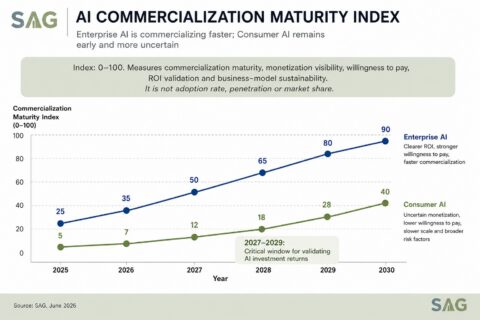
As shown in exhibit 2, SAG believes enterprise AI currently demonstrates a substantially clearer path toward commercialization than consumer AI.
The index does not measure adoption rates, market penetration, or revenue share. It measures monetization visibility, customer willingness to pay, ROI validation, ecosystem readiness, and business-model sustainability.
SAG rates enterprise AI rises from a maturity score of 25 in 2025 to 90 by 2030. Consumer AI rises from 5 to 40 over the same period.
This is why enterprise AI currently offers a more predictable path toward monetization.
Consumer AI Is Growing, But The Long-Term Question Remains
This does not mean consumer AI lacks opportunity. In fact, consumer AI is showing encouraging signs of progress.
AI-powered productivity, creativity, education, wellness, and personal assistant applications continue to gain traction across mobile platforms, including Apple’s App Store ecosystem.
A growing number of consumers are proving willing to pay for premium AI experiences. These developments are positive and suggest consumer AI monetization is gradually taking shape.
However, the larger question remains unresolved.
The internet fundamentally changed how people access information. Smartphones fundamentally changed communication, entertainment, navigation, commerce, media consumption, and social interaction.
Will AI create a similar behavioral shift? SAG believes the answer remains uncertain.
Consumers may adopt AI broadly, but the extent to which AI changes daily habits, communication patterns, content consumption, and entertainment behaviors remain one of the industry’s biggest unanswered questions.
Why Apple May Have More Time Than Critics Think
Apple clearly needs to improve Siri and Apple Intelligence. However, consumer AI commercialization remains at a relatively early stage.
For Apple, there is still time to catch up. The situation may not be as severe as many currently believe.
Apple remains uniquely positioned because of its massive installed base and integrated hardware ecosystem. AI can strengthen hardware demand, deepen ecosystem engagement, support premium pricing, and create new upgrade cycles across iPhone, AirPods, Apple Watch, Mac, iPad, and future AI wearables.
Meanwhile, services and software are becoming increasingly important growth drivers. As AI capabilities improve, Apple has the opportunity to expand recurring revenue streams while strengthen the value of its broader ecosystem.
SAG will provide live coverage and analysis throughout WWDC 2026. Stay tuned.
For WWDC 2026 Preview One, please click here to access the full article.