The current narrative around Apple and AI has become increasingly dramatic: the AI ship has sailed, competitors are racing ahead, and Apple is falling behind. But when we look at consumer behavior and hardware economics, the reality is far less alarming.
Despite the delayed rollout and uneven execution of Apple Intelligence, the iPhone 17 series delivered a stunning performance in Q4 2025 — Apple’s best fourth quarter on record. The result is even more striking in China, where Apple Intelligence is not available at all. A pure hardware upgrade was enough to move the needle, reignite enthusiasm among existing iPhone users, and even pull some Android users into the Apple ecosystem.
This is an important signal.
Per SAG’s channel observations in the United States, only about one in ten iPhone shoppers asked about Apple Intelligence when purchasing a new device in physical retail stores. That suggests AI is not a primary decision factor in the replacement cycle today. Hardware features still play the pivotal role.
Most consumers upgrade smartphones for familiar reasons: battery aging, camera improvements, ecosystem lock-in, pricing promotions, and brand loyalty. AI summarization tools, generative photo editing, and smarter assistants enhance the experience — but they are not yet mass replacement drivers. They are nice to have, not must-have features for the mainstream market.
Even if Apple is temporarily behind in the AI race, its hardware business remains supported by one of the strongest ecosystem moats in consumer technology. The iOS installed base (2.5 billion units) is enormous, deeply integrated, and highly sticky. Switching costs are behavioral, financial, and emotional. Structural advantages of that scale do not erode because of a single technology cycle measured in quarters.
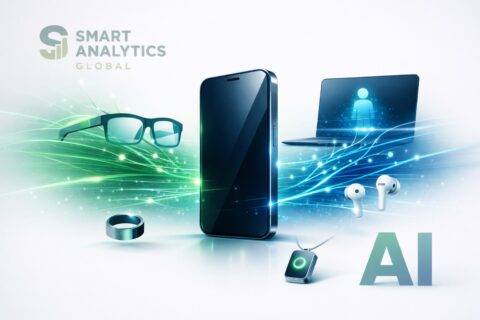
Meanwhile, the broader industry is clearly in an experimentation phase. AI is being embedded into glasses, earbuds, pendants, pins, and an expanding list of hardware form factors. Companies are attempting to inject an “AI soul” into existing devices, but the open question remains whether consumers will meaningfully change behavior in response.
In the near term, SAG expects AI applications to lean heavily toward productivity. Yet productivity has never been the primary driver of mass consumer electronics adoption. Entertainment and communication remain the dominant use cases for smartphones and most personal devices. Consumer adoption of AI in these social and entertainment contexts is much more slowly.
The lukewarm reception of high-profile AI creative tools illustrates the friction. Many consumers remain hesitant to generate personal social content using AI.
Being “real” still matters. If the internet is filled with too many fake, AI-made videos and posts, people get bored and stop paying attention instead of staying interested.
A great example of this is the recent struggle of OpenAI’s Sora app. After a massive launch in late 2025, the app saw a sharp 32% drop in downloads by December and a further 45% drop in January 2026. People quickly grew tired of the “synthetic” look of the videos, which many described as “AI slop” that lacked real emotional storytelling. Because Sora had to restrict the use of famous characters and real people to avoid legal trouble, the content became repetitive and boring, proving that without a human touch, even the most advanced AI tools can fail to keep us hooked.
Platforms like YouTube have made “combating AI slop” a top priority for 2026. They are introducing labels and filters that allow viewers to prioritize verified human content over synthetic videos, rewarding creators who use AI only for “boring” tasks like editing rather than full creation.
All above indicates from consumers angle, authenticity still matters. A digital ecosystem flooded with AI generated contents risk fatigue rather than engagement. Trust, comfort, and cultural acceptance are as important as technical capability.
The long-term transition from an app-driven interface to an agent-driven interface is meaningful. But it requires trust, reliability, privacy confidence. These are multi-year infrastructure challenges. As SAG noted in its early-2026 mobile market trends report, this shift will unfold gradually, measured in years rather than quarters.
Markets tend to react faster than users.
Much of the current anxiety reflects a perception gap between investor expectations and real-world consumer behavior. AI is unquestionably the future direction of consumer electronics, but the timeline is uneven.
Apple does not need to be first in AI. Historically, Apple succeeds by integrating technologies late, refining them deeply, and scaling them quietly. That pattern has repeated across multiple product categories.
The AI race is real, but the short-term fear of hardware disruption may be overstated.