
Key Takeaways
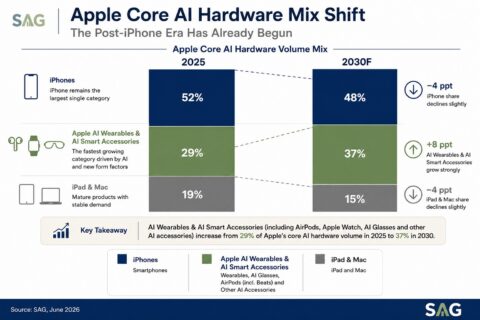
• SAG expects iPhone’s share of Apple’s hardware volume to decline from approximately 52% in 2025 to 48% by 2030.
• Wearables and AI-connected smart devices/ accessories are expected to grow from 29% of Apple’s hardware volume in 2025 to 37% by 2030.
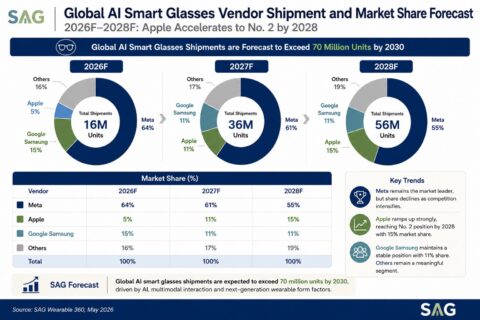
• SAG forecasts global AI smart glasses shipments will exceed 70 million units by 2030, with Apple expected to become the world’s No. 2 vendor by 2028.
• Future camera-equipped AirPods could emerge as one of Apple’s most important AI interface devices.
• Siri and Apple Intelligence will be critical to connecting Apple’s future AI hardware ecosystem.
As WWDC 2026 approaches, much of the discussion is centered around Siri, Apple Intelligence, and software upgrades. However, SAG believes a bigger long-term story is emerging.
The post-iPhone era has already begun.
This does not mean the iPhone will disappear. Instead, it means the iPhone’s dominance will gradually weaken as a growing number of AI-powered wearables and connected devices take on larger roles within Apple’s ecosystem.
The iPhone Stays, But Its Dominance Declines
The iPhone remains one of the most successful consumer products in history and will continue to be Apple’s largest hardware business for years to come.
However, SAG expects iPhone’s share of Apple’s hardware volume to decline from approximately 52% in 2025 to 48% by 2030 as wearables and AI-connected devices gain importance.
The future is about more devices working together.
AI Wearables Become the Next Growth Engine
SAG forecasts wearables and AI-connected devices / accessories will increase from approximately 29% of Apple’s hardware volume in 2025 to 37% by 2030.
AI smart glasses, AirPods, Apple Watch, smart home devices, and future AI smart accessories will increasingly complement the smartphone experience rather than replace it.
Exhibit 1: SAG Apple Core AI Hardware Mix Shift from 2025 to 2030F
SAG forecasts global AI smart glasses shipments will approach 16 million units in 2026, reach approximately 36 million units in 2027, and exceed 70 million units by 2030. Apple is expected to compete closely with Google/Samsung for the No. 2 position in 2027 and become the world’s second-largest AI smart glasses vendor by 2028, behind only Meta.
Exhibit 2: SAG AI Smart Glasses Vendor Shipment and Market Share Forecast: 2026F-2028F
Meanwhile, AirPods may become Apple’s most important AI wearable platform. SAG tracked AirPods shipments exceeding 70 million units globally in 2025. Including Beats products, Apple’s earwear ecosystem surpassed 100 million units.
Future camera-equipped AirPods could enable contextual recognition, environmental awareness, visual search, silent speech recognition, and real-time AI assistance, creating entirely new user experiences in the post-iPhone era.
Of course, significant technology barriers remain. Battery life, AI processing efficiency, thermal management, sensors, microphones, voice recognition, and privacy protection must continue improving before AI wearables can reach their full potential. However, advances in low-power AI processors, edge AI computing, multimodal AI models, and battery technologies are gradually making these devices more practical for everyday use.
Decentralized Connections and the Shift Toward Ambient Computing
Historically, the iPhone served as the center of Apple’s ecosystem.
In the post-iPhone AI era, intelligence is increasingly becoming decentralized across multiple devices rather than concentrated in a single product. AI glasses may provide visual context. AirPods may provide voice interaction. Apple Watch may contribute health and biometric insights.
The iPhone remains the computing hub, while AI becomes the connective layer linking everything together.
The future of consumer technology may become less screen-centric and more ambient, where AI is always available, context-aware, and seamlessly connected across multiple devices.
Consumer Behavior Shifting and Evolving
At the same time, consumer behavior is evolving. After two decades of smartphone and social media adoption, many consumers are experiencing screen-time fatigue and information overload. Increasingly, users are seeking technologies that work quietly in the background rather than constantly demanding attention.
This shift is helping drive interest in AI glasses, camera-equipped AirPods, smart rings, and other non-display devices that provide intelligence without requiring another screen.
This is why Siri and Apple Intelligence are becoming strategically important. Future AI wearables will depend less on hardware specifications and more on the ability of AI to understand context, intent, and environment across a decentralized ecosystem.
Apple’s Biggest Opportunity
Apple’s greatest advantage is about the combination of hardware, software, services, developer ecosystem, and hundreds of millions of active devices already in consumers’ hands.
No AI model company today possesses Apple’s scale of consumer hardware distribution.
Apple still needs to improve Siri and Apple Intelligence over the next 12-24 months, whether through internal development, strategic partnerships, or both. But unlike many AI-first competitors, Apple already owns the endpoints through which AI experiences will ultimately be delivered.
The post-iPhone era is not about replacing the iPhone. It is about surrounding it with intelligent devices that can see, hear, understand, and assist throughout the day.
WWDC 2026 may provide the clearest clues about how Apple plans to build that future through Siri, Apple Intelligence, and its next generation of AI-powered hardware.
SAG will provide live coverage and analysis throughout WWDC 2026 next week. Stay tuned.