
Smart Analytics Global (SAG) research team had the opportunity to experience the newly debuted AI smart glasses developed by Samsung and Google under the Warby Parker brand this week. The new glasses offer an attractive combination of lightweight design, competitive pricing and everyday wearability. However, SAG believes that the lack of compelling AI use cases remains a major barrier to mass-market adoption.
Executive Summary
- Lightweight and comfortable: At just 41 grams, the Warby Parker AI glasses are lighter than Meta’s competing AI smart glasses and even some audio-only models.
- Competitive pricing: Starting at US$395 without prescription lenses, the product is well positioned between Meta’s premium and more affordable offerings.
- Limited design choices: Three frame shapes and three colors are available, but the non-adjustable nose pads and limited frame selection remain drawbacks.
- AI remains the key challenge: Google Gemini powers the new glasses, but SAG has not yet tested its AI capabilities. Current AI smart glasses still lack breakthrough use cases.
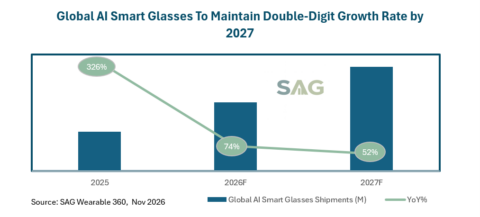
- Growth outlook: SAG expects global AI smart glasses shipments to maintain double-digit annual growth in both 2026 and 2027, although growth momentum has slowed from 2025 and the first half of 2026.
Lightweight Design and Competitive Pricing Are Key Strengths
The new Warby Parker AI smart glasses weigh just 41 grams, lighter than Meta Ray-Ban Gen 3 and Meta-branded AI glasses, both weighing more than 50 grams. They are even lighter than Meta Ray-Ban audio-only models, which weigh more than 43 grams.
SAG’s hands-on experience was positive. The glasses felt lightweight and comfortable, with a design suitable for everyday use as regular eyewear.
Image 1: Warby Parker Intelligence Glasses: Close-up View

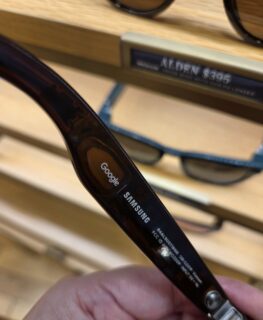
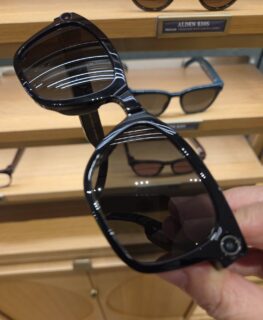
Three frame shapes are available: round, square and rectangular, with three color options: red, green and black. Each design offers both sunglasses and clear-lens versions.
Image 2: Warby Parker Intelligent Glasses : Full Display Shelf Overview
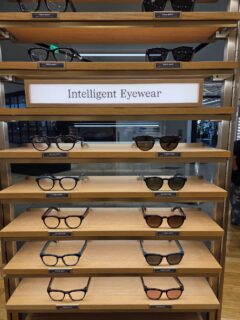
However, the frame selection remains limited compared with Meta’s broader portfolio. The non-adjustable nose pads are another drawback, potentially affecting fit and comfort for different users.
At US$395 without prescription lenses, the pricing is below Meta Ray-Ban Gen 3 but above Meta’s own-branded AI glasses and Ray-Ban audio-only models. SAG believes this is a well-calibrated pricing strategy that balances product positioning, functionality and affordability.
Battery life is estimated at approximately nine hours, comparable with Meta Ray-Ban Gen 3. While sufficient for many daily activities, it still falls short of supporting uninterrupted, all-day usage.
Pre-orders are now available, with initial shipments expected around mid-December 2026. The United States and South Korea will be the first two markets.
Prescription Support Expands the Addressable Market, but Affordability Remains a Consideration
The new glasses support prescription lenses up to -8.00 diopters, comparable with Meta Ray-Ban glasses, as SAG confirmed during its on-site discussions. This is encouraging for consumers with stronger vision correction requirements.
SAG believes sunglasses could ultimately offer greater mass-market potential than prescription-focused models, given their broader addressable consumer base and lower purchase barriers.
However, there is an important financial consideration in the United States. Non-prescription sunglasses generally do not qualify for Health Savings Account (HSA) or Flexible Spending Account (FSA) reimbursement, unlike eligible prescription eyewear. This could influence purchasing decisions.
Another emerging trend is the introduction of optional device protection plans by Meta, Ray-Ban and Warby Parker, resembling smartphone insurance programs. These plans typically involve a one-time payment of approximately US$50–70 or more, adding to the overall ownership cost.
Google Gemini vs. Meta AI: The Real Competition Is About Use Cases
The new Warby Parker glasses are powered by Google’s Gemini AI platform. SAG has not yet tested their Gemini-powered functions, so it is too early to evaluate the actual AI experience.
Meanwhile, SAG believes that current Meta AI glasses still offer relatively limited AI functionality. Although useful for selected tasks, especially for video capature, existing capabilities have yet to deliver a truly transformative consumer experience.
Meta’s next-generation Muse AI capabilities remain in beta testing and have not yet reached broad commercial availability in the USA right now. SAG will closely monitor whether Muse can introduce meaningful new AI applications and improve everyday usefulness.
Ultimately, the competitive advantage will increasingly depend on AI functionality and unique use cases rather than hardware specifications alone.
SAG Outlook: Double-Digit Growth Continues, but Mass Adoption Needs a Breakthrough
According to SAG’s latest AI Smart Glasses research, global shipments are forecast to maintain double-digit annual growth in both 2026 and 2027. However, growth momentum has moderated compared with 2025 and the first half of 2026.
Exhibit 1: Global AI Smart Glasses Growth Rate: 2025-2027F
Privacy concerns remain an important obstacle, particularly for camera-equipped glasses. Nevertheless, SAG believes the more fundamental challenge is the lack of compelling, differentiated use cases that justify regular and daily usage and additional consumer spending.
The new Samsung, Google and Warby Parker collaboration demonstrates meaningful progress in hardware design, comfort and pricing. These improvements are necessary to expand the market, but they are not sufficient to unlock mass adoption.
This article reflects Smart Analytics Global’s independent research, hands-on experience and market assessment. It is not sponsored or paid content.