
Executive Summary
- Strong Early Adoption: SAG estimates Meta Muse downloads reached 10.9 million in the US and Canada within six weeks of launch. Meta reports approximately 25% of users who completed setup are using Muse daily.
- Agentic E-Commerce Takes the Lead: Online shopping has emerged as Muse’s most popular use case. More than a quarter of engaged shopping users have an average purchase size exceeding US$200, highlighting substantial monetization potential.
- Positive SAG Hands-On Experience: SAG’s testing over the past month confirms Muse’s impressive proactive, always-on capabilities and ability to execute tasks in the background. We believe this marks a promising start for personal AI agents.
- Meta’s Ecosystem Advantage: Its massive social media user base, business relationships and AI smart glasses portfolio could differentiate Muse from standalone AI platforms.
- Opportunities and Headwinds: Amazon’s restrictions on third-party AI shopping agents, high cloud computing costs and the challenge of maintaining service quality at billion-user scale remain major uncertainties. Muse’s planned November integration with Meta AI smart glasses could help reignite slowing market growth.
Muse Surpasses 10 Million Downloads in Six Weeks
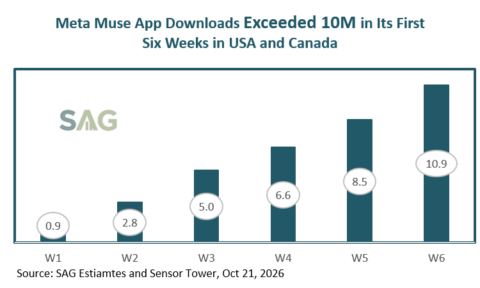
According to Smart Analytics Global (SAG) estimates based on Sensor Tower data, Meta Muse’s cumulative app downloads in the US and Canada reached 10.9 million during its first six weeks, following its early September 2026 rollout.
Exhibit 1: Meta Muse Downloads in USA and Canada
Meta also disclosed that approximately 25% of users who completed Muse setup are using it daily, suggesting encouraging early engagement. While downloads do not necessarily translate into active users, the initial momentum is impressive.
The SAG research team has been actively testing Muse over the past month, and our experience has been very positive.
Unlike conventional AI chatbots, Muse is highly proactive and capable of handling multiple tasks while continuing to work in the background. Its always-on cloud-based architecture makes it feel more like a personal assistant than a traditional AI application.
SAG believes Muse represents an important evolution from AI that answers questions to AI that actively gets things done for consumers.
Nevertheless, longer-term user retention, task completion rates and engagement frequency will be more meaningful indicators of sustainable success.
Agentic E-Commerce Emerges as Muse’s Biggest Commercial Opportunity
Perhaps the biggest surprise is that online shopping has emerged as Muse’s most popular use case, ahead of traditional AI activities such as information search and content generation.
Meta disclosed that more than a quarter of engaged Muse users shopping through the agent had an average purchase size exceeding US$200. This suggests consumers are increasingly comfortable involving AI agents in meaningful purchasing decisions.
Agentic e-commerce could fundamentally reshape online shopping. Instead of manually searching for products, comparing prices, reading reviews and navigating checkout processes, consumers could delegate these tasks to personal AI agents.
Muse’s cloud-based Secure VM architecture, combined with permission-based payment integrations through partners such as Stripe, provides an important technical foundation for agent-driven transactions. Early shopping adoption and payment activity are encouraging indicators of consumer acceptance, although they do not eliminate transaction security and reliability risks.
SAG believes agentic e-commerce could become one of the largest monetization opportunities for personal AI agents, potentially transforming product discovery, online advertising, merchant relationships and digital transaction economics.
However, transaction values alone do not guarantee attractive revenue. Meta’s ability to capture value will depend on merchant cooperation, transaction fees and the scale of agent-driven commerce.
Amazon’s Resistance Highlights Agentic Commerce Headwinds
Despite its promising start, Muse faces significant challenges in expanding agentic e-commerce.
Amazon has moved to restrict external AI shopping agents, including Muse, from accessing its shopping ecosystem. This highlights the growing competitive tension between personal AI platforms and established online marketplaces.
For Amazon, allowing external agents to control product discovery and purchasing could weaken its direct consumer relationships and threaten its advertising, marketplace and subscription economics.
Meta is developing partnerships with companies including Walmart, Shopify, Stripe and Sierra to facilitate secure, permission-based agent interactions.
However, SAG believes broad cooperation across major retailers, marketplaces and payment providers will be essential to scale agentic commerce.
Meta’s Social Ecosystem Could Provide a Competitive Advantage
SAG believes advanced AI models will play a critical role in determining the intelligence, reliability and user experience of personal AI agents. However, model capabilities alone may not be sufficient to build lasting competitive advantages.
Meta’s extensive social media ecosystem, including Facebook, Instagram, Threads, WhatsApp and Messenger, provides access to billions of consumers and a large network of businesses and advertisers.
These assets could accelerate Muse’s distribution, engagement and monetization, differentiating Meta from standalone AI model providers such as OpenAI.
Meta also envisions building a network in which personal AI agents interact with those belonging to family members, friends and businesses, supporting activities such as coordinating purchases, planning events and managing appointments.
SAG believes Meta’s existing consumer relationships, social graph, merchant ecosystem and wearable devices could become important competitive advantages.
Muse Coming to Meta AI Smart Glasses in November: A Potential Growth Catalyst
Meta plans to introduce Muse to its AI smart glasses in November 2026, potentially expanding their capabilities well beyond photography, video recording and basic voice assistance.
SAG’s ongoing market tracking suggests that AI smart glasses growth momentum has moderated in recent months following an earlier period of rapid expansion.
Meanwhile, the SAG team has been actively testing Meta AI smart glasses. Our experience indicates that hands-free video capture remains one of the most impressive and practical features, while the current AI capabilities have delivered mixed results.
Muse could potentially change this.
By integrating a more proactive personal AI agent, Meta could enable more sophisticated use cases, including real-world product identification, price comparisons, shopping, appointment booking, personalized assistance and task execution.
The combination of visual recognition, voice interaction and agentic capabilities could significantly improve the value proposition of AI smart glasses.
SAG believes Muse integration could become an important catalyst for AI smart glasses, potentially reigniting consumer interest and accelerating market growth.
However, the actual impact will depend on execution, including AI accuracy, response speed, battery life, connectivity and the quality of third-party integrations.
SAG will closely monitor the November rollout to evaluate whether Muse can meaningfully improve the everyday usefulness of Meta’s AI smart glasses.
Computing Costs and Scalability: Can Meta Serve Billions of Users?
Meta has outlined an ambitious vision to eventually bring Muse to billions of users.
However, personal AI agents are considerably more computing-intensive than conventional mobile applications and many traditional chatbot interactions.
Muse operates in the cloud, maintains dedicated secure computing environments and can continue executing tasks in the background. These capabilities underpin its differentiated user experience but also create substantial infrastructure costs.
Three key questions:
- Can Meta maintain Muse’s proactive, always-on experience as its user base expands from millions to potentially billions?
- Can improvements in AI models, chips and cloud infrastructure sufficiently reduce the cost per user?
- Can Meta preserve responsiveness, reliability and task execution accuracy as usage and task complexity increase?
SAG believes maintaining a high-quality user experience at massive scale could become one of Meta’s biggest challenges, particularly if the company intends to keep the core Muse service free for most consumers.
Monetization: E-Commerce, Subscriptions and Enterprise Services
Meta plans to monetize Muse through a combination of agentic commerce fees, premium subscriptions, business services, APIs and enterprise deployments, while keeping core consumer access free.
SAG believes e-commerce could offer particularly attractive upside because transaction-based revenue has the potential to scale with purchasing activity rather than depending entirely on subscription fees.
However, successful monetization will require a large and engaged user base, broad merchant participation and sustainable transaction economics.
Amazon’s resistance illustrates why cooperation from established e-commerce platforms will be critical.
Meanwhile, subscriptions and enterprise services could provide more predictable recurring revenue, especially for power users and businesses adopting AI-driven automation.
SAG expects a hybrid monetization model to emerge, combining consumer commerce, premium services and business / enterprise applications.
SAG Outlook: A Promising Start to the Personal AI Agent Era
SAG believes Muse’s first six weeks have delivered a highly promising and encouraging start.
Its rapid adoption, meaningful early engagement, popularity in online shopping and positive hands-on user experience suggest that personal AI agents could become an important new category of consumer AI services.
Our own testing indicates that Muse already delivers tangible value through its proactive, always-on capabilities and ability to execute real-world tasks.
SAG highlights four key takeaways:
- Personal AI Agents Are Becoming a Reality: Muse demonstrates growing consumer interest in AI that can execute tasks rather than simply provide information.
- Agentic E-Commerce Could Become a Major Revenue Engine: However, scaling will require broader merchant cooperation, particularly from major platforms such as Amazon.
- AI Models and Ecosystems Will Determine the Winners: Meta’s social media platforms, business relationships and wearable devices could provide meaningful differentiation from pure AI model providers.
- Scalability and Computing Costs Remain Key Uncertainties: Meta must maintain service quality while significantly expanding its user base and improving computing efficiency.
Looking ahead, Muse’s November integration with Meta AI smart glasses will be an important development to watch. More capable personal AI agents could significantly improve the practical value of smart glasses and potentially revive recent slowing growth momentum.
Overall, SAG believes Muse’s impressive early performance signals the beginning of the personal AI agent era. While commercial and technical uncertainties remain, its potential impact on consumer behavior, e-commerce, AI smart glasses and the broader digital ecosystem could be substantial.