
Key Takeaways
- Samsung showcased prototypes of its long-awaited AI smart glasses at the launch event but stopped short of formally launching the product.
- Two prototype designs developed with Gentle Monster and Warby Parker were displayed to selected media, although hands-on trials were not allowed.
- Samsung emphasized lightweight design, up to nine hours of battery life, Gemini AI integration and Qualcomm’s Snapdragon AR1 Gen 1 chipset.
- Samsung also teased potential integration between its AI smart glasses and Galaxy smartwatches, highlighting its broader ambition to build an AI hardware ecosystem.
- Pricing, the exact launch date and distribution strategy remain undisclosed beyond a broad “this fall” timeline.
- SAG forecasts Samsung and Google’s AI smart glasses could generate around 2 million units in 2026, representing approximately 12% of the global market, while Meta remains the dominant player.
“Samsung’s AI smart glasses demonstrate that the industry is moving beyond hardware competition toward an ecosystem battle, where AI experiences, fashion, comfort, personalization and retail execution will ultimately determine consumer adoption.” — Linda Sui, Founder, Smart Analytics Global
Samsung finally offered the industry a closer look at its highly anticipated AI smart glasses during its Galaxy Unpacked event. However, the company did not formally debut or commercially launch the product.
Selected media were invited to view two prototype models, although they were not allowed to try them on. Samsung also teased several important features, use cases and aspects of its broader product strategy.
Below are Smart Analytics Global (SAG) ’s seven key takeaways.
1. Lightweight Design Is the Right Product Philosophy
Samsung repeatedly emphasized that lightness and comfort remain central to the design philosophy of its AI smart glasses.
SAG believes Samsung is making the right bet.
AI smart glasses are fundamentally different from AR glasses and VR headsets. They are intended to be worn regularly throughout the day, making comfort, weight and daily wearability determining factors for consumer adoption and market scale.
Consumers will evaluate AI smart glasses first as eyewear and then as technology products. The glasses must fit naturally into people’s daily lives before their AI capabilities can achieve mass-market adoption.
2. More Frame Styles and Personalization Will Be Needed
Samsung demonstrated two prototype designs at the event.
The Gentle Monster version featured a more fashionable oval frame, while the Warby Parker model adopted a more classic and conventional frame style.
Image 1: Samsung AI smart glasses prototype models: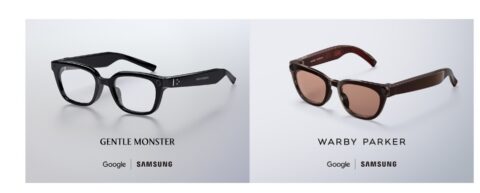
The two designs reflect an important reality: one frame will not fit every consumer.
People have different face shapes, nose shapes, fashion preferences and lifestyle requirements. Samsung will therefore need to offer more frame styles, colors and sizes, along with adjustable nose pads and other fitting options.
Unlike smartphones, AI smart glasses are highly personal products that sit directly on a consumer’s face. Fashion, fit and customization will be just as important as processors, cameras, batteries and AI capabilities.
Samsung’s partnerships with Gentle Monster and Warby Parker give it a strong starting point, but the company will eventually need a broader portfolio to address different customer segments.
3. The Market Is Beginning to Divide into Two Ecosystem Paths
Samsung’s AI smart glasses are expected to use Qualcomm’s Snapdragon AR1 Gen 1 platform, the same core chipset used by Meta’s AI glasses.
However, Samsung’s software and ecosystem approach differs significantly from Meta’s.
Samsung is relying on Google’s Android XR platform, Gemini AI and related Google applications. Meta, by comparison, operates a more vertically integrated ecosystem built around Meta AI, Horizon OS and its own social platforms.
Although the AI smart glasses market remains at a very early stage, it may gradually follow a path similar to smartphones.
Meta could represent the more closed and vertically integrated approach, similar to Apple’s strategy with iOS. Google, Samsung and other hardware partners could represent a broader and more open Android-style ecosystem.
This emerging divide will shape application development, AI services, hardware partnerships and user experiences over the coming years.
Qualcomm may become one of the biggest beneficiaries of this expansion. Its chipsets are likely to be widely adopted across major AI smart glasses products, although MediaTek is rapidly catching up and seeking a stronger position in the category.
4. Nine-Hour Battery Life Is Impressive, but Hardware Alone Will Not Decide the Winner
Samsung highlighted up to nine hours of battery life under normal usage conditions rather than under an especially light usage model.
If Samsung delivers this performance in real-world conditions, its AI smart glasses could outperform the second-generation Meta Ray-Ban glasses in battery endurance.
However, SAG believes consumers will judge the product based on the total user experience rather than battery life or any other individual hardware feature.
Fashion, brand strength, comfort, battery life, practical use cases, AI performance, ecosystem integration and personalization are all equally important.
AI smart glasses are not purely technology gadgets. They combine consumer electronics, eyewear, fashion and AI services in a single product.
This makes the category fundamentally different from the increasingly standardized smartphone market. A product with the strongest processor or longest battery life will not necessarily become the market winner if it falls short in comfort, styling, applications or customer experience.
5. Galaxy Watch Companion Could Become an Important Ecosystem Differentiator
Samsung also teased that its smartwatches could play a companion role alongside its upcoming AI smart glasses.
Although Samsung did not disclose detailed functions or explain exactly how Galaxy Watch and AI smart glasses would interact, this could become an important differentiator from Meta and many other competitors if Samsung executes the concept effectively.
Samsung is not simply preparing to launch another standalone wearable. The company appears to be building a broader AI hardware ecosystem that connects smartphones, smartwatches, earbuds, tablets, PCs and AI smart glasses.
This type of cross-device integration would allow Samsung to compete from a position of strength that many standalone AI glasses vendors do not possess.
Meta currently benefits from its vertically integrated AI, software and social-platform ecosystem. Samsung’s advantage could come from connecting a much broader portfolio of personal devices around Google Gemini and Galaxy AI.
Whether Samsung can fully deliver this vision remains to be seen. However, the strategic direction is clear: Samsung aims to build an integrated AI hardware ecosystem rather than compete through individual products alone.
SAG believes AI smart glasses will play an increasingly important role in this ecosystem. Over time, they could evolve from an accessory into one of the primary interfaces through which consumers interact with AI across multiple connected devices.
6. Privacy and Regulatory Uncertainty Remain Major Barriers
Privacy concerns remain one of the largest challenges facing the AI smart glasses industry, particularly because many products include cameras, microphones, video recording and AI-powered visual recognition.
Consumers may be concerned about when cameras are active, how images are processed, where personal data is stored and whether people nearby know they are being recorded.
Regulatory uncertainty will also vary significantly by region.
SAG believes North America will face fewer regulatory barriers than Europe, where consumer awareness of privacy issues is generally higher and the regulatory bar around data protection, cameras and artificial intelligence is more demanding.
This regional difference will affect both product availability and consumer adoption.
SAG expects North America alone to account for nearly 70% of global AI smart glasses sales in 2026, reinforcing its position as the largest and most strategically important market for the category.
However, vendors will still need to provide highly visible privacy indicators, transparent data policies and easy-to-understand controls to build consumer trust.
7. Pricing, Distribution and the Last-Mile Experience Will Be Critical
Samsung did not disclose the product’s pricing, exact commercial launch date or distribution strategy. The company only indicated that the product is expected to arrive this fall.
These unanswered questions may ultimately be just as important as the technical specifications.
SAG believes the last-mile customer experience will play a major role in determining whether AI smart glasses can move beyond technology enthusiasts and achieve mainstream adoption.
Offline retail will be especially important.
Consumers will want to try on different frames, evaluate comfort, compare colors, adjust the fit and understand the product’s capabilities before making a purchase. This creates a very different retail requirement from many other consumer electronics products.
Samsung will need to leverage the operator relationships, electronics retailers, eyewear partners and potentially optical channels to provide an effective hands-on experience.
Pricing will also be critical. Benchmarking the product against Meta’s AI smart glasses would be a practical approach for Samsung, particularly during the early stages of the market.
SAG Outlook
SAG maintains its positive outlook for the global AI smart glasses market.
We expect global AI smart glasses shipments to more than double year over year in 2026, making the category one of the fastest-growing areas within consumer electronics and wearable devices.
Exhibit 1: Global AI Smart Glasses Vendor Share Forecast in 2026
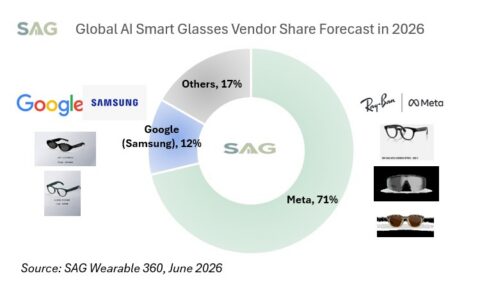
Meta is expected to remain the dominant player, capturing approximately 73% of global shipments. Its first-mover advantage, Ray-Ban partnership, expanding product portfolio and vertically integrated AI ecosystem will remain difficult for competitors to challenge in the near term.
However, Samsung and Google are well positioned to emerge as the most credible alternative ecosystem.
If Samsung executes well, launches the product on schedule this fall and establishes competitive pricing and strong distribution, SAG believes Samsung and Google’s AI smart glasses could generate more than 2 million units in 2026, representing around 12% of the global market.
More importantly, competition is beginning to evolve beyond individual hardware products.
The next phase of the AI smart glasses market will center on AI models, software platforms, connected hardware, fashion partnerships, personalization, privacy, retail execution and customer experience.
Samsung’s ability to connect AI smart glasses with Galaxy smartphones, smartwatches, earbuds and other devices could become one of its most important competitive advantages.
AI smart glasses will not replace smartphones in the near future. However, they are positioned to play an increasingly important role as a new AI interface and as a central component of the emerging AI hardware ecosystem.
Clients please click here to access SAG’s eye wearable forecast report.