
Key Takeaways
- WWDC 2026 emphasizes Apple’s differentiation through privacy, security, and ecosystem integration in its AI strategy.
- Vision Intelligence and spatial reframing represent important building blocks for future Apple AI smart glasses, paving the way for Apple’s entry into the category in late 2027.
- Apple’s biggest AI advantage remains its hardware ecosystem. SAG forecasts Apple-connected AI hardware annual sales will exceed 600 million units by 2030.
- Privacy continues to be Apple’s strongest competitive advantage. The company emphasized on-device AI and Private Cloud Compute while avoiding an aggressive multi-agent AI narrative.
- Enhanced child safety and parental control features may further strengthen ecosystem stickiness, particularly among families and younger users.
- Several notable topics were absent, including foldable iPhone software optimization, broader multi-agent AI strategy, and Apple’s emerging market AI roadmap.
- SAG believes the AI race is increasingly shifting from model performance toward ecosystem intelligence, where trust, privacy, and seamless cross-device experiences may become more important than raw AI capability.
Apple’s WWDC 2026 keynote demonstrated Apple’s effort to narrow the functionality gap with Google while differentiating through privacy, security, ecosystem integration, and spatial computing.
While many of the newly announced Apple Intelligence features already exist within Google’s Gemini ecosystem, WWDC 2026 highlighted a longer-term strategy that extends well beyond smartphones. The event emphasized Apple’s belief that AI will become deeply embedded across personal AI devices and future wearables, while trust and privacy remain central to user adoption.
1. Siri AI and Vision Intelligence Takes Center Stage, Spatial Reframing Stands Out
Apple introduced a more capable Siri AI with conversational interactions, cross-app task execution, on-screen awareness, and deeper integration of AI across photos, camera, and content creation tools.
One feature stood out: Spatial Reframing.
Built upon Apple’s Vision Intelligence and Vision Pro technologies, Spatial Reframing reconstructs depth and perspective within an image, allowing users to virtually adjust viewpoints and recompose photos after capture. While Gemini currently leads in real-time visual reasoning and camera-based assistance, Apple is beginning to leverage its Vision Pro investment to differentiate through spatial content creation and spatial computing experiences.
This matters because it lays important groundwork for future AI eyewear.
SAG expects AI smart glasses to emerge as one of the most AI-native personal computing categories over the next decade. Today’s Vision Intelligence upgrades are designed primarily for iPhone and Vision Pro, but they also establish critical building blocks for future AI glasses, including visual understanding, contextual awareness, multimodal interaction, and agentic AI capabilities.
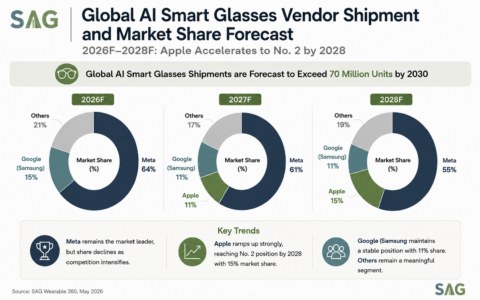
SAG expects Apple to formally enter the AI smart glasses market in late 2027 and become the world’s second-largest AI smart glasses vendor by 2028, behind only Meta Platforms.
Exhibit 1: SAG Global AI Smart Glasses Forecast
As the market matures, competition is likely to move beyond hardware specifications and AI models toward software intelligence, ecosystem integration, privacy, and user trust, where Apple has historically excelled.
2. Privacy and Ecosystem Remain Apple’s Advantage
Privacy was arguably the most important AI message delivered at WWDC 2026.
Apple continues to emphasize on-device AI processing and Private Cloud Compute, positioning privacy as a competitive advantage rather than a compliance requirement. This approach could become increasingly valuable as AI becomes more deeply integrated into personal and professional workflows.
Interestingly, Apple did not showcase a broad multi-agent AI strategy during the keynote, despite growing industry expectations. Apart from its continued partnership with Google Gemini, Apple focused heavily on first-party AI experiences, privacy protections, and secure infrastructure.
As concerns around AI governance, security, and data ownership continue to grow among both consumers and enterprises, Apple is prioritizing trust over experimentation.
OpenAI and Anthropic possess advanced AI capabilities but lack a large consumer hardware ecosystem. Google combines AI leadership with hardware, yet Pixel and Chromebook maintain relatively modest market shares globally.
Apple, by contrast, controls one of the world’s largest premium hardware ecosystems spanning iPhone, iPad, Mac, Apple Watch, AirPods, and future AI-native devices.
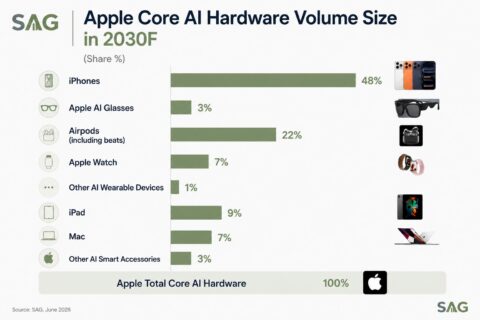
SAG forecasts annual sales of Apple-connected AI hardware will exceed 600 million units by 2030. This installed base gives Apple a unique ability to scale AI adoption while maintaining tight hardware-software integration and greater control over user experience than most competitors.
Exhibit 2: SAG Apple AI Hardware Device Annual Sales Volume by 2030F
3. Child Safety: An Underappreciated Strategic Move
One of the more interesting aspects of WWDC 2026 was the amount of time Apple dedicated to child safety and parental controls.
While these announcements received less attention than Apple Intelligence, they may prove strategically significant over the long term.
Apple’s child safety framework has evolved into a privacy-centric, system-wide protection model that relies heavily on local AI processing. Unlike Android’s more open ecosystem, Apple’s approach reinforces the value of an all-Apple household while limiting third-party access to sensitive user data.
For parents, digital safety increasingly influences device purchasing decisions.
As a result, these enhancements could strengthen ecosystem stickiness and support future iPhone, iPad, Apple Watch, and AirPods adoption among younger users and families.
Apple is cultivating users across multiple stages of life. Given the importance of younger demographics within Apple’s installed base, this represents a highly strategic long-term investment.
4. What Was Missing?
SAG noted several notable topics were absent from the keynote today.
Foldable iPhone software readiness
Apple did not discuss rumored iOS 27 optimizations for foldable devices, particularly the anticipated horizontal interface designed for the company’s upcoming foldable iPhone expected in late 2026. Apple may be reserving these announcements for its September hardware event.
Multi-agent AI strategy
Despite increasing industry focus on multi-agent systems, Apple avoided discussing broader agent orchestration capabilities. This likely reflects the company’s preference to move cautiously while prioritizing privacy and trust.
Post-app AI experiences
Apple’s AI strategy remains largely app-centric. While the broader industry is experimenting with post-app experiences and agent-driven workflows, Apple appears focused on evolving existing user behaviors rather than forcing radical changes.
Emerging market strategy
Although India and other emerging markets are becoming increasingly important contributors to Apple’s ecosystem growth, these regions received little attention during the keynote.
Leadership transition
New CEO John Ternus did not appear prominently during the event. Apple may be saving that moment for its September launch event, where SAG expects the company to unveil the iPhone 18 Pro series, foldable iPhone, camera-enabled AirPods, Apple Watch Series 12, and Apple Watch Ultra 3.
Key Areas to Watch Ahead
• Whether Apple can deliver Siri’s promised capabilities on schedule beginning in late 2026?
• How Apple navigates regulatory and privacy challenges in Europe and China?
• Whether iOS 27 introduces meaningful software optimizations for the upcoming foldable iPhone?
• How Apple evolves toward a multi-agent AI architecture without compromising its privacy-first approach?
• Whether Vision Intelligence becomes the foundation for Apple’s future AI smart glasses strategy?
SAG Takeaways
WWDC 2026 represented a meaningful step forward for Siri AI and Apple Intelligence, but the event was ultimately about much more than AI features.
Apple’s strategy remains centered on privacy, ecosystem integration, and user trust. These advantages are increasingly important as the industry moves toward agentic AI and AI-native devices.
As we pointed in WWDC 2026 Preview blog one last week, SAG believes that wearables and AI-native devices will play a growing role in personal computing. They will not replace smartphones overnight, but the device ecosystem will become increasingly decentralized as intelligence spreads across glasses, earbuds, watches, PCs, and other connected devices.
Apple remains fundamentally a hardware company, with hardware accounting for 72% of revenue in Q1 2026. That reality is unlikely to change in the near term. Instead, Apple will continue leveraging software and services to strengthen the value of its hardware ecosystem.
The larger question is whether consumers and enterprises ultimately value trust, privacy, and seamless ecosystem integration more than raw AI capability.
If the answer is yes, Apple may be uniquely positioned for the next phase of AI adoption.
The future AI race may be determined less by model benchmarks and more by which company can deliver intelligent experiences seamlessly across smartphones, PCs, tablets, watches, earbuds, and future AI wearables.
For Apple, ecosystem intelligence remains its most defensible advantage.