
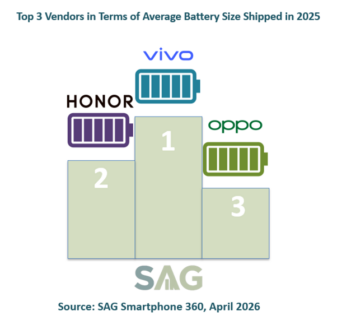
As per the findings from Smart Analytics Global (SAG) Smartphone 360 service, average size of battery shipped in a smartphone grew 11% YoY in 2025. This is the first year ever when the average battery size shipped crossed 5000 mAh. Vivo (IQOO) lead the chart followed by Honor and Oppo (OnePlus).
Exhibit 1: Top 3 Vendors with the Highest Smartphone Battery Capacity in 2025.
Silicon Carbon batteries played a key role in increasing the average battery size. At the quarter level, Q3 2025 was the first quarter when average battery size exceeded 5000mAh in a row and Q4 2025 was the second consecutive quarter for the same.
Brand Level Dynamics
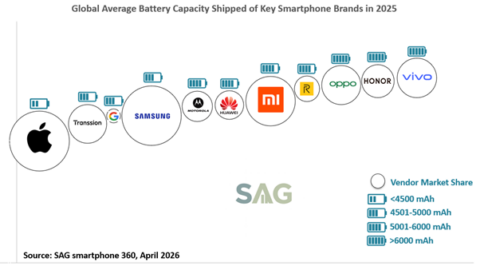
The average battery size of Vivo (IQOO) grew 18% YoY to cross the 6000 mAh mark in 2025. The growth in average battery size is driven by models from S series, Y500 series, iQOO Z series, T4, T4 Pro, etc. Vivo’s sub brand iQOO which targets the youth and gaming audience has contributed significantly.
Honor was the second vendor with average battery size of above 6000 mAh up 12% YoY. Despite it being the second, it deserves the special shoutout for debuting the Silicon Carbon tech in smartphones with Honor Magic 5 Pro back in 2023. Except for some entry level models, most of is portfolio has shifted to Silicon Carbon batteries. These include the number series, Magic slab phones as well as Magic V fold series, X series.
This is followed by Oppo (OnePlus) with average battery size in the range of 5500-6000 (refer the published report for exact number) growing 17% YoY. This is driven by models from Find X9 series, F31 series, A6 series, K13 series, etc. From the OnePlus portfolio, models like OnePlus Turbo 6v (9000 mAh), 6 (8300 mAh), Ace 6T (7800 mAh), 15, 15T contributed. All the mentioned models have adopted Silicon Carbon technology.
Exhibit 2: Global Average Battery Capacity Shipped of Key Smartphone Brands in 2025
Why are vendors opting for Silicon Carbon batteries?
As per our findings, battery is one of the key specs aside from camera, processor which many consumers look up to in a smartphone.
SAG estimates that roughly 6% smartphones shipped in 2025 were equipped with Silicon carbon batteries, led by Huawei, OPPO (OnePlus), vivo (IQOO) and Honor etc. Key selling models include Huawei Mate 70 and 80 series, Pura 80 series, Honor Magic 7 and 8 series, IQOO Number series and Nero and Z series, vivo’s X200 and X300 series, OPPO’s Reno 15 series and Find X8 series, OnePlus’s Ace series and number series, Motorola’s Razr 60 series and Edge 60 series.
Brands are opting for Silicon Carbon batteries for the following reasons.
Higher density batteries
Chinese vendors want to pack more power in a smartphone. To not make phone bulky and heavy like a brick, Silicon Carbon battery tech comes to the rescue. This way brands can pack in battery capacity as high as 10000 mAh in a normal form factor.
Slimmer foldable without a compromise on battery size
Not only this, but this tech also plays a key role in making the foldables slimmer. For example, Honor Magic V5 is 4.1mm thin and still able to pack 5820 mAh for an international unit. This is made possible through debit card like SiC battery packed in the foldable flaps of the phone. Similarly, we saw Vivo X Fold 5 and Oppo Find N6.
To support mobile gaming demand
Chinese vendors like Vivo (IQOO), Oppo want to be the first choice for gamers. For that to happen, having a good battery size and life is important. Silicon Carbon batteries come to the rescue here as consumers get a hig battery size phone without much increase in bulk and weight.
Use cases of higher capacity battery on a smartphone
There are multiple use cases for smartphones, but two of the most prominent today are mobile gaming and content creation. Even though dedicated gaming smartphones like those from ASUS (ROG series) have largely exited the market, gaming as a use case continues to grow strongly on mainstream devices. For these users, longer battery life is critical, enabling extended sessions on titles like Free Fire, PUBG Mobile, and Genshin Impact.
SAG Estimates on Gaming Smartphone Market
As gaming communities expand, demand is shifting toward smartphones that combine bigger batteries, strong processors, and better heat dissipation. At Smart Analytics Global (SAG), our tracking shows gaming smartphones remain niche—around 3% of global shipments in 2025—but the segment grew 40%+ YoY, significantly outpacing the overall market’s ~3% growth.
There’s also a clear correlation between battery capacity and mobile gaming smartphone share. As per SAG, Vivo (iQOO) led the gaming smartphone market in 2025 with 55% share, followed by Oppo (OnePlus), Honor, Xiaomi, and Realme. Notably, these brands also rank among the top in average battery capacity, reinforcing gaming as a key driver behind the shift toward larger batteries.
Why are few vendors still reluctant to use Silicon Carbon batteries?
Samsung, Apple, and Google are yet to adopt Silicon-Carbon (Si-C) batteries, largely due to cost and safety considerations.
Cost: Si-C batteries are roughly 20% more expensive than Lithium-Ion, driven by limited supply chains, complex nano-engineering, and lack of scale, making vendors cautious on BoM.
Safety: Silicon’s natural expansion brings risks like swelling, faster degradation, and potential thermal runaway if structural safeguards fail. While nano-structuring with carbon has largely mitigated these issues, and no major smartphone incidents have been reported but truly global brands are likely waiting for greater long-term validation before adopting it at scale.
Chinese OEMs are moving fast to solve this. Honor is increasing silicon ratios with thinner cells, Xiaomi is optimizing via in-house chips, and OnePlus uses nano-structured Si-C designs—enabling faster commercialization.
Also, bigger battery does not equal better battery life. Optimization matters more. For instance, Arun Maini (aka Mrwhosetheboss on YouTube) showed Samsung devices ranking near the top in endurance despite smaller batteries.
Battery becomes smartphones’ next big spec war as silicon-carbon adoption tops 10% in 2026
SAG Forecast on Battery Size and Technology
Smart Analytics Global (SAG) forecasts the global average smartphone battery capacity shipped in 2026 will exceed 5500mAh, marking another sharp jump as Chinese Android vendors aggressively push larger batteries across flagship and mid-tier portfolios.
SAG estimates silicon-carbon battery powered smartphones will account for more than 10% of global smartphone shipments in 2026, up from roughly 6% in 2025. What started as a flagship-led differentiation feature is now rapidly moving into broader commercial deployment, driven by the technology’s ability to deliver materially higher capacity without increasing device thickness.
Vendor Forecast Related to Battery
Chinese vendors including HONOR, OPPO, vivo, Xiaomi and Huawei are expected to remain the key force behind this expansion, steadily widening silicon-carbon adoption from premium models into upper mid-range and selected mass-market devices.
Samsung is expected to begin selective commercialization of silicon-carbon batteries in upcoming models as development progresses, though adoption will remain measured rather than portfolio-wide in the near term. Apple, meanwhile, is still taking a cautious approach given long-term durability, thermal management and cost considerations, making 2026 adoption unlikely.
Takeaway
The takeaway is clear: battery is becoming one of the most visible remaining hardware upgrade battlegrounds in smartphones. As annual camera, display and processor improvements generate less immediate consumer excitement than before, longer battery life is increasingly emerging as a spec users can instantly understand and value. Chinese OEMs have moved first, and pressure is now building on Apple and Samsung to respond.
Clients, please click here to access the published report.