
The recent leadership transition at Apple marks a strategic shift that extends beyond organizational structure and into the company’s future product roadmap. With Tim Cook moving into the role of Executive Chairman and John Ternus stepping in as CEO, Smart Analytics Global (SAG) views this transition as a signal of Apple entering a new phase of hardware-led innovation.
Leadership Continuity with Strong Hardware Focus
The transition is expected to be smooth. John Ternus has spent more than 20 years at Apple and has played a central role in hardware development across key product categories, including iPhone, Mac, and AirPods. His long tenure ensures continuity in execution while reducing operational risk during the leadership change.
Ternus’s engineering background suggests a continued emphasis on steady hardware execution and product refinement. Compared with more disruptive leadership styles, he is less likely to take large risks, which supports a more measured approach to innovation. This is likely to result in a more consistent product roadmap with fewer execution missteps, particularly as Apple expands into new hardware categories.
Hardware Innovation to Take Center Stage
Under the new leadership, SAG expects Apple to place greater emphasis on hardware innovation as a key growth driver. While Apple has historically taken a disciplined and incremental approach to product development, the next phase is likely to focus on refining form factors and expanding into adjacent device categories.
In particular, hardware innovation is expected to accelerate in the wearable segment. Areas of focus may include AI-enabled smart glasses and next-generation AirPods with integrated camera capabilities to support environmental sensing and enhanced voice interaction. These developments point toward a broader shift to context-aware and always-on computing experiences, where hardware plays a critical role in enabling AI use cases.
AI: Catching Up, but Not Yet a Replacement Driver
From an AI perspective, Apple is expected to continue catching up under the new leadership. However, SAG believes the near-term impact of AI will be more visible in new device categories such as AI smart glasses and Air pods etc. rather than in smartphones.
Despite significant industry focus, AI remains over-marketed in the smartphone segment. Current AI features have yet to become a primary driver for device replacement among mainstream users. Instead, hardware improvements and new form factors are expected to remain the key drivers of upgrade cycles in the near term.
Foldable iPhone: A Major Hardware Upgrade Cycle in 2H 2026
SAG expects Apple to enter the foldable smartphone segment in the second half of 2026 with a wide fold form fact that prioritizes usability, durability, and ecosystem integration. Consistent with Apple’s historical approach, the company is likely to focus on delivering a mature and refined device rather than an experimental design.
Exhibit 1: Global Foldable Smartphone by Form Factor Forecast
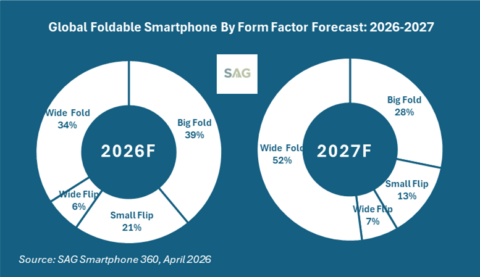
The foldable iPhone is expected to represent a meaningful hardware upgrade cycle for Apple, particularly in the premium segment. While AI features will be present, they are unlikely to be the primary driver of adoption. Instead, the combination of new form factor, improved user experience, and ecosystem integration will play a more significant role.
Competitive Landscape: From Innovation to Execution
The foldable market has so far been shaped by early movers such as Huawei and Samsung. Huawei has established itself as a pioneer with a full portfolio across four foldable form factors, while Samsung continues to lead in global scale and distribution.
Apple’s entry is expected to shift the competitive landscape. The focus will gradually move from form factor innovation toward execution quality, ecosystem strength, and pricing power. This transition marks the next phase of the foldable market, where scale and user experience become more important than early innovation.
SAG Forecast: Apple to Lead Foldable Market by 2027
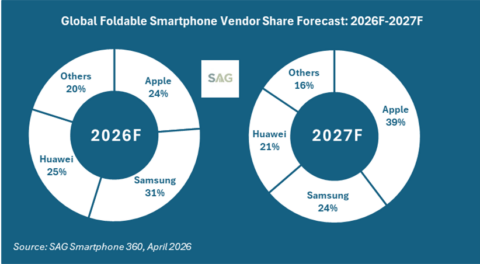
SAG expects Apple to rapidly scale its presence in the foldable segment following its market entry.
- 2026: Apple foldable share expected to remain below 25%, reflecting a late entry and limited launch window
- 2027: Apple projected to become the world’s largest foldable smartphone vendor, reaching nearly 40% market share
This growth will be driven by Apple’s strong ecosystem, premium positioning, and global distribution capabilities. However, increased competition from Huawei, Samsung, and other OEMs will continue to intensify the market environment.
Exhibit 2: Global Foldable Smartphone Vendor Share Forecast
Conclusion
Apple’s leadership transition signals more than a management change. It reflects a shift toward a new hardware cycle, where innovation in form factors and device categories will play a central role.
While AI will continue to evolve, hardware remains the primary driver of user adoption in the near term. The introduction of a foldable iPhone in 2026 is expected to mark a key milestone, both for Apple and for the broader smartphone industry.
From SAG’s perspective, the foldable market is entering a new phase, transitioning from early innovation to large-scale competition. Apple’s entry will accelerate this shift and reshape the competitive dynamics across the premium smartphone segment over the next several years.