
Key Takeaways
- Agibot is accelerating its global expansion by positioning Western Europe as its highest-priority overseas market, following recent launches in Germany and the UK.
- Localized partnerships and Robot-as-a-Service (RaaS) will become key competitive differentiators, helping accelerate customer adoption and ecosystem development across Europe.
- Industrial applications will remain the primary growth engine for humanoid robots, despite increasing adoption in education, entertainment, and commercial demonstrations.
- SAG expects Agibot to remain the world’s second-largest humanoid robot vendor by shipments in 2026, while maintaining its industry-leading revenue position through its premium industrial product portfolio.
- The global humanoid robotics industry is entering a new commercialization phase, supported by Agility Robotics’ IPO, Unitree’s expected IPO in Q3 2026, and China’s large-scale industrial deployment initiatives.
- Chinese robotics vendors are rapidly expanding into overseas markets, with Europe emerging as one of the most important battlegrounds for global growth.
- SAG believes future success will depend on localized partnerships, software ecosystems, and scalable commercial deployment, while Chinese vendors should prepare to operate dual-market strategies—one optimized for China and another tailored to overseas markets amid an increasingly fragmented global robotics ecosystem.
Agibot hosted its APC 2026 launch event in London this week, marking another important milestone in the company’s international expansion strategy. SAG closely followed the event and believes the launch reflects the company’s growing ambition to become one of the leading global humanoid robotics suppliers. Below are SAG’s key observations and market implications.
Western Europe Has Become Agibot’s Top Overseas Market
SAG believes Western Europe has become Agibot’s highest-priority overseas market. The London launch follows the company’s official European debut in Munich in February 2026, where Agibot announced a strategic partnership with Minth Group. Beyond serving as Agibot’s European distribution partner, Minth will also leverage its manufacturing footprint across Europe to provide localized system integration and after-sales support.
Earlier this year, Agibot also showcased multiple humanoid and quadruped robots at MWC Barcelona, further increasing its visibility among European enterprises, developers, and ecosystem partners. SAG believes Agibot is executing a structured localization strategy rather than simply exporting robot hardware into overseas markets.
Local Partnerships and Robot-as-a-Service Will Accelerate Market Adoption
One of the most notable aspects of Agibot’s European strategy is its emphasis on building a localized robotics ecosystem. Rather than focusing solely on hardware sales, the company is working closely with local partners to establish Robot-as-a-Service (RaaS) capabilities, enabling enterprises, educational institutions, and consumers to access its robotics solutions with lower upfront investment.
Exhibit 1: Agibot London APC 2026 Launch Event
Image source: Agibot
During the London event, Agibot also introduced its new A3 full-sized humanoid robot, targeting education, entertainment, exhibitions, and commercial demonstrations. The company further announced a robot leasing business model, which has become increasingly popular in China over the past year.
SAG believes robot leasing and RaaS will play an important role in helping more customers experience humanoid robots while accelerating brand awareness and ecosystem development across Europe.
Industrial Applications Will Continue to Drive Commercialization
Although education and public demonstrations remain important for increasing awareness, SAG believes industrial deployment will remain the largest commercial opportunity for humanoid robots over the coming years.
Agibot’s growing cooperation with European automotive manufacturers and industrial partners demonstrates that the company remains focused on scalable commercial deployments. Manufacturing, logistics, warehousing, and factory automation continue to offer the clearest return on investment and will remain the primary drivers of humanoid robot adoption throughout this decade.
Agibot Continues to Narrow the Gap with Unitree
SAG estimates Unitree remained the world’s largest humanoid robot vendor by shipments in 2025, while Agibot ranked second globally with approximately 33% market share, just behind Unitree’s 34%.
SAG expects this competitive ranking to remain unchanged during 2026. However, Agibot’s aggressive European expansion, localized partnership strategy, and increasing industrial deployments are expected to further narrow the competitive gap with Unitree.
Exhibit 2: Global Humanoid Robot Vendor Share: 2025-2026F
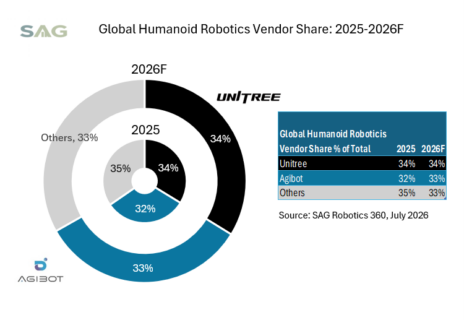
While Unitree continues to lead global shipments, Agibot generated the industry’s highest revenue in 2025, benefiting from its focus on premium full-sized humanoid robots designed for industrial applications. SAG expects Agibot to maintain its revenue leadership over the next several years as enterprise adoption accelerates.
The Global Humanoid Robotics Industry Is Entering a New Commercialization Phase
SAG believes 2026 marks a turning point for the humanoid robotics industry as commercialization accelerates worldwide.
Several major industry developments underscore this transition, including Agility Robotics’ successful IPO, Unitree’s expected IPO in Q3 2026, and China’s ambitious target of deploying approximately 10,000 industrial humanoid robots by the end of 2026. In addition, Agibot’s expansion into Europe reflects a broader industry trend as Chinese robotics companies increasingly pursue global growth opportunities beyond their domestic market.
SAG forecast global humanoid robot shipment volume will see a triple digit growth in 2026.
Geopolitics Will Reshape the Global Robotics Landscape
While the long-term growth outlook remains highly positive, SAG believes geopolitical competition between the United States and China will become one of the defining factors shaping the robotics industry over the next decade.
As technology regulations, supply chains, AI platforms, and software ecosystems continue to diverge, the industry is likely to evolve into two relatively independent ecosystems, one centered on China and the other serving overseas markets.
For Chinese robotics companies, global expansion will require much more than exporting products. Success will increasingly depend on building strong partnerships with local distributors, system integrators, software developers, and enterprise customers in overseas markets. At the same time, vendors should prepare to operate dual operating models in the future—one optimized for the Chinese domestic market and another tailored to international markets with localized software, services, compliance, and ecosystem partnerships.
SAG Perspective
Linda Sui, Founder of Smart Analytics Global (SAG), commented:
“Agibot’s London event demonstrates that Chinese robotics companies are entering a new phase of global expansion. Success will increasingly depend on localized partnerships, software ecosystems, and scalable commercial deployment. While Unitree continues to lead global shipments, Agibot is rapidly strengthening its competitive position through industrial-focused solutions and strategic expansion across Europe. Looking ahead, Chinese robotics vendors should prepare to build localized ecosystems and operate dual-market strategies to compete effectively in both China and overseas markets.”