
Key Takeaway:
- Agility Robotics’ US$2.5 billion public listing today marks an important milestone for the humanoid robotics industry, providing additional capital to accelerate commercialization and manufacturing scale.
- SAG’s robotics 360 service forecasts Agility’s Digit deployments remain in hundreds of units during 2026. Following the IPO, next-generation deployments could expand into the thousands of units over the next 12–24 months as production scales.
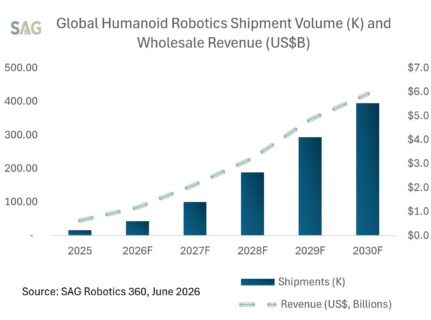
- SAG forecasts the global humanoid robot market will grow at a CAGR of more than 70% over the next five years, with annual shipments approaching 100,000 units by 2027. Industrial applications are expected to account for the majority of early demand.
- Chinese authorities have established a target of deploying around 10,000 industrial humanoid robots in manufacturing environments by the end of 2026.
- Competition between the United States and China is becoming fierce for the industry. China is focusing on manufacturing scale and deployment volume, while U.S.-based companies are leveraging capital markets, advanced AI computing platforms, and strategic partnerships to accelerate commercialization.
- The next phase of the humanoid robotics industry will be determined by scale, cost reduction, and proven ROI rather than technology demonstrations alone.
Agility Robotics today announced plans to go public through a SPAC merger valued at approximately US$2.5 billion. For the humanoid robotics industry, the transaction is significant because it reflects increasing investor confidence in the long-term commercial potential of humanoid robots.
At Smart Analytics Global (SAG), we believe industrial and manufacturing applications will remain the primary growth driver for humanoid robots over the next several years. While home service robots continue to attract attention, large-scale deployment in consumer environments still faces challenges related to safety, reliability, regulation, and affordability.
Why Manufacturing Remains the Key Opportunity
Factories provide a more structured environment for humanoid robots and face ongoing labor shortages in many regions. However, successful deployment ultimately depends on economics rather than technology alone.
For humanoid robots to scale, they must demonstrate a clear return on investment (ROI) compared with human labor and existing automation solutions. Higher production volumes can help reduce hardware costs, improve reliability, and accelerate adoption.
According to SAG’s robotics 360 service, global deployments of Agility Robotics’ Digit robots remain in the hundreds of units during 2026. Following the IPO, additional funding could support faster manufacturing expansion and broader deployment of future Digit generations (v5) over the next two years, to reach thousands by 2027.
Robotics Help Bringing Manufacturing Back to the U.S.
The growth of industrial robotics may also support efforts to bring manufacturing back to the United States and other developed markets. As labor costs rise and geopolitical uncertainties increase, manufacturers are looking for ways to improve domestic production efficiency.
Humanoid robots have the potential to complement existing automation systems and reduce dependence on manual labor in selected manufacturing tasks. While it remains early for the industry, robotics could become an increasingly important component of future manufacturing strategies.
Growing Competition Between the United States and China
SAG forecasts the global humanoid robot market will grow at a CAGR of more than 70% over the next five years. Global annual shipments are expected to approach 100,000 units by 2027, with industrial applications accounting for the majority of demand.
Exhibit 1: Global Humanoid Robot Volume and Value Forecast
At the same time, competition between the United States and China is becoming increasingly visible.
China continues to accelerate humanoid robot development through government support, local manufacturing strength, and large-scale pilot deployments. As part of its industrial development roadmap, Chinese authorities have established a target of deploying around 10,000 industrial humanoid robots in manufacturing environments by the end of 2026, placing significant emphasis on industry-wide adoption and scaling.
Meanwhile, Agility Robotics has built partnerships across several key technology hubs. The company benefits from support across the United States, Europe, Japan, and Taiwan, including collaborations involving NVIDIA, Amazon, Schaeffler, SoftBank, and Foxconn etc.
SAG Takeaway
The humanoid robotics industry is moving from early pilot projects toward broader commercial deployment. However, the market remains at an early stage, and large-scale adoption will depend on cost reduction, reliability improvements, and proven ROI.
The competitive landscape is also becoming increasingly influenced by geopolitical factors. China is focusing on rapid deployment and manufacturing scale, while U.S.-based companies are leveraging capital markets, advanced semiconductor technologies, and strategic partnerships.
Over the next several years, the key question will be whether they can deliver measurable economic value at scale.
Clients please click here to access SAG humanoid robot forecast report in details.