
San Francisco, September 15, 2026 – Samsung A Series overtook Apple’s latest iPhone 17 series to become the world’s best-selling smartphone product family in Q2 2026, according to the latest research from Smart Analytics Global (SAG)’s Smartphone 360 service.
Key Takeaways
- Samsung A Series became the world’s No. 1 smartphone product family in Q2 2026, capturing 18% of global shipments and growing 11% YoY.
- Apple iPhone 17 Series ranked No. 2 with 16% share and grew 24% YoY, with iPhone 17, iPhone 17 Pro Max and iPhone 17 Pro taking the top three positions among individual smartphone models.
- Mass-market Android families faced increasing pressure, with Xiaomi Redmi, vivo Y, OPPO A, Honor X, POCO and Lenovo-Motorola G all declining YoY.
- Huawei bucked the broader trend, with Nova Series growing 19% YoY and Changxiang Series surging around 94%.
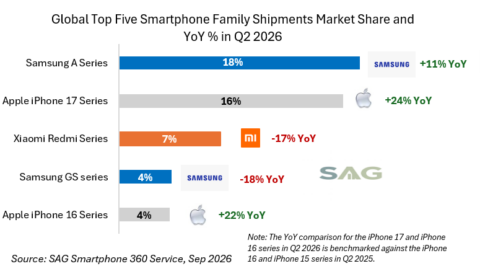
Samsung A Series captured 18% of global smartphone shipments and grew 11% YoY, while Apple iPhone 17 Series ranked second with 16% share and 24% YoY growth. Xiaomi Redmi Series ranked third with 7% share, followed by Samsung Galaxy S Series and Apple iPhone 16 Series, each with around 4%.
Exhibit 1: Global Top Five Smartphone Families: Market Share and YoY % in Q2 2026
The results come as the global smartphone market faces increasing pressure from higher memory and component costs. SAG’s broader Q2 research shows that weakness has been concentrated in lower price tiers, while premium demand has remained considerably more resilient.
“The Q2 results show two different ways to win in a difficult smartphone market,” said Linda Sui, Founder and Chief Analyst at Smart Analytics Global (SAG). “Samsung is aggressively protecting volume and market share through its broad A-Series portfolio, even at the expense of profitability, while Apple continues to benefit from strong premium demand. However, the dynamics could change in 2H 2026. Higher prices for the iPhone 16 and 17 Series could pressure demand, particularly in emerging markets, while the new iPhone 18 Pro Series faces a tough comparison with last year. Whether premium demand can remain resilient will be a key trend to watch.”
Samsung A Series was the clear standout in the mass market. Galaxy A17 5G was the family’s leading model, while Galaxy A16 4G, A56 5G, A17 4G and A07 5G also delivered strong volumes. Samsung’s strategy has become increasingly clear: prioritize shipment volume and market share while many Chinese competitors become more conservative in lower price tiers. Samsung’s broad geographic reach and stronger ability to manage component costs have given it greater flexibility to compete aggressively on price, although this strategy comes with profitability pressure. The broader industry data also point to Samsung gaining ground in the budget segment as Chinese vendors reduce product lineups and raise prices.
Apple iPhone 17 Series remained exceptionally strong at the premium end, growing 24% YoY to capture 16% of global shipments. iPhone 17, iPhone 17 Pro Max and iPhone 17 Pro were the three best-selling individual smartphone models globally in SAG’s Q2 shipment database, while iPhone 17e was another important contributor. iPhone 17 Pro Max was particularly well received in major premium markets including the US and China, while iPhone 17e performed well in Japan. SAG’s broader Q2 research found that the 17e slightly exceeded expectations and was well received in both the US and Japan.
Xiaomi Redmi Series remained the third-largest smartphone family globally with 7% share, but declined 17% YoY. Redmi 13C, Redmi K90 Max, Redmi 12C and Redmi Turbo 4 were among its major volume contributors. Redmi’s performance highlights the pressure facing value-focused Android portfolios as higher memory and component costs make it increasingly difficult to maintain low prices and healthy margins at the same time.
Samsung Galaxy S Series captured around 4% global share and declined 18% YoY. The Galaxy S26 generation had a solid start in Q1 2026, but momentum weakened in Q2 as the initial launch effect faded. Galaxy S26, S26 Plus and S26 Ultra were key contributors, while Galaxy S25 FE continued to generate meaningful volume. The softer family performance contrasts with Samsung A Series and shows the difficulty of sustaining premium Android flagship momentum throughout the product cycle.
Apple iPhone 16 Series also held around 4% global share and grew 22% YoY compared with the iPhone 15 generation a year earlier. iPhone 16 remained the family’s leading model. Its continued strength after the launch of the iPhone 17 generation demonstrates the unusually long commercial lifecycle of Apple’s smartphones.
Outside the Top Five, weakness was widespread among mass-market Android families. vivo Y series and OPPO A series each declined around 18% YoY, Honor X series fell 24%, Xiaomi POCO family dropped around 40%, and Lenovo-Motorola G series declined around 35%. These families have greater exposure to price-sensitive consumers, making them more vulnerable to rising component costs and higher retail prices.
Huawei was one of the notable exceptions. Huawei Nova Series grew 19% YoY and 36% QoQ, supported by models including Nova 16, Nova 15 and Nova 15 Pro. Huawei Changxiang Series delivered even stronger growth of around 94% YoY, supported by products including Changxiang 90 Pro Max and Changxiang 90 Plus. The performance reflects Huawei’s continued momentum in China and its expanding coverage across different price tiers.
What to Watch in 2H 2026
Looking into 2H 2026, a key question is whether premium smartphones can maintain their strong momentum. SAG expects combined shipments of the new iPhone 18 Pro and Pro Max to decline by double digits versus the iPhone 17 Pro generation. With no new basic iPhone 18 this year, Apple will rely more heavily on the iPhone 17 Series to support mainstream volume, while some premium demand will shift to the new iPhone Duo.
Pricing is another key factor to watch. Rising memory and component costs are pushing smartphone prices higher, and price increases for the iPhone 17 and 16 Series could hurt demand, particularly in price-sensitive emerging markets. SAG will closely monitor whether premium demand remains resilient in 2H 2026 as affordability pressure spreads across the market.
SAG clients please click here to access the full report, covering global top 30 families and top 300 best-selling smartphone models in Q2 2026.