
SAN FRANCISCO, August 16, 2026 — According to the latest Smart Analytics Global (SAG) Robotics 360 research, global quadruped robot shipments reached approximately 26,000 units in 1H 2026, growing 75% year over year from 14,800 units in 1H 2025. Unitree remained the clear global leader with 52% shipment share, although its share declined sharply from 75% in 1H 2025, as second-tier vendors expanded rapidly across both consumer and industrial applications.
Key Takeaways
- Global quadruped robot shipments reached approximately 26K units in 1H 2026, up 75% YoY from 14.8K units in 1H 2025.
- Unitree remained the clear No. 1 vendor with 52% shipment share, down from 75% a year earlier, as competition intensified and second-tier vendors including DEEP Robotics, Vbot, DOBOT and AiMOGA gained ground.
- Consumer applications accounted for approximately 45% of global quadruped robot shipments, up significantly from 33% in 1H 2025, becoming the largest application segment.
- Chinese vendors accounted for approximately 93% of global shipments, down from 96% in 1H 2025. However, China itself consumed approximately 76% of global quadruped robot shipments, up from 74%, supported by surging consumer demand.
- SAG expects global quadruped robot shipments to approach 60K units in 2026 and approach 500K units by 2030.
- Unlike humanoid robots, where enterprise applications are expected to remain the primary commercialization path over the next five years, consumer applications are expected to remain the largest volume opportunity for quadruped robots, while industrial and professional deployments continue to expand.
“Quadruped robots are following a distinctly different commercialization path from humanoid robots. Consumer applications are already the largest use case by shipment volume, accounting for approximately 45% of global shipments in the first half of 2026, up sharply from 33% a year earlier,” said Linda Sui, Founder and Principal at Smart Analytics Global (SAG).
“Rapid price declines, improved mobility and intelligence, and a growing range of general-purpose consumer products are helping quadruped robots move beyond research laboratories and industrial environments. However, broader consumer adoption will depend on whether vendors can develop more compelling everyday use cases while further improving battery life, autonomy, reliability and affordability.”
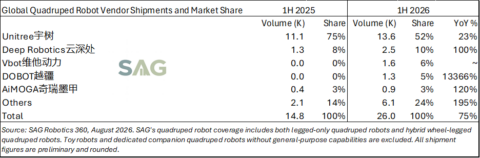
Exhibit 1: Global Quadruped Robot Shipments and Vendor Share: 1H 2025 vs. 1H 2026
Unitree Remains Clear No. 1, but Loses Share
Unitree remained the world’s largest quadruped robot vendor in 1H 2026, shipping approximately 13,600 units, up 23% YoY, although its share fell sharply from 75% to 52% as competition intensified. Its Go series continued to drive consumer volume, while the company expanded further into industrial applications.
DEEP Robotics ranked second with 2,500 units and 10% share, doubling YoY, primarily driven by industrial and professional applications. Vbot and DOBOT captured 6% and 5% share, respectively, benefiting from rising consumer demand.
AiMOGA, backed by Chinese EV maker Chery, captured 3% share, primarily targeting enterprise applications while expanding into the consumer market. SAG expects more automakers, including BYD and XPENG, to explore robotics by leveraging their strengths in batteries, motors, AI, supply chains and manufacturing.
Other vendors increased their combined share from 14% to 24%, highlighting the rapid diversification of the global quadruped robot market.
Consumer Leads Quadruped Applications, While Industrial Demand Expands
SAG estimates that consumer applications accounted for approximately 45% of global quadruped robot shipments in 1H 2026, up from 33% in 1H 2025, becoming the largest application segment. Growth was particularly strong in China, driven by lower prices and a growing range of advanced consumer quadrupeds supporting autonomous navigation, human following, interaction and task execution. Emerging use cases include home companionship and monitoring, outdoor activities and autonomous photography.
Industrial and professional applications remained the second-largest segment, spanning inspection, emergency response, public safety, security and defense. Vendor strategies are increasingly diverging: Vbot and DOBOT are more consumer-focused, while DEEP Robotics and other specialist vendors concentrate on industrial and professional applications. Unitree spans both markets, while AiMOGA, backed by Chery, primarily targets enterprise applications while expanding into consumer use cases. Industrial quadrupeds also carry significantly higher ASPs, making their revenue contribution substantially higher than their unit share.
The consumer market nevertheless remains at an early stage. Broader adoption will require more compelling everyday use cases, longer battery life, improved autonomy and reliability, and lower prices. SAG excludes toy robots and dedicated companion robots without broader general-purpose capabilities and purely wheeled robots.
China Demand Accelerates While Chinese Vendors Remain Dominant
China accounted for approximately 76% of global quadruped robot shipments in 1H 2026, up from 74% a year earlier, primarily driven by surging consumer demand, lower prices and expanding product availability.
Meanwhile, Chinese vendors accounted for 93% of global shipments, down from 96% in 1H 2025. The contrasting trends highlight China’s strengthening domestic demand while competition from non-Chinese vendors gradually increases globally.
SAG expects China to remain the world’s largest quadruped robot market and Chinese vendors to remain dominant globally but gradually lose share, as non-Chinese players expand and geopolitical restrictions reshape competition, particularly in security-sensitive industrial, government and defense applications.
Geopolitics Could Reshape Global Competition
Tighter US restrictions on foreign-made advanced robots could limit Chinese vendors’ expansion in the US while creating opportunities for Western suppliers such as Boston Dynamics and Ghost Robotics etc.
However, tighter restrictions could also create supply-chain challenges for Western robot makers that rely on Chinese components or manufacturing support. Further localization could raise costs and require alternative suppliers, making geopolitics an increasingly important factor in vendor strategies and regional market shares.
SAG Forecasts Quadruped Shipments to Approach 500K by 2030
SAG expects global quadruped robot shipments to approach 60K units in 2026 and 500K units by 2030. Consumer applications are expected to remain the largest volume segment over the next five years, while industrial and professional deployments continue to scale.
The commercialization path differs fundamentally from humanoid robots. Quadrupeds are scaling consumer-first, while humanoids are expected to scale enterprise-first. SAG forecasts humanoid robot shipments to approach 500K units by 2030, with industrial and commercial applications remaining the key growth engine over the next five years.
Combined, SAG expects general-purpose humanoid and quadruped embodied AI robot shipments to approach one million units annually by 2030.
For consumer quadrupeds, broader adoption will depend on more compelling everyday use cases, longer battery life, greater autonomy and reliability, and lower prices. For industrial quadrupeds, reliability, safety, integration and measurable ROI will remain critical.
SAG Definitions
Humanoid Robots: SAG defines humanoid robots as embodied AI robots designed around the human body form and capable of performing general-purpose physical tasks in human environments. SAG coverage includes full-size and half-size bipedal humanoid robots, wheeled humanoid robots, and highly biomimetic humanoid robots. Dedicated single-purpose service robots, including restaurant/hotel delivery robots and cleaning robots, as well as toy robots, are excluded.
Quadruped Robots: SAG defines quadruped robots as embodied AI robots with four articulated legs, covering both legged-only and hybrid wheel-legged quadruped robots. Toy robots, dedicated companion robots without broader general-purpose capabilities, and purely wheeled robots without articulated legs are excluded.