
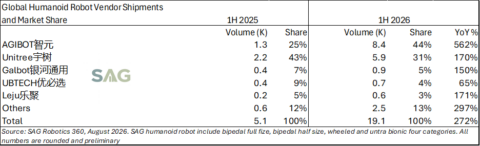
SAN FRANCISCO, August 10, 2026 — According to the latest SAG Robotics 360 research from Smart Analytics Global (SAG), global humanoid robot shipments reached approximately 19,100 units in 1H 2026, surging 272% year over year from 5,100 units in 1H 2025. The market also experienced a notable leadership shift, with AGIBOT overtaking Unitree to become the world’s largest humanoid robot vendor.
Key Takeaways
- Global humanoid robot shipments surged 272% YoY to 19.1K units in 1H 2026, up from 5.1K units a year earlier.
- AGIBOT overtook Unitree for the No. 1 position, capturing 44% global shipment share, compared with Unitree’s 31%. Together, the two vendors accounted for approximately 75% of global shipments.
- Industrial and commercial applications accounted for more than 70% of humanoid robot shipments in 1H 2026, up from approximately 50% in 1H 2025, and will remain a key path toward meaningful market scale.
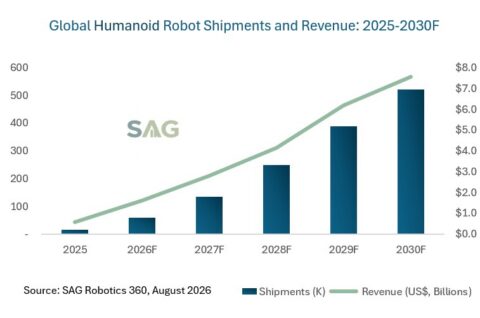
- SAG expects global humanoid robot shipments to approach 60K units in 2026, nearly tripling YoY, with industry revenue reaching approximately US$1.6 billion.
- Geopolitical and regulatory risks are rising as the industry expands, potentially affecting overseas market access, deployment requirements and the competitive landscape.
“Global humanoid robot shipments nearly quadrupled in 1H 2026, but an equally important shift is taking place in how these robots are being deployed. Industrial and commercial applications accounted for more than 70% of shipments, up from approximately 50% a year earlier,” said Linda Sui, Founder and Principal at Smart Analytics Global (SAG). “At the same time, new segments such as ultra-bionic humanoid robots targeting human interaction and emotional companionship are emerging, although their commercial potential remains to be proven. Regulatory uncertainty around highly human-like robots and AI interactions, together with rising geopolitical risks, could also become increasingly important factors shaping the industry’s next phase of growth.”
Exhibit 1: Global Humanoid Robot Shipments and Vendor Share: 1H 2025 vs. 1H 2026
AGIBOT Takes the Lead as Vendor Competition Intensifies
AGIBOT shipped approximately 8,400 humanoid robots in 1H 2026, up 562% YoY, lifting its global shipment share from 25% in 1H 2025 to 44% and moving ahead of Unitree for the No. 1 position.
Its growth was supported by a diversified portfolio spanning full-size bipedal A-series, half-size bipedal X-series and wheeled G-series robots. Industrial and commercial applications represent a major deployment focus. The company is also accelerating international expansion, particularly in Europe, with products already deployed in markets including the UK and Germany.
Unitree moved to second place despite delivering strong growth, with shipments rising 170% YoY to approximately 5,900 units, representing 31% global share. Half-size bipedal robots dominate its humanoid portfolio, led by the G1 hero model, whose cumulative manufacturing volume reached approximately 11,000 units by mid-2026. Unlike AGIBOT and several other leading vendors, research, education and performance-related applications continue to represent a meaningful portion of Unitree’s deployments.
Galbot ranked third with approximately 900 units shipped, focusing primarily on wheeled humanoid robots for industrial and commercial applications. Its strategy highlights the growing role of wheeled designs in structured working environments where mobility, stability and cost can take priority over fully human-like locomotion.
UBTECH ranked fourth with approximately 700 units, mainly driven by its full-size bipedal Walker series targeting industrial and commercial applications. The company is also expanding into wheeled robots, while SAG expects its newly introduced U-series ultra-bionic robots to become an increasingly important part of its portfolio in 2H 2026.
Leju rounded out the top five with approximately 600 units shipped. SAG’s estimates include only the KUAVO series, excluding Aelos and Roban as these products do not meet SAG’s definition of functional embodied humanoid robots.
The remaining market remains fragmented, with a long tail of vendors including Fourier, NOETIX, Agility Robotics and others.
Industrial Adoption Will Be Key to Scaling the Market
SAG estimates industrial and commercial applications represented more than 70% of global humanoid robot shipments in 1H 2026, up from approximately 50% in 1H 2025. Manufacturing, logistics, warehousing and other structured commercial environments are becoming the primary path toward commercialization, where robots can perform more defined tasks and demonstrate measurable productivity and economic value.
Meanwhile, new use cases are emerging, particularly ultra-bionic humanoid robots targeting human interaction and emotional companionship. However, meaningful adoption remains to be proven given current costs, technology limitations, consumer acceptance, as well as potential ethical and regulatory concerns surrounding highly human-like robots and AI interactions.
Broad home-service humanoid robots remain a longer-term opportunity, given the complexity and unpredictability of household environments. SAG does not expect general-purpose home-service humanoid robots to reach meaningful mass-market scale within the next five years.
Technology Maturity Remains a Barrier
Despite rapid shipment growth, humanoid robot hardware is scaling faster than the underlying technology maturity. Challenges around real-world training data, AI model capabilities, reliability, manipulation accuracy, safety and cost continue to constrain broader deployment.
Technologies including Vision-Language-Action (VLA) models and world models are advancing rapidly but remain at relatively early stages. Moving from “robots that can demonstrate” toward “robots that can reliably work” will be critical to unlocking broader commercial adoption.
China Remains the Center of the Current Humanoid Robot Ecosystem
China remains the center of the current humanoid robotics boom. Chinese vendors contributed more than 97% of global humanoid robot shipments in 1H 2026, while China represented more than 85% of global demand, according to SAG estimates.
Government support and industrial policies, abundant funding, expanding manufacturing capacity and an emerging IPO wave are supporting the development of the domestic robotics ecosystem. Meanwhile, Physical AI is attracting robotics startups, major technology companies and a growing number of automakers.
China’s large manufacturing ecosystem is also providing humanoid robot developers with opportunities to test and deploy robots in industrial environments, potentially accelerating the transition from prototypes and pilot projects toward larger-scale commercial deployment.
Geopolitics Emerges as an Important Uncertainty
Geopolitical risk is becoming another important variable for the humanoid robotics industry. Recent US restrictions on foreign-made robots could create headwinds for Chinese vendors seeking to expand into mature overseas markets, particularly as intensifying competition in China encourages leading vendors to pursue international growth.
The impact could vary significantly by vendor depending on geographic exposure, customer mix and international expansion strategy. Restrictions could also influence supply chains, partnerships and investment decisions while potentially creating opportunities for robotics companies based outside China.
It remains to be seen how US restrictions and broader geopolitical tensions will affect individual vendors and potentially reshape the competitive landscape of the global humanoid robotics market.
SAG Forecasts Global Humanoid Robot Shipments to Approach 60K Units in 2026
SAG expects global humanoid robot shipments to approach 60,000 units in 2026, nearly tripling year over year. The industry is forecast to generate approximately US$1.6 billion in revenue in 2026, rising to nearly US$3 billion in 2027.
Looking further ahead, SAG expects global humanoid robot shipments to reach 500K units by 2030, as industrial and commercial deployments expand, and the technology gradually moves toward broader real-world adoption.
Exhibit 2: Global Humanoid Robot Shipments and Revenue Forecast: 2025-2030F
While rapid shipment growth demonstrates strong momentum across the ecosystem, SAG believes the industry’s next phase will increasingly be defined by commercial adoption rather than hardware volume alone.
Industrial deployment, AI capabilities, reliability, manufacturing scale, cost reduction and the ability to demonstrate measurable economic value will become increasingly important competitive differentiators. Meanwhile, emerging categories such as ultra-bionic companion robots could open new opportunities, but their ability to develop into meaningful volume markets remains to be seen.
SAG clients please click here to access the comprehensive excel report, covering quarterly global humanoid robot shipments, trade wholesale revenue, ASP, shipment share, and revenue share by vendor and product type from Q1 2025 through Q2 2026. It covers 14 leading vendors, including Unitree, AGIBOT, Galbot, UBTECH, Boston Dynamics, and Agility etc., across full-size bipedal, half-size bipedal, wheeled, and ultra-bionic humanoid robots. A pivot table and flat file are included to enable flexible, customized analysis.