
SAN FRANCISCO, November 8, 2026 — According to the latest research from Smart Analytics Global (SAG) Robotics 360 service, global humanoid robot shipments surged 347% year over year (YoY) to 16,500 units in Q3 2026. AGIBOT maintained its global leadership, while UBTech overtook Unitree to become the world’s second-largest humanoid robot vendor, driven by accelerating industrial adoption, expanding product portfolios and manufacturing capacity ramp-ups.
China continued to dominate the emerging industry, with Chinese vendors accounting for approximately 97% of global shipments and China representing 87% of worldwide humanoid robot consumption.
Executive Summary
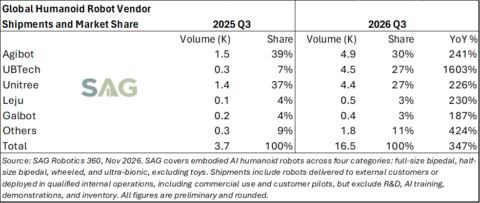
- Global humanoid robot shipments reached 16.5K units in Q3 2026, up 347% YoY. AGIBOT retained the No. 1 position with 30% share, followed by UBTech and Unitree, each capturing approximately 27%.
- UBTech emerged as the fastest-growing major vendor, with shipments increasing approximately 17-fold YoY, supported by its expanding industrial customer base, new products and manufacturing capacity ramp-ups.
- China accounted for 87% of global humanoid robot consumption, up from 85% in 1H 2026, while Chinese vendors maintained 97% global shipment share.
- Full-size bipedal humanoid robots increased their shipment share to 47%, up from 38% in Q3 2025, while half-size bipedal robots declined from 49% to 36%, reflecting accelerating industrial and commercial adoption.
- SAG forecasts global shipments to reach 54K units in 2026 (+277% YoY) and 86K in 2027 (+59%), with industry revenue reaching US$1.9 billion and US$2.8 billion, respectively.
AGIBOT Leads Global Market While UBTech Surpasses Unitree As No. 2
AGIBOT maintained its No. 1 position in Q3 2026, shipping 4,900 humanoid robots, capturing 30% global share. Its balanced product portfolio, including full-size bipedal A-series, half-size X-series and wheeled G-series, supports a broad range of industrial, commercial, research and education applications.
UBTech delivered the strongest growth among leading vendors, with shipments surging 1,603% YoY to 4,500 units, representing 27% global share, up from 7% a year earlier. The company overtook Unitree to become the world’s No. 2 humanoid robot vendor.
UBTech’s growth was supported by its expanding industrial customer base, particularly automotive manufacturers, alongside its diversified product portfolio. Newly introduced Cruzr Y1, Walker C1 and UWORLD U1 ultra-bionic robots, together with established Walker S2, Cruzr S2 and other humanoid platforms, broadened its industrial and commercial coverage.
Manufacturing capacity ramp-ups in Shenzhen and Liuzhou during Q3 further supported UBTech’s shipment expansion. The company’s industrial applications include automotive manufacturing, electronics assembly, material handling, logistics and factory automation.
Unitree ranked third, shipping approximately 4,400 units and capturing 27% global share, down from 37% a year earlier. Its G1 series remained the primary volume contributor, complemented by the affordable R1 and R1 Air and higher-end H2 series.
While Unitree retains competitive advantages in motion control, hardware integration and pricing, its commercial exposure remains relatively concentrated in research, education, entertainment and developer-oriented applications. SAG believes expanding into industrial manufacturing, logistics and other productivity-driven applications will be increasingly important for Unitree’s next phase of growth.
Leju and Galbot rounded out the top five, each capturing approximately 3% share.
Leju continued expanding its industrial footprint through KUAVO 5 and wheeled KUAVO 5-W, targeting automotive, home appliance manufacturing, material handling and logistics customers.
Galbot focused on wheeled humanoid robots for commercial and industrial applications. Its Galaxy Space Capsule retail network continued expanding across China, while Galbot S1 gained traction in industrial manufacturing, including battery production applications.
Other emerging vendors, including RobotEra and Fourier Intelligence etc., continued developing specialized applications in logistics, industrial manufacturing, healthcare and rehabilitation.
Exhibit 1: Global Humanoid Robot Vendor Shipments (K) and Market Share: Q3 2025 vs. Q3 2026
Full-Size Humanoid Robots Gain Share as Industrial Adoption Accelerates
The global humanoid robotics market continued shifting toward larger, more capable platforms designed for industrial and commercial applications.
Full-size bipedal humanoid robots accounted for 47% of global shipments in Q3 2026, up from 38% in Q3 2025. In contrast, half-size bipedal humanoid robots, which led the market with 49% share a year earlier, declined to 36% this quarter.
This structural shift reflects the increasing adoption of full-size robots in automotive manufacturing, electronics assembly, logistics, material handling and other professional applications.
Wheeled humanoid robots are also gaining importance, particularly in structured industrial environments where stability, operational efficiency and manipulation capabilities are critical.
According to SAG estimates, industrial, commercial, healthcare and other professional applications accounted for approximately 65% of global humanoid robot shipments in Q3 2026. Research and education represented 31%, while consumer applications, primarily ultra-bionic humanoid robots, accounted for the remaining 4%.
While industrial deployment is accelerating, most humanoid robots remain in the early stages of commercialization, with ongoing challenges around reliability, task complexity, autonomy and return on investment.
China Strengthens Its Leadership in Production and Consumption
Chinese vendors maintained their overwhelming leadership, accounting for approximately 97% of global humanoid robot shipments in Q3 2026, unchanged from 1H 2026.
Meanwhile, China’s share of global humanoid robot consumption increased from 85% in 1H 2026 to 87% in Q3 2026, reflecting faster deployment across industrial and commercial applications.
China’s extensive manufacturing ecosystem, particularly automotive, electronics, batteries and industrial automation, provides favorable conditions for humanoid robot development, customer testing and commercialization.
SAG believes China’s advantages in supply chains, hardware manufacturing, production scale and expanding industrial deployment will continue supporting its leadership in the global humanoid robotics industry.
SAG Forecasts 54K Shipments in 2026 and 86K in 2027
SAG forecasts global humanoid robot shipments to reach approximately 54,000 units in 2026, followed by 86,000 units in 2027, up 59% YoY.
Global humanoid robotics revenue is expected to reach approximately US$1.9 billion in 2026, and US$2.8 billion in 2027, up 47% YoY.
Exhibit 2: Global Humanoid Robot Shipments (K) and Trade Wholesale Revenue Forecast (US$ B)
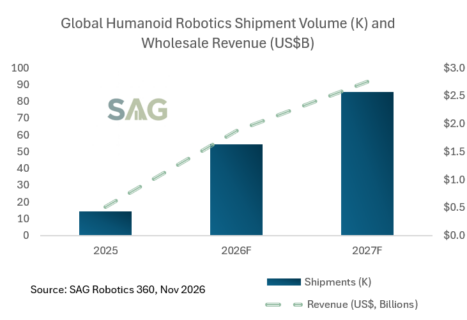
SAG has revised its shipment forecasts downward while raising its revenue outlook, reflecting the anticipated impact of US restrictions, which could slow market scaling and price declines. Meanwhile, faster-than-expected industrial and commercial adoption is driving a higher shipment mix of full-size and wheeled humanoid robots, which command higher average selling prices and support stronger revenue growth.
While Chinese vendors dominated shipments in Q3, SAG expects overseas players, including Tesla, Figure AI, Agility Robotics and 1X Technologies etc., to gradually ramp up production and commercial deployments from Q4 2026 onward, with more meaningful volume contributions expected in 2027.
Most overseas vendors remained in early-stage manufacturing, testing and pilot deployment during Q3 2026, without shipment volumes comparable to leading Chinese manufacturers.
However, US import restrictions and regulatory barriers affecting foreign made humanoid robots and related components could slow the pace of industry scaling and price declines in the US market. Restrictions on access to competitively priced Chinese robotic platforms and components may limit competition, increase deployment costs and delay broader commercial adoption.
SAG believes stronger local incentives, including manufacturing support, R&D funding, industrial pilot programs and supply chain investment, will be essential to accelerating the US humanoid robotics ecosystem and supporting domestic production scale.
Looking ahead, SAG expects competition to increasingly shift from hardware capabilities and robot demonstrations toward real-world deployment, productivity, reliability, cost efficiency and sustainable commercial value.