
As Xiaomi global smartphone shipments fell 23% YoY in 1H 2026, its shift toward higher-end devices lifted Qualcomm’s chipset share, while Xring remains a selective bet on differentiation.
Key Takeaways
- Qualcomm’s share of Xiaomi smartphone chipsets rose from 43% in 2025 to 55% in 1H 2026, while MediaTek fell from 51% to 38% and UNISOC increased from 6% to 8%.
- Xiaomi’s smartphone shipments declined 23% YoY in 1H 2026, with SAG expecting another double-digit decline in 2H 2026. Higher component costs are accelerating Xiaomi’s shift toward higher-end devices, benefiting Qualcomm.
- Xiaomi remains cautious with Xring. O1 was used only in the Xiaomi 15S Pro, representing less than 0.1% of Xiaomi’s 2025 smartphone volumes, while the O3-powered Xiaomi 18 Fold is unlikely to generate meaningful volumes in 2026 or 2027.
- Xring has made impressive progress in computing performance, but modem/RF remains a key gap. Real-world performance and consumer acceptance will ultimately determine whether Xiaomi can scale its own silicon.
- SAG sees near-term geopolitical and commercial risks as manageable. Xiaomi is not another Huawei case, while Qualcomm’s increasing share demonstrates the continued importance of their partnership.
- Longer term, the bigger question is how deeply Xiaomi-designed silicon penetrates its broader “Human × Car × Home” ecosystem.
Xiaomi’s renewed push into in-house silicon comes at a challenging time for its smartphone business. According to Smart Analytics Global (SAG), Xiaomi’s global smartphone shipments declined 23% YoY in 1H 2026, and SAG expects the company to remain on a double-digit decline trajectory in 2H 2026.
Under this context, Xring O3 should be viewed less as an immediate attempt to replace external chipset suppliers and more as a strategic differentiation tool. As Chinese Android vendors increasingly compete with similar hardware platforms and supply chains, in-house silicon could give Xiaomi greater control over hardware-software integration, AI experiences and premium product differentiation.
Qualcomm Gains Share Despite the Xring Push
Interestingly, Xiaomi’s investment in its own silicon has not yet reduced its reliance on Qualcomm.
According to SAG Smartphone 360, Qualcomm accounted for 55% of Xiaomi smartphone chipset volumes in 1H 2026, up from 43% in 2025. MediaTek’s share declined from 51% to 38%, while UNISOC increased from 6% to 8%.
Exhibit 1: Xiaomi’s Smartphone Chipset Supplier Share: 2025 vs. 1H 2026
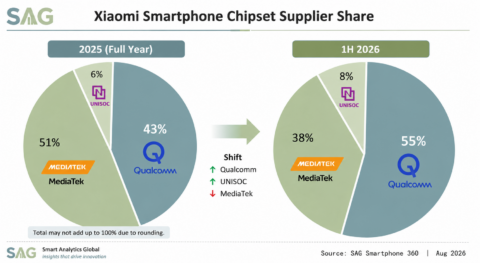
The shift partly reflects Xiaomi’s greater focus on higher-end and higher-value smartphones amid rising memory and other component costs, segments where Qualcomm has a stronger position. Moving toward higher-value devices can also help Xiaomi defend margins while overall shipment volumes remain under pressure.
The data therefore highlights an important point: Xring and Qualcomm can coexist. Qualcomm’s increasing share and close cooperation with Xiaomi suggest that near-term disruption from Xiaomi’s in-house silicon remains limited. Xiaomi still has strong incentives to maintain the relationship while selectively developing Xring as a strategic capability.
Xring Is Improving, but Modem Remains a Key Gap
Xring has made impressive progress in raw computing performance, but SAG believes modem and RF capabilities remain one of the biggest gaps versus more mature platforms from Qualcomm and Huawei/HiSilicon.
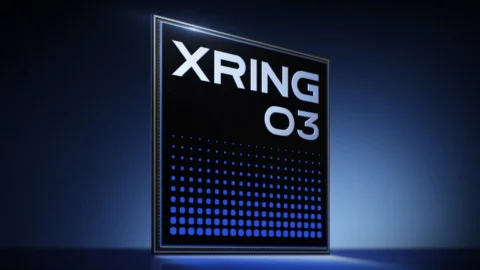
Image 1: Xiaomi Xring O3
Benchmark performance alone is therefore insufficient to judge Xring’s competitiveness. Power efficiency, thermal performance, connectivity, imaging, software optimization and ultimately consumer experience and acceptance will determine whether Xiaomi can move its own silicon into higher-volume products.
Xiaomi’s deployment strategy so far reflects this caution. The first-generation Xring O1 was used only in the Xiaomi 15S Pro, launched in 1H 2025 and accounting for less than 0.1% of Xiaomi’s 2025 smartphone volumes, according to SAG estimates.
O3 is initially being deployed in the Xiaomi 18 Fold, featuring a wider foldable form factor. SAG does not expect the model to generate meaningful volumes in 2026 or 2027. This gives Xiaomi a relatively low-risk environment to test O3 with real consumers before considering broader deployment.
Why O3 Matters During Xiaomi’s Smartphone Downturn
The timing of O3 is significant. Xiaomi needs new ways to differentiate as its smartphone business faces a prolonged downturn, while higher component costs make aggressive competition in lower-price segments increasingly difficult.
In-house silicon gives Xiaomi another card to play.
Rather than competing only through specifications and pricing, Xring could eventually support deeper hardware-software integration and differentiated AI and user experiences. This could be particularly valuable against other Chinese Android vendors that rely heavily on similar Qualcomm and MediaTek platforms.
But Xiaomi is unlikely to push Xring aggressively until the technology and consumer experience are proven.
Xiaomi Is Not Another Huawei — At Least for Now
SAG views Xiaomi’s near-term geopolitical risk as manageable, although not negligible.
Huawei was a fundamentally different case, with deep positions across telecom infrastructure, 5G standards, modem/RF technology, network equipment and semiconductor design. Xiaomi remains primarily a consumer electronics and EV company and continues to depend heavily on the global semiconductor ecosystem.
The fact that Qualcomm’s share at Xiaomi actually increased to 55% in 1H 2026 further demonstrates that developing in-house silicon does not currently mean moving away from U.S. semiconductor suppliers.
However, the risk deserves monitoring as Xiaomi’s silicon ambitions expand.
The Bigger Story: Human × Car × Home
The longer-term story may extend well beyond smartphones.
Xiaomi is building an increasingly integrated “Human × Car × Home” ecosystem, spanning smartphones, AI devices, EVs, smart-home products and potentially robotics. The penetration of Xiaomi-designed silicon across this ecosystem could eventually become more strategically important than Xring’s smartphone share alone.
That makes in-house silicon a double-edged sword. It can provide differentiation, greater technology control and long-term supply-chain resilience, but also require substantial R&D investment and introduce execution risk, potentially more complex relationships with semiconductor partners, and greater geopolitical exposure as deployment expands.
SAG therefore expects Xiaomi to remain measured rather than aggressive with Xring in the near term.
Beyond smartphones, an equally important metric to watch will be how deeply Xiaomi-designed silicon penetrates the company’s Human × Car × Home ecosystem. That, rather than benchmark leadership alone, would mark the real turning point in Xiaomi’s semiconductor strategy.