
The Smart Analytics Global team attended the launch of the Vivo X300 Ultra and Vivo X300 FE in India today. It felt more like a professional camera launch event than a smartphone launch event. More than 80% of the presentation was centered around imaging: camera hardware, video recording, audio capture, AVEC codecs, etc. That focus is both the biggest strength and, interestingly, one of the concerns.
Vivo X300 Ultra: A Camera Beast
This is clearly the most premium smartphone Vivo has ever launched and first Ultra from Vivo making into the market. And to be fair, the device is a camera beast. From ultra-wide to wide to telephoto, everything looks top-tier, at least from the samples shown during the presentation (I haven’t used the device yet). Add the telephoto extenders, and the device goes to another level altogether in terms of zooming experience.
Exhibit 1: Vivo X300 Ultra, Source-Vivo
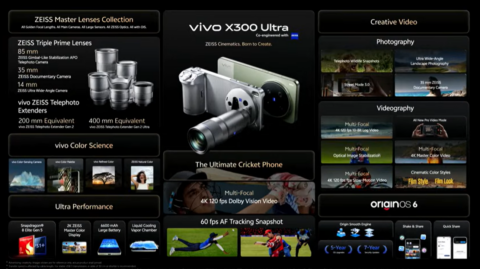
Vivo X300 Ultra Source: Vivo
What works:
- Camera system: 200MP+200MP+50MP. Easily the highlight. Probably among the best in the market right now.
- Processor: Snapdragon 8 Elite Gen 5, one of the most powerful chips available.
- Battery: 6600 mAh, which actually makes sense for a content capture-focused device.
- Charging: Fast charging support for both wired (90W) and wireless (40W).
Aside, kudos to the marketing team of vivo. I remember they launched V70 Elite in Q1 and highlighted a lot on Holi which was the upcoming festival. Now they launch X300 Ultra and focus a lot on cricket amidst ongoing IPL season.
What could have been better:
- Design: Feels generic. The circular camera ring is something we’ve already seen across multiple mid-range devices in 2024–2025. No real identity unless you notice Zeiss and T*.
- Launch narrative: Too camera-heavy. AI, security, barely discussed. More than 80% of the time was focused on camera related things and rest on battery, processor and software. More talks around security, AI aside camera, could have been better.
At ₹1,59,999, it’s even higher than devices like the iPhone 17 Pro and Samsung Galaxy S26 Ultra. Would adversely affect sales given the aspirational image of Apple and Samsung and Vivo sill trying to build it. And at that price, consumers will naturally compare, and many may still lean toward Apple or Samsung. That said, a niche segment continues to lean toward Chinese Ultra devices for their superior camera capabilities and additional accessories.
Vivo X300 FE: Better Balance, Still Some Gaps
Now coming to the FE. This one actually feels more balanced and fresh.
Exhibit 2: Vivo X300FE, Source-Vivo
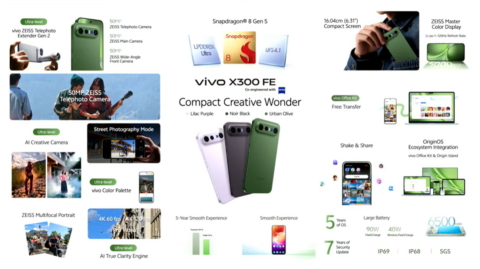
Vivo X300FE, Source: Vivo
What works:
- Camera: 50+50+8MP. Again, strong. Not Ultra-level, but still very good based on samples.
- Design: Much better than the Ultra. The horizontal capsule module gives it a distinct identity.
- Battery: 6000 mAh in a compact form factor is impressive.
- Processor: Snapdragon 8 Gen 5, is good enough.
What could be better:
- Security communication: Again, barely discussed.
- AI positioning: Mostly limited to camera use cases.
- AI transparency: Image refinement features that alter scenes don’t watermark outputs as AI-generated, this is concerning. AI watermark should be there for AI images.
- Pricing: Around ₹80,000, which is slightly on the higher side given competition from Apple and Samsung with high aspirational engine.
- Camera: 8MP Ultrawide could have been avoided.
Both devices offer 5 years of software updates and 7 years of security updates, which is a strong positive.
Bigger Picture: Vivo’s Strategy Is Clear
One thing that stood out clearly, this launch is about value maximization. Launches are more skewed towards higher segments. With the pricing of both smartphones and the additional telephoto extender kits, Vivo is targeting higher margins, positioning them as premium ecosystem products and driving profitability rather than just volume
The extender kits, in particular, don’t just act as differentiators, they’re likely high-margin add-ons, directly contributing to overall profitability.
Beyond the device sales, this launch will act as a strong branding tool to sell lower segment models like V series.
Final Thoughts
Vivo is clearly doubling down on camera-first positioning, and in that aspect, they’ve absolutely delivered.
But the trade-off is also visible:
- Limited focus beyond imaging, as witnessed from the communication during the launch event.
- Weak communication around AI (outside camera) and security
As far as the X300FE is concerned, it would perform better than the Ultra in terms of sales but will face stiff competition from Samsung Galaxy S26, Apple iPhone 17 Pro, OnePlus 16.
That said, brand perception doesn’t change overnight. Vivo has been steadily improving, and if this trajectory continues, 5 years down the line, the company could very well become a serious volume player in the premium segment, across FE, Pro, and Ultra. As per SAG estimates, in the “More than INR 1 Lakh” segment (roughly >US1050), Samsung and Apple contributes to more than 90% while Chinse brands have very limited presence (for exact estimates, do contact us).
For now, though, this feels like a camera-first flagship. The “more than INR 1 lakh” segment continues to be dominated by two global brands, Apple and Samsung. Among the four Ultra models, Samsung leads the sales volumes driven by n and n-1 generation Ultra models. The sales gap with the Chinese counterparts is huge. Chinese vendors still operate on a smaller base. The volume share is small. However, they are steadily gaining mind share through these launches, particularly in the imaging department. Both Vivo and Oppo are more confident now. They have received praises and awards for imaging capabilities of X300 Pro and Find X9 Pro. On the sales part, they might have grown as well but on a small base and the number is still tiny.
In the near term, Chinese Ultra smartphones are more effective at building mindshare and brand prestige than driving meaningful volumes. That said, they are steadily gaining momentum. We view these launches as a necessary step, consumer perception does not shift overnight, and sustained presence with competitive flagship devices is critical to gradually reshape positioning in the premium segment.
Camera remains a critical spec and plays a decisive role in smartphone purchase decisions. However, in the super-premium segment, where these Ultra models compete, aspirational value tends to take the lead. In the camera space, Apple and Samsung offer well-rounded (if not class-leading) camera systems, consumers often gravitate towards devices from the global giants for the overall proposition. That said, a niche segment continues to lean toward Chinese Ultra devices for their superior camera capabilities and additional accessories.
Clients, read our India smartphone research Q1 2026 here and Global smartphone research here.