
Smart Analytics Global (SAG) sat down with Ziad Asghar, Senior Vice President and General Manager of XR, Wearables and Personal AI at Qualcomm, during Snapdragon Summit 2026 for an exclusive executive interview on the future of personal AI devices.
In the interview, SAG Founder and Principal Linda Sui explored three key areas with Asghar: technology and product roadmaps, consumer adoption and use cases, and the evolving competitive landscape.
The discussion covered the future role of smartphones in the personal AI ecosystem, the rapid rise of AI smart glasses, emerging form factors such as AI pins and camera-enabled earbuds, privacy, enterprise opportunities, and the growing importance of AI agents.
One message came through clearly: personal AI is unlikely to be defined by a single device replacing the smartphone. Instead, smartphones, smart glasses, hearables and other AI-native devices could increasingly coexist around the same user.
Executive Summary
SAG highlights eight key takeaways from the discussion:
- Smartphones are not going away. Qualcomm expects smartphones to remain a critical computing platform while cloud-centric, smartphone-connected and distributed computing architectures coexist.
- Smart glasses are leading the personal AI device market, but they will not be alone. AI pins, pendants, camera-enabled earbuds and other wearable form factors could develop alongside glasses.
- Consumers could eventually own multiple personal AI devices. Unlike smartphones, where ownership typically centers around one primary device, personal AI could support multiple complementary devices per user.
- AI glasses will develop across multiple technology and price tiers. The market could range from audio-only smart glasses to camera-enabled AI glasses, monocular and binocular display products, and ultimately immersive AR devices.
- Personal AI wearables are fundamentally “AI-first” and “agent-first.” Their ability to see what users see and hear what users hear could enable contextual and hands-free AI experiences.
- Privacy will become increasingly important. Qualcomm is exploring visible recording indicators, tamper detection and always-sensing cameras that can provide visual context while obscuring faces.
- Enterprise and healthcare remain relatively untapped opportunities. Qualcomm sees these areas as potential “blue ocean” markets for personal AI devices.
- Technology remains a major barrier to mass adoption. Battery life, AI performance, form factor and power efficiency still require significant innovation.
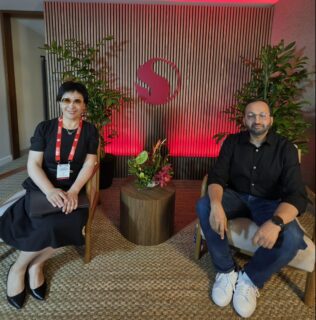
Exhibit 1: SAG Founder Linda Sui with Qualcomm SVP Ziad Asghar at Snapdragon Summit 2026
Smartphones Will Remain Critical in the Personal AI Era
As wearable devices gain more independent connectivity and access to cloud AI, an important question is whether smartphones could become less important over time.
Asghar does not expect that to happen.
“The smartphone is ubiquitous. It’s in everybody’s pocket. Everybody has one.”
He compared the transition toward personal AI devices with the earlier rise of smartphones. Laptops did not disappear when smartphones became mainstream, and he expects smartphones to remain an important part of the personal computing ecosystem.
At the same time, Qualcomm sees several architectures emerging for personal AI devices.
One approach connects devices such as smart glasses more directly to cloud services, with the smartphone primarily providing connectivity. A second uses the smartphone more directly as the connected computing platform. A third introduces a separate device—a “puck” or “compute block”—that can offload processing from glasses, earbuds, watches or pendants.
“We think all of these models will coexist.”
From SAG’s perspective, this suggests that personal AI is unlikely to converge around a single computing architecture. Cloud-centric, smartphone-centric and distributed edge-computing models could develop in parallel, depending on device form factor, power consumption, connectivity, AI workloads and user experience.
Smart Glasses Are Leading, but Multiple Personal AI Devices Will Coexist
Among emerging personal AI devices, Asghar sees smart glasses as one of the categories gaining the strongest early momentum.
One advantage is the familiarity of the form factor. Consumers already wear glasses, which lowers the behavioral barrier to adoption compared with entirely new device categories.
Asghar also pointed to another factor in markets such as the U.S.: insurance coverage can potentially help offset the cost of prescription smart glasses.
But personal AI will not stop at glasses.
Qualcomm sees opportunities across AI pins, pendants and increasingly capable earbuds, among other form factors. Camera-enabled earbuds, for example, could add visual context to an AI agent while offering a very different wearing experience from glasses.
Different devices could also target different applications, including healthcare, enterprise, productivity and education.
Most importantly, Asghar expects personal AI devices to differ fundamentally from smartphones in the number of devices consumers may eventually own.
“You might have one smartphone per person, but you could have a lot more than one device per person when it comes to personal AI devices.”
This could become one of the most important characteristics of the emerging market.
Rather than competing for one device slot, smart glasses, hearables, watches and other personal AI devices could increasingly complement one another around the same user, with each optimized for different contexts and use cases.
Why AI Pins Could Still Have a Role
AI pins have generated mixed reactions in the market, but Asghar believes the form factor could address a specific consumer need.
Not everyone wears glasses, and not everyone wants to wear them.
A pin or pendant can potentially provide cameras, microphones and speakers without requiring a face-worn device.
Asghar explained:
“There are many friends of mine—and many people I know—who don’t wear glasses and don’t want to wear glasses.”
A pin could still provide visual and audio context to AI, enabling a multimodal agentic experience.
The reference platform Qualcomm introduced at the event includes two front-facing cameras, illustrating how the company is exploring multimodal AI experiences across form factors beyond glasses.
From SAG’s perspective, the longer-term opportunity for AI pins will likely depend on whether the category can establish distinct use cases rather than simply reproducing functions already available through smartphones and smart glasses.
AI Glasses Will Expand Across Multiple Price and Technology Tiers
The smart-glasses market itself is becoming increasingly segmented.
Products range from audio-only glasses to camera-equipped AI glasses, HUD products and more sophisticated AR devices with immersive displays.
Asghar expects these categories to coexist rather than converge into one universal type of smart glasses.
At the entry level, removing the camera can reduce component costs and enable lower-priced smart glasses.
Moving upward, devices can progressively add cameras, monocular displays, binocular displays and eventually full perception and immersive AR capabilities.
Asghar summarized Qualcomm’s broad vision with a memorable phrase:
“No glass left behind.”
He described a hierarchy extending from audio glasses at the lower end through camera-enabled AI glasses and display products to fully immersive binocular AR devices.
For SAG, this supports the view that eye wearables are evolving into a multi-tier product category rather than a single homogeneous market, with meaningful differentiation in functionality, price, design, battery life and target users. Interview with ziad_transcript
Display AI Glasses Could Reach an Inflection Point Earlier Than Expected
Today, AI glasses without displays are seeing stronger early consumer adoption.
Asghar believes this is a logical starting point, but adding displays could significantly expand the experience once the industry solves the challenges around size, weight, appearance and cost.
“When people wear something on their face, they want it to look good. They want it to be a fashion accessory, not simply a consumer-electronics device.”
This is particularly important for smart glasses because the device is worn directly on the face and becomes part of the user’s appearance.
Asghar also believes more sophisticated AR experiences could arrive relatively quickly as the technology and ecosystem mature. During the discussion, he argued that the industry could achieve sufficient quality and price competitiveness to begin ramping advanced products much sooner than a five-year horizon.
For SAG, the key challenge is therefore not simply adding more technology.
The industry needs to combine AI and AR functionality with a form factor that consumers are comfortable wearing for extended periods. Weight, battery life, industrial design and fashion will matter alongside compute and AI performance.
Personal AI Devices Are “AI-First” and “Agent-First”
One of the most important questions surrounding personal AI devices is whether AI itself can genuinely drive consumer adoption.
The smartphone market provides an interesting comparison. Smartphone vendors have aggressively promoted AI capabilities in recent years, but AI alone has not necessarily transformed the hardware replacement cycle.
Asghar sees an important difference between smartphones and emerging personal AI wearables:
“These devices are AI-first. These devices are agent-first.”
Smartphones already perform a broad range of functions, with AI adding another layer of capability.
Personal AI wearables, by contrast, can be designed around AI agents from the beginning.
The combination of cameras, microphones and other sensors allows them to potentially understand what a user sees and hears.
Asghar gave a simple example: if a user says, “I’d like to buy that,” a wearable AI device could potentially understand that the user is looking at a particular lamp.
That contextual awareness could become a major differentiator for AI-native wearables.
“These devices should give us ‘superhuman powers.’ They should allow us to do things that current and existing devices cannot do.”
SAG believes this distinction is critical.
The longer-term opportunity for personal AI devices may depend less on reproducing smartphone AI functions and more on creating context-aware, hands-free and multimodal experiences that smartphones cannot deliver as naturally.
Open AI Ecosystems Could Become an Important Competitive Battleground
Competition in personal AI will not be limited to hardware.
Vertically integrated companies can tightly connect devices, operating systems and AI services. Qualcomm, meanwhile, is positioning itself as a horizontal technology enabler working across device makers and AI platforms.
Asghar believes access to different AI agents could become particularly important.
“We have the ability to bring in any agent.”
As AI agents evolve quickly, the ability to integrate different agents could allow device makers to adopt new capabilities without being tied entirely to one vertically integrated ecosystem.
Privacy Will Be Critical as Cameras Become Always Available
As cameras become embedded in glasses, earbuds and other always-worn devices, privacy will become an increasingly important challenge.
Asghar described several layers of technology that can help address these concerns.
The first is visible notification. An LED can indicate when a device is taking a picture or recording video.
The second is tamper detection. If someone attempts to cover or manipulate the indicator, the system can potentially stop the camera from operating.
The third involves what Asghar described as always-sensing cameras.
These low-capability cameras can detect that a face is present without necessarily identifying the individual.
“We don’t need to know who those faces belong to.”
The system could therefore obscure or cover faces while still providing the contextual visual information required by an AI agent.
This approach illustrates a broader challenge for the industry.
The more useful a personal AI device becomes through continuous contextual awareness, the more important privacy protections become.
SAG expects privacy to emerge as one of the defining design considerations as the industry moves from devices that users actively operate toward devices that can continuously see, hear and understand their surroundings.
Camera-Enabled Earbuds Could Add Another Layer of Context
AI glasses are not the only wearable devices gaining visual capabilities.
Camera-enabled earbuds could potentially use small cameras to provide additional visual cues to an AI agent.
This could allow hearables to move beyond audio input and output toward more multimodal AI experiences.
The approach also illustrates why Asghar believes different personal AI form factors can coexist.
A consumer might use smart glasses in some situations, earbuds in others, while still relying on a smartphone as an important part of the personal computing ecosystem.
The opportunity therefore may not be about finding one device that replaces everything else.
Instead, different sensors and form factors could give an AI agent access to different types of context throughout the user’s day.
Enterprise and Healthcare Could Be Major Untapped Opportunities
Consumer products currently dominate much of the discussion around personal AI, but Qualcomm also sees significant opportunities in enterprise and healthcare.
Asghar described these areas as relatively underdeveloped compared with consumer wearables.
“What we are doing with the Start program is going after areas that we feel are really blue ocean.”
Through its Start program, Qualcomm is seeking to reduce development complexity by providing more of the hardware and software stack required to build new devices.
But Asghar stressed that lowering barriers to entry cannot come at the expense of quality.
“These devices only work when the experience is pristine.”
Qualcomm is therefore developing software across the glasses, smartphone and cloud, together with hardware modules designed to accelerate product development.
For SAG, enterprise applications could become particularly important for AI and AR wearables because the value proposition can potentially be connected to specific workflows, productivity improvements and measurable returns, rather than depending entirely on consumers adopting a new device category.
Personal AI Will Remain a Technology-Intensive Race
Competition among semiconductor suppliers is also increasing as more companies target personal AI devices.
Asghar emphasized Qualcomm’s long-term technology investment as a key part of its competitive positioning.
“We excel when you need to raise the technology bar.”
He pointed to multimodal AI models and other technology investments as examples of the challenges Qualcomm has been working to address.
Interestingly, Asghar said complaints about smart-glasses battery life do not necessarily discourage him. Instead, they demonstrate that the category still has major technical problems to solve—and therefore significant room for technology innovation.
Qualcomm believes its more than decade-long investment in this area provides an advantage as personal AI devices become increasingly demanding across AI compute, connectivity, sensing and power efficiency.
For SAG, the technology challenge is particularly important because personal AI wearables operate under much tighter physical and power constraints than smartphones or PCs.
SAG Takeaway
SAG believes personal AI is evolving into a multi-device ecosystem rather than a race to replace the smartphone. Unlike smartphones, where AI is increasingly integrated into an already mature computing platform, wearables can be AI-first and agent-first, providing AI agents with more continuous and contextual access to what users see, hear and experience. Smart glasses are emerging as a leading form factor, while hearables, AI pins and other AI-native devices could coexist with smartphones and serve different roles across the personal AI ecosystem.