
Key Taeaways:
- Rokid launched three new products in China: Rokid Glasses 2, Rokid Color full-color AI glasses, and Rokid Ring, priced at RMB 3,699 (~US$555), RMB 4,999 (~US$750), and RMB 1,699 (~US$255) respectively.
- Rokid Color is the key highlight, introducing full-color visuals through a customized Micro-LED optical engine. The display could expand AI glasses use cases beyond notifications to include navigation, stock information, images, and videos.
- Rokid Glasses 2 combines Qualcomm’s Snapdragon AR1 platform with the BES2800BP chip, alongside improved battery life, a 12MP camera, and enhanced imaging capabilities.
- AI features on Rokid Glasses 2, including meeting summaries, call translation across 89 languages, and information recall, could strengthen the appeal of AI glasses as productivity tools.
- Rokid Ring introduces gesture-based controls, offering an alternative to voice commands and frame-based touch controls, while accessibility features could open additional use cases for visually and hearing-impaired users.
- According to Smart Analytics Global’s Wearable 360 service, Rokid ranked fourth globally in AI smart glasses, with a 3% share in Q2 2026, and third in the HUD subcategory, with a 19% global share. The new portfolio could help strengthen its position, although adoption will depend on pricing, comfort, battery performance, and software capabilities.
Three new products target the evolving AI glasses market
Rokid launched three new products in China yesterday: the Rokid Glasses 2, Rokid Color full-color AI glasses, and Rokid Ring in the Jungle 2026 launch event.
The Rokid Glasses 2 is priced at around RMB 3,699 (~US$555), while the Rokid Color starts at RMB 4,999 (~US$750). The Rokid Ring is priced at around RMB 1,699 (~US$255).
According to Smart Analytics Global’s Wearable 360 service, Rokid ranked as the fourth-largest AI smart glasses vendor globally in Q2 2026, with a 3% market share. In China, it ranked third, behind Qwen and Xiaomi, with a 12% share. In the heads-up display (HUD) subcategory, Rokid ranked third globally with a 19% share and second in China with a 24% share during the same period.
Exhibit 1: Global AI Smart Glasses
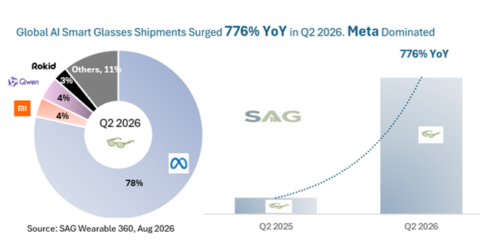
Against this backdrop, the latest launch is significant as Rokid looks to strengthen its position through differentiated display technology, improved AI capabilities, and new interaction methods. The key highlight of the event was the Rokid Color, which is the world’s first binocular full-color AI glasses.
Rokid Color brings full-color visuals to AI glasses
The Rokid Color uses a customized 0.16cc Micro-LED optical engine and weighs around 55 grams, excluding the nose pads. It supports richer visual information, including colored navigation, stock data, images, and videos.
Exhibit 2: Rokid Color

Essentially, the product brings a smartphone-like visual experience directly in front of the user’s eyes through a heads-up display (HUD). Instead of relying only on voice responses or basic text, users can view colorful and more detailed information without constantly looking at their smartphones.
We believe this could be an attractive proposition for consumers, particularly in a market like China, where users are increasingly looking for advanced and feature-rich smart devices. Full-color visuals could make AI glasses more engaging and expand their use cases beyond notifications and basic information. However, adoption will also depend on display quality, outdoor visibility, comfort, and software optimization.
Some of the features are accessing AI models such as Qwen, DeepSeek, etc, showing color coded navigation, stock market movements, local service searches, product recognition, integration with Qwen Office, etc.
The chip which powers these glasses is Qualcomm’s Snapdragon AR1+.
Exhibit 3: Close look of Color

The preorder starts 28th October 2026 and deliveries start April 2027 onwards.
Rokid Glasses 2 improves battery life, imaging, and AI capabilities
Moving on to the Rokid Glasses 2, the device combines Qualcomm’s Snapdragon AR1+ platform with the BES2800BP chip. Its battery capacity has increased by 25% over the previous generation, while Rokid claims battery life has improved by 50%.
Exhibit 4: Rokid Glasses 2

The glasses also feature a 12MP camera, with support for 4K video recording at 30fps and 2K video at 60fps. Imaging improvements include better low-light photography and video stabilization. The Glasses 2 optical engine is 30% smaller, with reduced rainbow patterns and reflections. These upgrades could make the device more useful for capturing everyday moments without requiring users to take out their smartphones.
AI features target productivity and communication
The Rokid Glasses 2 supports AI meeting summaries, call translation across 89 languages, information recall, improved night photography, and video stabilization.
The meeting-summary and translation capabilities are particularly relevant for professional users who frequently attend meetings or communicate across languages. These features could expand the utility of AI glasses beyond content consumption and everyday convenience, positioning them as productivity tools.
Rokid Ring introduces a new way to control AI glasses
Another important development is the Rokid Ring, which is priced at around RMB 1,699. The ring introduces fingertip gestures, including swipes and clicks, allowing users to control the glasses through finger movements.
Exhibit 5: Rokid Ring

We believe this is an important addition because interaction remains one of the challenges for AI glasses. Voice commands are convenient, but they are not always practical in public places or meetings. Similarly, touch controls on the frame can have limitations. The ring offers an alternative interaction method, allowing users to navigate and control the glasses without relying entirely on voice commands.
Accessibility could become another important use case
The Rokid Glasses 2 includes features such as obstacle warnings and object recognition, which could be useful for visually impaired users. However, we are yet to review the device, so its real-world effectiveness in accessibility scenarios remains to be evaluated.
For hearing-impaired users, the glasses also support speaker identification and subtitle-related features, alongside meeting summaries. These capabilities could help users follow conversations more easily, particularly in meetings and group discussions.
Outlook: Full-color displays could help Rokid strengthen its market position
Overall, we believe Rokid’s latest launch highlights the company’s efforts to address multiple aspects of the AI glasses experience. The Rokid Color focuses on richer visual output, the Glasses 2 combines imaging improvements with AI capabilities, and the Rokid Ring introduces an additional method of interaction.
According to Smart Analytics Global’s Wearable 360 service, Rokid’s stronger position in the HUD subcategory, with a 19% global market share and a 24% share in China in Q2 2026, highlights its existing presence in display-based AI glasses. Rokid has also been utilising platforms like CES to market themselves the communicate the message globally. We believe with this type of product and marketing push, Rokid will continue to gain share not just in China but also global smart AI glasses market.
The introduction of full-color display glasses could help Rokid further differentiate its portfolio and expand the potential applications of HUD-based AI glasses. However, the extent to which this translates into stronger market share will depend on consumer adoption, pricing, comfort, battery performance, and the usefulness of the software ecosystem.
While we are yet to review the devices, the launch represents an interesting development in the evolving AI glasses market. We will be watching how Rokid’s new products perform as competition intensifies and vendors look to differentiate their offerings through display technology and AI-powered experiences.