
Key Takeaways
- Flat shipments, modest share gain: SAG forecasts Google Pixel smartphone shipments to stay broadly flat annually in 2026, while global smartphone market share edges up from 1.0% to 1.1% amid a double-digit smartphone market decline.
- Pixel 11 offers limited hardware upgrades: Displays, cameras and batteries remain largely unchanged, with Tensor G6, faster on-device AI and improved efficiency/connectivity as the key upgrades. Pixel 11 family shipments are forecast to stay broadly flat versus Pixel 10.
- Memory costs pressure pricing and configurations: Google raises prices on several Pixel 11 models and cuts RAM to 12GB on selected 256GB Pro variants, while dropping the 128GB Pro to support a higher-value product mix.
- Pixel 11 Pro Fold should grow but remains niche: An earlier August launch should lift shipments versus the delayed Pixel 10 Pro Fold, but Google is forecast to hold less than 1% of global foldable shipments in 2026.
Google has launched its latest Pixel 11 flagship smartphone family today, including the Pixel 11, Pixel 11 Pro, Pixel 11 Pro XL and Pixel 11 Pro Fold. The new generation brings relatively limited conventional hardware upgrades, while Google is putting greater emphasis on Tensor G6, on-device AI, software and privacy features.
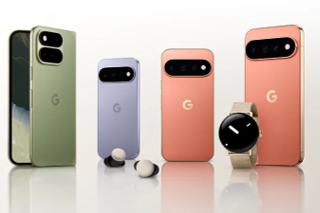
Image 1: Google Pixel 11 Series
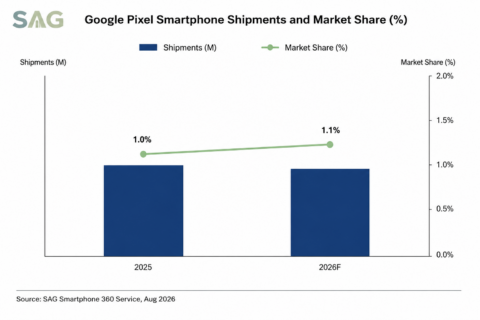
Despite price increases across several models, SAG expects the impact on demand to remain manageable, supported by installment plans, trade-in programs and operator promotions. SAG forecasts Google Pixel smartphone shipments will remain broadly flat annually in 2026, with its global smartphone market share edging up from 1.0% in 2025 to 1.1% in 2026.
Exhibit 1: Google Pixel Smartphone Shipments and Share Forecast :2025 vs. 2026F
Limited Hardware Changes, with Tensor G6 and AI Taking Center Stage
Compared with the previous generation, conventional hardware upgrades across the Pixel 11 family are relatively limited. Display, camera and battery specifications remain broadly similar rather than delivering a major generational leap.
The more meaningful change comes from the new Tensor G6 platform, which delivers improvements in power efficiency and faster local AI processing. Google has also switched its 5G modem solution to MediaTek, targeting improved connectivity and efficiency.
Together with Android 17, the Pixel 11 family increasingly demonstrates Google’s strategy of differentiating Pixel through AI and software rather than primarily competing through hardware specifications. Expanded AI and privacy capabilities, faster on-device AI processing and deeper integration between Google’s AI models and Android are becoming increasingly central to the Pixel value proposition.
From SAG’s perspective, this direction makes strategic sense. As flagship smartphone hardware matures, the competitive battleground is increasingly shifting from individual specifications toward AI capabilities, operating-system integration and overall user experience.
Price Increases and RAM Downgrades Highlight Memory Cost Pressure
Pricing and memory configurations are among the most interesting takeaways from the Pixel 11 launch.
Google has raised US pricing on several models, with the Pixel 11, Pixel 11 Pro XL and Pixel 11 Pro Fold seeing increases of around US$100 versus their predecessors.
More importantly, SAG noticed that Google has reduced RAM on the 256GB versions of the Pixel 11 Pro and Pixel 11 Pro XL from 16GB previously to 12GB, while the higher-storage 512GB and 1TB variants continue to carry 16GB RAM.
SAG views this as another indication of the increasing memory cost pressure facing the smartphone industry in 2026. Instead of passing the entire cost increase to consumers, smartphone vendors are increasingly making trade-offs among memory configuration, retail pricing and profitability.
Google has also retired the 128GB Pixel 11 Pro, making 256GB the entry configuration while maintaining the pricing of its 256GB, 512GB and 1TB variants.
From a product-positioning perspective, this is a smart move. The higher starting storage capacity should improve consumers’ perception of value despite the RAM adjustment, while potentially helping Google drive a higher Pro mix within the Pixel 11 family.
Pixel 11 Pro Fold Should Grow, but Google Will Remain a Small Foldable Player
The Pixel 11 Pro Fold also represents an incremental rather than transformational hardware upgrade. The overall product design and form-factor strategy remain broadly consistent with its predecessor, while Tensor G6 and AI capabilities represent some of the more meaningful changes.
The device continues with a large book-fold form factor, with an external display aspect ratio of approximately 19.5:9. From SAG’s perspective, the rounded-corner external-display design provides limited visual differentiation from its predecessor and may appear less attractive against increasingly refined competing foldable designs, with wide fold form facor to quickly gain popuarlity.
Nevertheless, SAG expects Pixel 11 Pro Fold shipments to grow compared with the Pixel 10 Pro Fold.
One important reason is the longer selling window. The Pixel 10 Pro Fold did not become available until October 2025, considerably later than the other Pixel 10 flagship models. In contrast, the Pixel 11 Pro Fold will become available in August alongside the Pixel 11, Pixel 11 Pro and Pixel 11 Pro XL, giving the new foldable a substantially longer sales window during the calendar year.
This should provide a meaningful year-over-year shipment tailwind for Google’s foldable business even without a major hardware redesign.
However, the absolute volume will remain relatively small. SAG forecasts Google will account for less than 1% of global foldable smartphone shipments in 2026, leaving the company a niche participant in the global foldable smartphone market.
Higher Prices Should Have a Manageable Impact on Demand
Despite the price increases, SAG does not expect a major negative impact on Pixel 11 demand.
This is particularly true in the United States and other developed markets, where monthly installment plans, trade-in programs and operator promotions substantially reduce consumers’ sensitivity to headline retail prices. Google’s own financing and trade-in offers should provide additional support.
As a result, SAG believes the Pixel 11 price increases should be manageable from a demand perspective, although higher pricing could contribute to longer replacement cycles among more price-sensitive consumers.
SAG Forecasts Pixel to Stay Flat but Gain Share in 2026
According to SAG Smartphone 360 research, Google ranked No. 10 in the global smartphone market in Q2 2026, with approximately 1% shipment share.
For the full year, SAG forecasts Google Pixel smartphone shipments will remain broadly flat YoY in 2026, compared with 2025. However, because the overall smartphone market is expected to contract significantly, Google’s global shipment share is forecast to increase modestly from 1.0% in 2025 to 1.1% in 2026.
SAG also forecasts Pixel 11 family shipments will remain broadly flat compared with the Pixel 10 family in 2025.
While flat shipments may appear unexciting in isolation, the performance needs to be viewed against a significantly weaker industry backdrop. SAG expects global smartphone shipments to decline by double digits in 2026, meaning Google should meaningfully outperform the overall market on a relative basis.