
Huawei officially launched the Mate 90 series in China on October 1, 2026, with prices starting from RMB 5,999 (US$845) for the Mate 90 and reaching RMB 18,999 (US$2,676) for the highest-end Mate 90 RS Ultimate Design. The new generation brings meaningful upgrades in chipset and camera technologies, but also comes with significant price increases.
Executive Summary
- Huawei raised comparable Mate 90 series prices by roughly RMB 1,000–2,000 (US$141–282) versus the Mate 80 generation. Some premium configurations also offer lower RAM despite substantially higher prices.
- The Mate 90 family adopts the latest Kirin 9030/9035/9050/9050 Pro chipsets. More advanced processors and higher component costs, particularly memory, are likely contributing to the price increases.
- Camera is the biggest hardware upgrade: Huawei continues to strengthen imaging as a key flagship differentiator, with the Mate 90 Pro Max featuring a new 200MP camera.
- The October 1 launch is almost two months earlier than the Mate 80 series, giving Huawei nearly a full quarter of Mate 90 shipments in Q4 2026.
- SAG tracked more than 8 million Mate 80 series shipments by the end of June 2026. While SAG continues to forecast double-digit Huawei smartphone shipment growth in 2026, the Mate 90 series’ substantially higher pricing could make it more difficult to replicate the Mate 80’s lifecycle success. More of Huawei’s incremental volume growth may come from mass-market models and the Nova series.
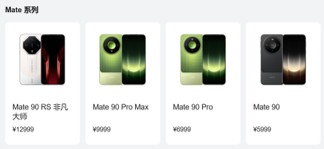
Image 1: Huawei Mate 90 Series
Price Hikes Are the Biggest Concern
Compared with the Mate 80 series, Huawei has increased comparable Mate 90 prices by roughly RMB 1,000–2,000 (US$141–282) across many configurations.
For example, the Mate 90 12GB+256GB increases from RMB 4,699 (US$662) to RMB 5,999 (US$845), while the Mate 90 Pro 16GB+1TB rises from RMB 7,999 (US$1,127) to RMB 9,999 (US$1,408). The Mate 90 Pro Max 16GB+512GB increases by RMB 2,000 (US$282) to RMB 9,999 (US$1,408).
More notably, the Mate 90 RS Ultimate Design reduces RAM from 20GB in the previous generation to 16GB, while its 512GB and 1TB versions increase in price by RMB 1,000 (US$141) and RMB 2,000 (US$282), respectively.
Rising memory and other component costs are likely contributing to the increases. Huawei Consumer Business Chairman Richard Yu also referenced rising memory prices during the launch event.
New Kirin Chips and a Major Camera Upgrade
The Mate 90 family introduces Huawei’s latest Kirin chipset generation, including Kirin 9030, 9035, 9050 and 9050 Pro, depending on model and configuration. The more advanced chipsets and their associated manufacturing costs could also contribute to the higher device pricing.
Camera is arguably the biggest hardware upgrade. The Mate 90 Pro Max features a new 200MP RYYB telephoto camera with OIS, alongside a 50MP variable-aperture main camera and 40MP ultrawide camera. Huawei has also introduced an optional modular camera system for the premium models.
Earlier Launch Could Boost Q4, but Lifecycle Demand Is the Question
Another important change is timing. Huawei launched the Mate 90 series on October 1, almost two months earlier than the late-November launch window of the Mate 80 generation. This gives the Mate 90 series almost the entire fourth quarter to contribute to Huawei’s shipments and could result in stronger launch-quarter volumes.
SAG tracked cumulative Mate 80 series shipments at more than 8 million units by the end of June 2026, demonstrating the strong performance of Huawei’s previous flagship generation in China.
For full-year 2026, SAG continues to expect double-digit shipment growth for Huawei smartphones. However, we expect a larger portion of incremental volume to come from Huawei’s mass-market products and the Nova series.
The Mate 80 series performed strongly in China. The key question is whether the Mate 90 series can repeat that success with significantly higher price tags. The earlier launch should support stronger Q4 2026 performance, but higher prices could become a headwind to total lifecycle volume.