
Key Takeaways
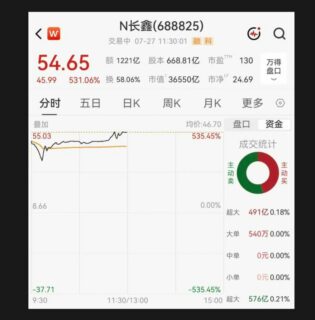
- CXMT officially debuted on China’s A-share market today, with its market capitalization surpassing RMB 3.65 trillion by noon, becoming the largest listed company on the A-share market by market value.
- Smart Analytics Global (SAG)’s analysis of the company’s IPO filing shows revenue accelerated sharply from 2H 2025, with Q1 2026 revenue surging 727% YoY. Based on the company’s 1H 2026 guidance, SAG estimates Q2 2026 revenue likely grew by more than 500% YoY.
- Revenue mix continues to diversify. LPDDR accounted for 66% of revenue in 2025 (down from 83% in 2024), while DDR increased to 32% (up from 13%), highlighting rapidly growing demand from AI servers and data centers. Alibaba, Tencent and ByteDance are among its major customers, while LPDDR remains the largest revenue contributor from smartphones, tablets and PCs.
- While CXMT still trails Samsung, SK Hynix and Micron in both technology and global market share, the company has become an increasingly important supplier amid the global memory shortage since 2H 2025.
- Smart Analytics Global believes CXMT has two practical paths to materially influence the global DRAM market over the next three to five years: expanding further into premium smartphones and accelerating HBM development for AI infrastructure.
Exhibit 1: Figure 1. CXMT Shares Surge More Than 500% on A-Share Market Debut
Source: Wind (Intraday stock trading data, July 27, 2026)
Revenue Growth Continues to Accelerate in 1H 2026
CXMT’s IPO filing illustrates one of the fastest growth trajectories currently seen across the global semiconductor industry.
Following strong momentum beginning in the second half of 2025, revenue continued to accelerate in Q1 2026, increasing 727% year over year. Based on the company’s revenue guidance for the first half of 2026, Smart Analytics Global estimates Q2 revenue likely maintained growth of more than five times year over year.
Exhibit 2: CXMT Total Revenue and Gross Profit Margin
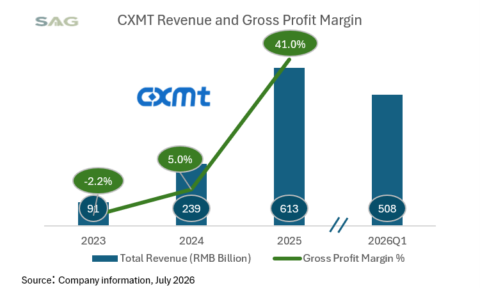
Such momentum reflects both robust domestic demand and an increasingly favorable industry environment as memory pricing recovered and AI infrastructure investment accelerated.
Business Mix Is Expanding Beyond Mobile
Another important observation is the continued diversification of CXMT’s revenue mix.
Although LPDDR remains the company’s largest business, supported by smartphones, tablets and notebooks, its contribution declined from 83% in 2024 to 66% in 2025.
Meanwhile, DDR revenue nearly tripled its contribution, rising from 13% to 32%, indicating rapidly growing shipments into servers and AI data centers.
Major Chinese cloud providers including Alibaba, Tencent and ByteDance have become important customers, while leading Chinese smartphone OEMs including Huawei, Xiaomi, OPPO and vivo continue expanding the adoption of CXMT memory solutions.
Technology Gap Is Narrowing
Despite still trailing Samsung, SK Hynix and Micron in leading-edge process technology, CXMT has rapidly improved both manufacturing capability and product competitiveness.
The company has benefited from favorable market conditions during the recent memory shortage while simultaneously expanding production scale and improving profitability.
Meanwhile, industry reports indicate Apple is evaluating CXMT memory products. Smart Analytics Global believes that if technical qualification is completed successfully and geopolitical approvals permit, initial adoption would most likely begin with selected non-iPhone Apple products sold exclusively within China before any broader deployment.
Two Strategic Paths Could Reshape the DRAM Industry
Smart Analytics Global believes CXMT has two realistic opportunities to become a much more influential player globally.
1. Premium Smartphones: The Near-Term Growth Engine
The first path is continued expansion within premium smartphones from leading Chinese OEMs including Huawei, Xiaomi, OPPO and vivo etc.
Success in flagship smartphones would demonstrate that the technology gap with Samsung, SK Hynix and Micron continues to narrow. More importantly, it would strengthen customer confidence and improve CXMT’s credibility among global OEMs, potentially opening opportunities with Western customers over time.
This represents the company’s most practical near-term strategy for scaling shipments, improving profitability and gaining manufacturing experience.
2. HBM: The Long-Term Strategic Opportunity
The second path is accelerating the development of High Bandwidth Memory (HBM) for AI servers and data centers.
Supported by substantial government investment together with fresh IPO proceeds, HBM represents CXMT’s most important long-term strategic opportunity.
If the company succeeds in narrowing the technology gap in HBM over the next several years, its influence on the global DRAM market would extend well beyond shipment growth. It could increasingly shape pricing dynamics, competitive positioning and future industry investment.
Geopolitical Risks Remain a Key Variable
While CXMT’s technological progress and commercial momentum have been impressive, geopolitical uncertainty remains one of the company’s largest long-term risks.
Export controls, technology restrictions, and broader U.S.-China geopolitical tensions could continue to influence CXMT’s access to advanced manufacturing equipment, global customers, and overseas expansion opportunities. These factors may also affect the pace at which international OEMs adopt CXMT memory solutions.
For example, even if Apple successfully completes product qualification, broader deployment beyond products sold exclusively in China would likely require not only technical validation but also regulatory clearance and a more favorable geopolitical environment.
As a result, Smart Analytics Global believes geopolitical developments will remain one of the most important variables influencing CXMT’s international expansion strategy over the next several years.
Smart Analytics Global View
Smart Analytics Global believes expanding into premium smartphones will remain CXMT’s primary growth engine over the next several years, while HBM represents its most important long-term strategic bet.
Together, these two initiatives could fundamentally reshape CXMT’s competitive position over the next three to five years and further strengthen China’s ambition to become a leading force in the global semiconductor industry.
Disclaimer
This article reflects the independent analysis and opinions of Smart Analytics Global (SAG). All forecasts and forward-looking statements are based on information available at the time of publication and are subject to change without notice. Company names and trademarks belong to their respective owners.