
SAN FRANCISCO, August 19, 2026 — According to the latest Smart Analytics Global (SAG) Robotics 360 research, Chinese brands captured 93% of global quadruped robot shipments in 1H 2026 but only 62% of trade wholesale revenue, reflecting a significant divergence in product positioning and application mix. Chinese brands recorded an average ASP of approximately US$6,100, compared with US$49,000 for non-Chinese brands, an approximately eight-fold difference.
Key Takeaways
- Chinese brands captured 93% of global shipments but only 62% of revenue share in 1H 2026.
- Chinese brands averaged approximately US$6,100 ASP, versus US$49,000 for non-Chinese brands.
- Unitree led with 52% shipment share and 24% value share.
- Chinese vendors are increasingly targeting affordable, higher-volume applications, while non-Chinese vendors remain more concentrated in industrial, public-safety and defense applications.
- SAG expects the ASP gap to remain significant and potentially widen as geopolitical restrictions and supply-chain restructuring reshape the market.
Exhibit 1: Global Quadruped Robot Shipment Share and Revenue Share: 1H 2026
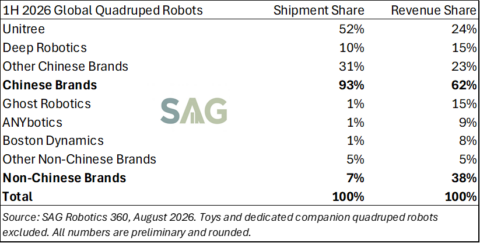
An 8x ASP Gap Reflects Different Market Positioning
The significant ASP gap is primarily driven by different product and application mixes rather than simply different pricing for comparable robots.
Many Chinese vendors are increasingly expanding into lower-priced consumer, education, developer and other higher-volume applications. Falling prices are making quadruped robots more accessible and supporting rapid volume growth, but are also pulling down blended ASPs.
Non-Chinese vendors, including Ghost Robotics, ANYbotics, Boston Dynamics and Rainbow Robotics, remain much more concentrated in higher-value industrial, public-safety and defense applications. Ghost Robotics positions itself largely for defense missions, while ANYbotics’ ANYmal focuses heavily on industrial inspection, including mining, energy, chemicals and hazardous environments.
“The eight-fold ASP gap reflects two very different market strategies rather than simply a pricing difference,” said Linda Sui, Founder and Principal Analyst at Smart Analytics Global. “Chinese vendors are pushing quadruped robots toward more affordable and higher-volume applications, while Western vendors remain concentrated in specialized industrial and defense markets where significantly higher ASPs can be supported.”
Geopolitics Could Further Widen the Gap
SAG expects the ASP gap between Chinese and non-Chinese vendors to remain significant and potentially widen over the next few years. US restrictions on Chinese robotics companies and broader geopolitical tensions could favor Western vendors in sensitive industrial, government and defense applications.
However, Western vendors could also face near-term challenges. Some remain dependent on Chinese components and manufacturing partners, meaning supply chains may need to be reshuffled and reorganized, potentially increasing costs. Chinese vendors, meanwhile, will increasingly need alternative sourcing strategies, favoring domestic semiconductor, AI model and component suppliers while diversifying into markets outside the US.
Consumer Leads Volume, While Industrial and Defense Gain Importance
SAG expects consumer applications to remain the largest quadruped robot segment by shipment volume, supported by declining prices and improving capabilities. However, industrial, public-safety and defense applications are expected to play an increasing role, particularly in market value.
The global quadruped robot market is therefore likely to become increasingly fragmented along geographic, supply-chain and application lines. Chinese vendors should retain a strong position in affordable, high-volume products, while Western vendors such as Ghost Robotics, ANYbotics and Boston Dynamics could strengthen their positions in high-value industrial, public-safety and defense applications. Geopolitics, defense demand and supply-chain restructuring are likely to make this divergence even more pronounced over the next several years.