
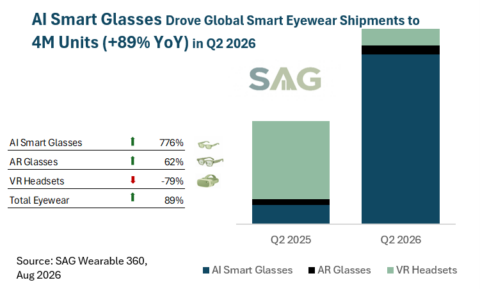
SAN FRANCISCO, August 18, 2026 — According to the latest Smart Analytics Global (SAG) Wearable 360 Service, global eye wearable shipments grew approximately 89% year-over-year to over 4 million units in Q2 2026, driven by explosive growth in AI smart glasses. AI smart glasses accounted for over 85% of total eye wearable shipments, up from around 80% in Q1 2026 and only 19% in Q2 2025, highlighting a dramatic structural shift in the market.
Key Takeaways
- Global eye wearable shipments grew approximately 89% YoY to over 4 million units in Q2 2026.
- AI smart glasses accounted for over 85% of total shipments, up from around 80% in Q1 2026 and 19% in Q2 2025.
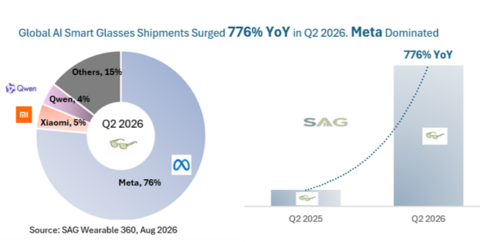
- Meta remained the clear AI smart glasses leader with approximately 76% shipment share, followed by Xiaomi at 5% and Qwen at 4%.
- North America dominated the global eye wearable market with over 60% share and led all three major segments.
- SAG expects the global eye wearable market to grow approximately 50% in 2026 and 47% in 2027, with significantly divergent trends by segment.
“Global eye wearable shipments grew 89% YoY to over 4 million units in Q2 2026, with AI smart glasses accounting for over 85% of the market, compared with only 19% one year ago,” said Linda Sui, Founder and Principal of Smart Analytics Global (SAG). “SAG expects the global eye wearable market to grow approximately 50% in 2026 and another 47% in 2027. Meta will remain the clear leader in both the overall eye wearable and AI smart glasses markets, but competition will intensify significantly in 2027 as Samsung ramps volumes and Apple formally enters the segment.”
Exhibit 1: SAG Global Eye Wearable Shipment Mix by Product Type: Q2 2025 vs. Q2 2026
AI Smart Glasses Surged, Dominated by Meta
Global AI smart glasses shipments surged 776% YoY in Q2 2026, accounting for over 85% of the total eye wearable market. Meta remained the dominant vendor with approximately 76% shipment share, followed by Xiaomi at 5% and Qwen at 4%. Qwen ramped quickly in China during the quarter, further intensifying competition among local AI smart glasses players.
Exhibit 2: AI Smart Glasses Vendor Share: Q2 2026
SAG expects AI smart glasses to remain the industry’s primary growth engine, with shipments more than doubling in 2026 before growth moderates to a double-digit rate in 2027.
AR Glasses Grew 58% YoY, RayNeo, VITURE and XREAL Remain Top Three
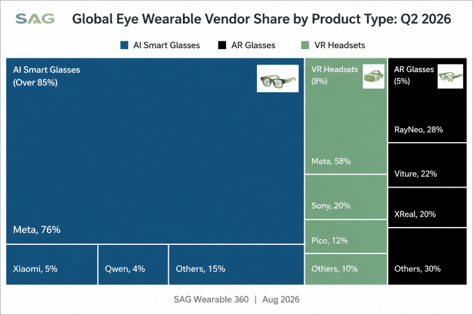
Global AR glasses shipments grew approximately 58% YoY in Q2 2026. RayNeo maintained the No. 1 position with approximately 28% shipment share, followed by VITURE at 22% and XREAL at 20%. VITURE continued to gain momentum, driven largely by channel expansion in North America.
Competition will broaden further as Snap Specs formally enter the market in late 2026, although SAG expects initial volumes to remain relatively small given their higher price positioning. Overall, SAG expects AR glasses to maintain double-digit growth in both 2026 and 2027, albeit from a relatively small base.
VR Headsets Continued to Decline Sharply
Global VR headset shipments declined nearly 80% YoY in Q2 2026, reflecting an aging product cycle, limited major hardware launches and soft consumer demand. Meta remained the clear leader with approximately 58% shipment share, followed by Sony at 20% and Pico at 12%.
SAG expects VR headset shipments to post another sharp double-digit decline in 2026 before rebounding in 2027, supported by an expected refresh of Meta’s Quest portfolio.
Exhibit 3: Global Eye Wearable Vendor Share by Product Type: Q2 2026
North America Dominated with Over 60% Share
North America accounted for over 60% of global eye wearable shipments in Q2 2026 and led all three segments, representing over 60% of AI smart glasses, over 45% of AR glasses and over 35% of VR headset shipments. Its leadership was supported by a well-established technology ecosystem, continued channel expansion from online to offline retail and improving consumer awareness.
China and Western Europe rounded out the top three regional markets. China benefited from its strong local ecosystem and rapidly expanding domestic players, while regulatory and privacy risks, particularly around camera and video usage, remain an important uncertainty for Western Europe.
Outlook: Strong Growth, but Increasing Competition and Adoption Challenges
SAG expects global eye wearable shipments to grow approximately 50% in 2026 and 47% in 2027, but trends will diverge significantly by segment. AI smart glasses will more than double in 2026 before slowing to double-digit growth in 2027; AR glasses will maintain double-digit growth in both years; while VR headsets will decline sharply in 2026 before rebounding in 2027.
Non-display AI smart glasses will continue to dominate in the near term, benefiting from lighter form factors, lower hardware complexity and more accessible pricing. More sub-categories are also emerging to address different user needs and privacy concerns, including HUD glasses without cameras or audio. Hardware still needs further improvements in weight, battery life, slimmer and sleeker form factors, and more fashionable designs to support broader adoption.
Meta will remain the clear leader in both AI smart glasses and VR headsets, but its AI glasses share is expected to decline as competition intensifies. SAG expects Samsung to ramp volumes and Apple to formally enter the segment in 2027, with both quickly joining the global top-three AI smart glasses vendors. Chinese players will continue to dominate their home market, while Apple’s expected entry into China will place it directly into one of the world’s most competitive AI smart glasses markets.
Despite rapid market growth, a compelling killer use case remains a key challenge for mass consumer adoption. Privacy and data security concerns, together with potential regulatory restrictions on camera and video usage in public spaces, particularly in Europe, remain important risks. Longer term, competition will increasingly extend beyond hardware toward AI capabilities, applications, ecosystems, channels and everyday user experiences.
SAG defines AI smart glasses as eyewear-form wearable devices that integrate AI to provide hands-free intelligent assistance. The category includes non-display AI smart glasses such as Ray-Ban Meta and HUD AI smart glasses such as Meta Ray-Ban Display.
SAG defines AR glasses as wearable devices that combine digital visual content with the user’s real-world view. The category includes tethered and standalone AR glasses, such as XREAL 1S and Snap Specs.
SAG defines VR headsets as head-mounted devices that provide a fully immersive digital experience, replacing or substantially occluding the user’s view of the physical environment. Examples include Meta Quest and Apple Vision Pro.