
Key Takeaways
- AI smart glasses are moving beyond a one-size-fits-all approach. Regulatory restrictions, social acceptance and consumer privacy concerns are pushing vendors to explore different hardware designs and use cases.
- SAG has expanded its AI smart glasses tracking from two to four sub-categories: Audio Only, Audio + Camera, Audio + Camera + Display, and Display Only.
- Audio + Camera will remain the dominant category, although its shipment share is forecast to decline from around 90% in 2025 to 86% in 2026 and 82% in 2027.
- Audio Only is gaining momentum, particularly in privacy-sensitive markets such as Europe. SAG forecasts nearly three-fold shipment growth in 2027, significantly outperforming the overall AI smart glasses market.
- Meta is well positioned to defend its leadership, supported by its hardware, distribution network and growing AI ecosystem. Samsung, Apple and smaller specialists will face different challenges as competition shifts increasingly toward the AI experience.
Privacy Is Reshaping the AI Smart Glasses Market
The global AI smart glasses market is entering a new phase. While shipments continue to grow, vendors are increasingly taking different approaches to product design and positioning.
Privacy is becoming an important factor behind this shift.
Camera-equipped smart glasses have attracted consumer interest, but they also raise concerns about photography and video recording in public places. People around the wearer may not know when they are being recorded. Regulatory requirements and social acceptance can therefore create barriers to adoption, particularly in markets such as Europe, where privacy and data protection rules are more stringent.
To better capture these developments, SAG has expanded its AI smart glasses coverage from two broad categories — Without Display and With HUD (Head-Up Display) — into four more detailed sub-categories:
| Sub-category | Main characteristics |
|---|---|
| Audio Only | Speakers and microphones, without a camera or display |
| Audio + Camera | Speakers, microphones and camera, without a display |
| Audio + Camera + Display | Audio, camera and integrated HU display |
| Display Only | Integrated HU display, without camera or speakers |
This new segmentation reflects how vendors are balancing functionality, privacy, product cost and consumer demand.
We expect market fragmentation to continue as more brands enter the category and target different consumer groups.
Audio + Camera Still Dominates, but Audio Only Is Catching Up
Despite growing privacy concerns, SAG expects Audio + Camera to remain the largest AI smart glasses sub-category through 2027.
Exhibit 1: Global AI Smart Glasses by Sub-Category: 2025-2027
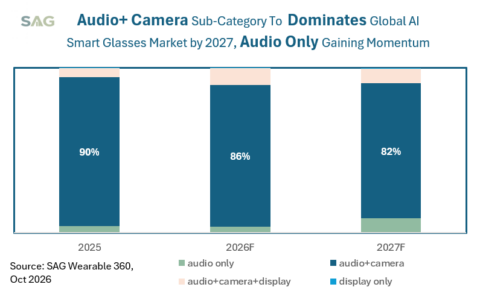
However, its dominance will gradually weaken as other designs gain traction.
Audio + Camera remains popular because it supports two of the most practical smart glasses use cases.
First, users can listen to music, make calls and interact with AI assistants without holding a smartphone.
Second, the camera allows hands-free photography and video recording. Based on SAG’s own hands-on experience, first-person video recording stands out as one of the strongest use cases for AI smart glasses. Capturing what users see, without holding a phone, provides a natural and convenient experience.
These benefits are easy for consumers to understand and use in everyday life.
However, the Audio Only category is emerging as an increasingly important alternative.
SAG forecasts that global Audio Only AI smart glasses shipments will grow by nearly three times in 2027, significantly faster than the overall AI smart glasses market, which is expected to record double-digit growth.
Although the overall market will continue expanding, its growth rate is expected to moderate from the triple-digit levels seen in earlier years as the market base becomes larger.
Audio Only: A New Opportunity for Privacy-Sensitive Markets
Removing the camera addresses one of the biggest concerns surrounding AI smart glasses: the possibility of recording other people without their knowledge or consent.
This could make Audio Only glasses more acceptable in offices, public spaces and other environments where camera-equipped devices face restrictions or social resistance.
Europe could become an important growth market for this category, given its relatively strict privacy and data protection environment.
Vendors are already responding.
Meta has introduced its Ray-Ban Meta Audio AI glasses, with a starting price of US$349. Preorders recently began in the United States, with availability expected to expand across North America, Europe and other international markets.
Beyond Meta, several smaller players are targeting the same opportunity.
- Solos has built a portfolio of AI-enabled audio glasses, focusing on voice interaction, translation and hands-free AI assistance.
- Lucyd offers smart audio eyewear with smartphone-connected AI capabilities, supported by its eyewear and retail partnerships.
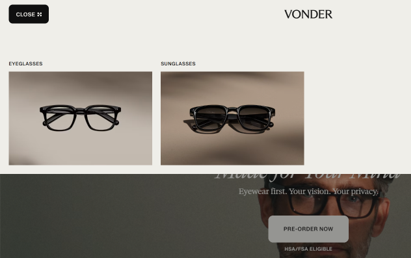
- VONDER, a new venture associated with a co-founder of VITURE, is also entering the Audio Only segment, focusing on AI assistance without a camera or display.
Exhibit 2: Vonder Audio-only AI Smart Glasses Products
SAG expects more vendors to enter this segment in 2027.
However, removing the camera also changes the competitive landscape.
For Audio Only products, the AI model becomes even more important because voice is the primary user interface.
Without a camera or display, users depend heavily on the quality of AI conversations, response speed, contextual understanding and the ability to complete tasks through voice.
For people around the wearer, the absence of a camera reduces privacy concerns. For the wearer, however, the value of the product depends largely on how useful and reliable the AI assistant becomes.
This creates both opportunities and challenges for vendors.
Display Only: Better Privacy, but Limited Mainstream Appeal
Display Only smart glasses take a different approach.
Products such as Even Realities G1 and G2 remove both the camera and speakers, relying on a small visual display and smartphone connectivity to deliver information and AI responses.
This design helps address camera-related privacy concerns while offering a discreet way to receive information.
However, SAG believes this category will remain relatively niche in the near term.
Without speakers, AI interaction and information delivery depend heavily on the visual display and connected smartphone. This limits the range of use cases compared with Audio + Camera or Audio Only products.
Display Only glasses may appeal to certain professionals and users who value discreet information access, including navigation, notifications, translation and presentation assistance.
Nevertheless, SAG expects mainstream consumer adoption to remain challenging unless vendors can demonstrate more compelling everyday use cases.
Meta’s Biggest Advantage Is No Longer Just Hardware
As AI smart glasses become more fragmented, competition is moving beyond hardware specifications. The underlying AI model, software experience and ecosystem will become increasingly important. This is where Meta has a significant advantage.
Meta already has a strong position in AI smart glasses, supported by its Ray-Ban partnership, global distribution network and growing consumer adoption.
Its expanding personal AI ecosystem, including Muse and Muse Charm, could further strengthen that position.
Exhibit 3: Muse Leads Google Play Rankings Since Launch, Surpasses 5 Million Cumulative Downloads

The early consumer response to Muse suggests growing interest in dedicated personal AI agents. If Meta successfully brings the next generation of Muse capabilities to its smart glasses, the company could deliver a more integrated and differentiated experience.
For smaller players such as Solos, Lucyd and VONDER, the challenge is different.
Some vendors emphasize compatibility with multiple third-party AI models, including ChatGPT and Claude, Gemini etc. This gives consumers flexibility and allows smaller brands to benefit from rapid improvements in AI technology.
However, it also means that a large part of the user experience depends on external AI providers.
These companies may have less control over AI performance, product integration and long-term differentiation.
In this respect, Meta increasingly resembles Apple in the smartphone market: a company seeking to control hardware, software, AI capabilities and distribution within one ecosystem.
Smaller vendors may find it increasingly difficult to compete on both price and user experience.
Samsung and Apple: Strong Hardware, but AI Will Be the Real Test
Competition will intensify further as Samsung and Apple enter the AI smart glasses market.
SAG expects the upcoming Samsung and Apple AI smart glasses to focus initially on the Audio + Camera category, which offers the broadest range of practical consumer use cases.
For Samsung, the main advantages are its hardware expertise, established Galaxy ecosystem and global distribution channels.
However, software and AI integration will be critical. Samsung is expected to work closely with Google, and the quality of that partnership will play an important role in shaping the user experience.
For Apple, the challenge is different.
Apple has a highly integrated hardware and software ecosystem, a large installed base of loyal customers and strong retail distribution.
However, the performance of Apple Intelligence will be a key factor in determining whether Apple’s AI smart glasses can stand out.
Consumers will increasingly judge AI glasses not only by design, battery life and camera quality, but also by how effectively their AI assistants understand users and complete everyday tasks.
This could become the next major competitive battleground.
From Smart Glasses to Personal AI Agents: Who Will Own the User Interface?
The rise of AI smart glasses is part of a broader shift toward personal AI devices.
Smartphones will remain the main computing and connectivity hub for most consumers in the foreseeable future. However, AI glasses and other wearable and pocket companion devices are creating new ways for users to interact with AI.
Meta’s Muse ecosystem could become an important test of this transition.
If the next generation of Muse delivers a compelling AI agent experience through smart glasses, it could strengthen Meta’s leadership and accelerate consumer adoption.
Looking further ahead, the expected introduction of 5G connectivity to Muse Charm could allow certain personal AI devices to operate more independently from smartphones.
This raises an important question for the industry:
Will smartphones remain the center of the personal AI ecosystem, or will new AI-native devices gradually bypass them and create their own user interfaces?
SAG believes smartphones will remain the primary hub for years to come. However, the emergence of more capable AI models, new wearable form factors and independent connectivity could open a new competitive landscape from 2027 onward.