
After several years of experimentation and limited adoption, AI smart glasses (not including AR and VR devices) are set to enter a breakout growth phase beginning in 2026, marking one of the most significant inflection points in the consumer AI hardware market. According to Smart Analytics Global (SAG), the category is transitioning from niche trials into a scalable, mass-market AI device segment, driven by proven commercial success of Ray-Ban Meta and the anticipated entry of major ecosystem players and smart vendors, including Apple and Samsung.
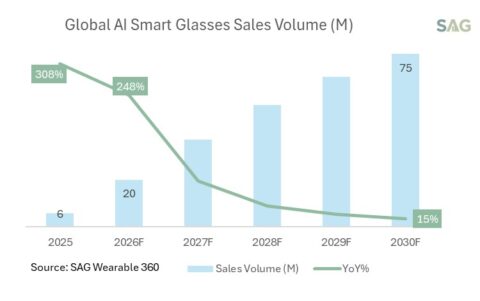
SAG forecasts that global AI smart glasses sales will surge from 6 million units in 2025 to 20 million units in 2026, representing 248% year-over-year growth, while market revenue is expected to expand from US$1.2 billion to US$5.6 billion over the same period. By 2030, sales volume are projected to reach 75 million units, with revenue climbing to US$29 billion, implying a five-year CAGR of more than 89%. The United States and China will remain the two largest markets in the near term, jointly accounting for nearly 79% of global demand in 2026, before adoption broadens to Europe, India, and other emerging markets.
Exhibit: Global AI Smart Glasses Sales Volume and YoY % Forecast: 2025-2030
The inflection point was clearly established in 2025, when Ray-Ban Meta demonstrated that smart glasses can achieve mainstream consumer traction when fashion-forward design, hardware maturity, AI functionality, and the right distribution channels converge. Ray-Ban Meta’s success validated AI smart glasses as product consumers are willing to wear daily, not merely test as a novelty—providing the commercial proof point that catalyzed broader industry investment.
Building on this momentum, 2026–2027 will see a rapid influx of new entrants, spanning incumbent AR/VR players, AI platform and content providers, smartphone and automotive OEMs, mobile operators, traditional eyewear brands, and startups. Among them, Apple and Samsung are expected to play particularly influential roles. SAG believes Apple is more likely to enter the AI smart glasses market in 2027 rather than 2026, consistent with its strategy of waiting for technologies and user behavior to stabilize. Leveraging its strengths in industrial design, fashion credibility, and the iOS ecosystem, Apple’s entry could mark a major acceleration in mainstream adoption.
From a technology perspective, SAG expects HUD (heads-up display) AI smart glasses to outpace and overtake audio-only AI smart glasses from 2028 onward. While audio AI smart glasses have driven early adoption due to lower cost and simplicity, HUD-based designs unlock a broader range of visual AI use cases, including real-time translation, navigation, contextual search, and on-the-go AI assistance. Continued improvements in display technology, optics, power efficiency, and on-device AI will support this transition.
Despite their rapid growth, AI smart glasses are unlikely to replace smartphones in the foreseeable future. Instead, SAG expects them to co-exist with smartphones as a complementary, hands-free AI interface, shifting selected interactions—such as search, translation, and contextual assistance—away from screens. At the same time, AI smart glasses are expected to gradually cannibalize portions of the TWS earwear market, as voice-driven and multimodal AI experiences migrate to eyewear form factors.
Looking ahead, SAG believes the long-term winners will be hybrid players that combine socially acceptable, lightweight design, fast-evolving AI software and services, and scalable global branding and distribution. By 2030, SAG expects Apple, Samsung, and Meta to emerge as the top three global AI smart glasses vendors, while the broader market undergoes accelerating consolidation from 2026 onward, due to product homogenization and price competition.
Meanwhile, an escalating memory chip supply shortage is expected to affect AI smart glasses supply in 2026 and 2027. However, the impact should remain manageable and materially lower than that on smartphones, PCs, and other consumer electronics. Most AI smart glasses require relatively modest memory configurations, limiting the impact on BOM costs. Furthermore, the smaller volume base of the AI smart glasses market reduces the scale and duration of supply disruption compared with higher-volume device categories.
Clients please click here to access the comprehensive AI smartphone glasses feature report from SAG.