
Smart Analytics Global (SAG) was invited to attend Agibot Innovation Day 2026, held on October 29 at the Shanghai World Expo Center. Under the theme “Leap” (跃迁), the event highlighted Agibot’s ambition to move beyond robot demonstrations toward large-scale industrial deployment.
Image 1: Agibot Innovation Day 2026 – Event Entrance and “Leap” Theme

Source: Smart Analytics Global (SAG). Photos taken on-site by Yiwen Wu at Agibot Innovation Day 2026, Shanghai, October 29, 2026.
The timing is significant. According to SAG’s Robotics 360 service, Agibot shipped approximately 8,400 humanoid robots in H1 2026, capturing around 41% of the global market and ranking as the world’s No. 1 humanoid robot vendor by shipment volume.
This blog highlights SAG’s on-site observations from the main event and the dexterous hand sub-forum, with a focus on industrial deployment, full-stack ecosystem development, and the progress of robotic manipulation.
Key Takeaways
- From Humanoid Robotics Demonstration to Deployment: Agibot is making progress toward real industrial applications, supported by factory production data and a hardware lineup designed for practical deployment.
- Building a Full-Stack Ecosystem: Agibot is expanding beyond robot manufacturing into AI models, software platforms, and operating systems. Its Link-U OS 1.0 is expected to be fully open-sourced by the end of 2026.
- Dexterous Hands Gain Momentum: Agilink, Agibot’s dexterous hand spinoff, has emerged as one of the fastest-growing players tracked by SAG. Its competitive pricing and data-driven development strategy target the critical challenge of fine robotic manipulation.
- Measuring Real Productivity: Agibot’s new Worken metric is a constructive step toward measuring humanoid productivity, although clearer efficiency benchmarks and task complexity adjustments are still needed.
- The Next Challenge Is Task Complexity: Current industrial applications remain concentrated in repetitive, relatively simple tasks. Moving into more complex, higher-value work will be the next major test.
Agibot’s Humanoid Full-Stack Ambition: From Hardware to Operating System
Agibot used Innovation Day to unveil several platform-level announcements. These included AHA3, its 3rd-generation hardware platform integrating locomotion, interaction, and task execution capabilities. The company also previewed GO-3, its next-generation embodied AI foundation model, and introduced WITA-Omni, an omni-modal interaction model with full-duplex conversation capability. The most strategically significant announcement was Link-U OS 1.0, which Agibot described as the first operating system purpose-built for embodied intelligence. The company plans to fully open-source it by end of 2026.
These announcements reveal a clear strategic intent. Agibot is positioning itself not as a robot manufacturer alone, but as an infrastructure provider for the broader embodied intelligence industry. We view that the OS is primarily aimed at component suppliers and developers who build on top of Agibot’s platform with the goal to enhance the platform dependency among upstream and downstream partners. Whether this translates into durable ecosystem control depends on how much value third-party developers find in the platform. The ambition is clear and the adoption path is not yet to be seen.
Industrial Deployment: Moving Beyond Robot Demonstrations
The humanoid robot industry is transitioning from showcase to industry deployment and Agibot’s event reflected this shift. In addition to entertainment deployments like the Chimelong Spaceship Park, where more than 300 Agibot robots are already operating, the company presented more data from manufacturing environments including Longcheer Technology’s tablet assembly line in Nanchang, where humanoid robots perform MMIT station tasks. Agibot claims throughput of 310 units per hour with a cycle time of 19 to 20 seconds and over 99% success rate. If these figures hold at scale, they represent a meaningful step from lab benchmarks to factory output.
Image 2: Agibot Innovation Day 2026 – Main Stage Presentation Highlighting the Shift Toward Industrial Deployment
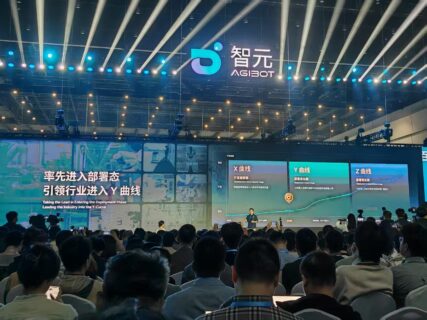
Source: Smart Analytics Global (SAG). Photos taken on-site by Yiwen Wu at Agibot Innovation Day 2026, Shanghai, October 29, 2026.
Agibot also launched G2 Max, a heavy-duty wheeled industrial robot with dual-arm 40kg payload capacity and working height range from 0.1 to 2.5 meters, during the innovation day. This is a product designed for deployment, not demonstration however.
Moreover, the company introduced a productivity metric called “Worken”, defined as the product of active robots, autonomous working hours, and an output efficiency ratio benchmarked against human worker performance. The intent is constructive, as the industry does need a standardized way to quantify humanoid productivity beyond unit count. Going forward, SAG would like to see the framework develop further in a few areas. We expect that the efficiency ratio would benefit from clearer definition boundaries, while a weighting mechanism for task complexity would help distinguish simple pick-and-place from more demanding manipulation work.
The broader trajectory is encouraging. Current deployed tasks are concentrated in repetitive, low-complexity roles where the ROI case rests on labor cost displacement. That is a natural starting point, not a limitation. Expanding into higher-value tasks will take time, better manipulation, and more capable autonomy. Moving from controlled demonstrations to real factory output is exactly the kind of progress the industry needs at this stage. The foundation is being built.
Dexterous Hands: Solving the Last 10 cm of Robotic Manipulation
Agilink, the dexterous hand company spun off from Agibot in January 2026, was a major focus of the event’s dedicated sub-forum. The company has experienced remarkable growth, expanding its team from 11 to 94 employees in just nine months, shipping more than 15,000 dexterous hand units across different DoF configurations, and reaching a unicorn valuation within five months of its founding.
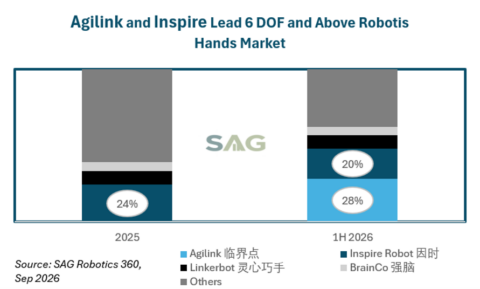
According to SAG research, Agilink captured 28% of the global humanoid dexterous hand market for products with 6 DoF and above in H1 2026. Its rapid expansion in shipments, workforce, and market presence positions Agilink among the fastest-growing robotics component suppliers tracked by SAG.
Exhibit 1: 6DOF and Above Dexterous Robotics Hands Vendor Share: 1H 2026
The Data Flywheel: Connecting Hardware, Intelligence, and Scale
A key part of Agilink’s strategy is collecting real-world manipulation data to improve robotic hand performance. The company has developed its own teleoperation gloves, including a lightweight version and a flagship model with distributed tactile feedback. These gloves collect manipulation data to train robotic hand control models. As more dexterous hands are deployed in production environments, they generate additional operational data, creating a data-to-model-to-deployment flywheel that continuously improves robotic manipulation capabilities.
SAG believes this approach is strategically important. Hardware alone cannot solve the challenges of fine manipulation. Robotic hands must learn to grasp different objects, adjust force, perform precise movements, and adapt to changing conditions. The combination of hardware, AI models, and real-world training data could become a key competitive advantage, differentiating Agilink from traditional component suppliers.
Meanwhile, Agilink offers five dexterous hand products, ranging from the compact OmniHand 3 Lite to the flagship OmniHand 3 Ultra-M, at competitive prices compared with overseas alternatives. This reflects the growing maturity and cost advantages of China’s robotics supply chain. Lower prices could accelerate adoption, expand real-world deployment, and generate more training data, further strengthening Agilink’s data flywheel.
However, aggressive pricing could also pressure margins and limit R&D investment. Dexterous manipulation remains an emerging technology, particularly for complex tasks involving flexible or deformable materials. SAG believes Agilink’s long-term success will depend on its ability to balance scale, pricing, and continued innovation while translating its growing data advantage into more capable and commercially viable dexterous hands.
The Next Test Is Productivity, Not Just Shipments
- Agibot’s transition from humanoid robotics demonstration to industrial deployment is becoming more tangible, supported by factory production data, industrial-focused hardware, and a broader software ecosystem.
- Full-stack integration is emerging as a key competitive strategy. Agibot’s expansion into AI models and operating systems could strengthen its position across the embodied intelligence ecosystem, although third-party adoption remains to be proven.
- Task complexity is the next major challenge. Current deployments focus on relatively simple, repetitive tasks. Moving toward higher-value applications will require more advanced manipulation, autonomy, and measurable productivity improvements.
- Agilink is gaining momentum in dexterous hands, supported by rapid shipment growth, competitive pricing, and a strategy linking hardware development with real-world manipulation data.
- The next phase of competition will increasingly focus on real-world productivity, deployment economics, and sustainable innovation, rather than shipment growth or technical demonstrations alone.
SAG believes 2026 marks an important transition for China’s humanoid robotics industry. The industry is beginning to move from showcasing what robots can do toward proving what they can deliver in real production environments.
The next challenge is to make humanoid robotics capable of performing more complex tasks with consistent productivity and attractive economics.
For a deeper look at the humanoid robot and dexterous hand markets, including vendor shipments, market share, value share, and forward-looking forecasts, please check out SAG’s latest research reports as below:
SAG Humanoid Robot Vendor Shipments, Market Share & Forecast Intelligence, August 2026 Edition
SAG Humanoid Robot Dexterous Hands Supply Chain Intelligence, September 2026 Edition