
Smart Analytics Global expects the foldable smartphone market to grow 35% year over year in 2026, driven by new wide fold and wide flip device designs.
Recent reporting from Bloomberg about Apple’s upcoming foldable iPhone has reignited discussion around the future direction of the foldable smartphone market. A comment posted by Smart Analytics Global under the article attracted more than 2,500 impressions, highlighting growing industry interest in the design choices behind next-generation foldable devices.
From Smart Analytics Global’s perspective, the next stage of the foldable smartphone market will be defined less by hinge engineering and more by display aspect ratio and usability.
SAG believes two emerging form factors, wide fold and wide flip, will gain traction beginning in 2026, while traditional booklet foldables and small flip devices gradually lose share as manufacturers optimize foldable designs for content consumption and multitasking.
Aspect Ratio May Become the Key Differentiator
Traditional foldable smartphones have generally followed two form factors:
• Booklet-style foldables (SAG names as big fold), which unfold into narrow tablet-like displays often close to 20:9 aspect ratios
• Small flip phones (SAG names as small flip), which typically feature tall narrow displays with ratios around 21:9 or 22:9
While these designs solve portability challenges, they do not necessarily deliver the most comfortable experience when the device is unfolded for extended use.
Smart Analytics Global believes the display aspect ratio of the unfolded screen will become one of the most important design factors in the next phase of foldable development.
Two emerging formats illustrate this shift:
• Wide fold devices (SAG names as wide fold), such as the expected foldable iPhone, rumored to adopt a 4:3 display ratio similar to the Apple iPad
• Wide flip devices (SAG names as wide flip), such as the Huawei Pura X, which adopts a 1:1.4 ratio, similar to the proportions of an A4 paper layout
Both formats provide significantly wider viewing areas than traditional foldable smartphone designs.
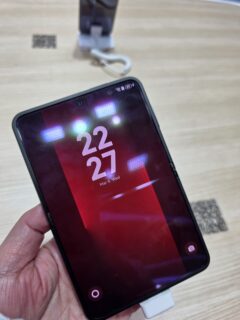

Images (from left to right: Huawei Pura X unfold and fold)
Why Wide Displays Work Better for Foldables
The advantage of wider foldable displays is closely tied to human viewing behavior.
Human vision naturally spans a horizontal field, meaning wider screens tend to feel more natural for activities such as video consumption, web browsing, document reading, and side-by-side multitasking.
This design logic is reflected in the display ratios of most television screens and PC monitors, which prioritize horizontal viewing comfort.
Traditional smartphones did not adopt such wide ratios primarily because they are designed for one-hand operation. Narrow displays allow users to easily reach across the screen with their thumb.
Foldable devices introduce a different usage model.
Once unfolded, most foldable smartphones are held with two hands, and the primary use cases shift toward content viewing, multitasking, and productivity on larger screens.
Based on Smart Analytics Global analysts’ hands-on user experience, current foldable designs still present several usability challenges.
For booklet-style foldables (big fold), the external display is often too narrow for comfortable everyday usage, while the unfolded screen can feel overly large and difficult to operate with one hand. This creates a usability gap between the two modes.
For small flip smartphones (small flip), portability is a clear advantage. However, once unfolded, the displays are typically very long and narrow, which is not always ideal for natural viewing behavior. The tall aspect ratios used in many flip devices can feel less comfortable for reading, browsing, and video viewing.
By contrast, wide fold and wide flip form factors provide a more balanced display experience, better aligned with how users consume content and interact with large-screen devices.
Apple’s Wide Fold Could Redefine the Category
Smart Analytics Global believes Apple’s foldable strategy could accelerate this design shift.
If Apple launches a wide fold device in the second half of 2026, the company would effectively combine elements of the iPhone and iPad experience into a single product category.
Apple’s rumored 4:3 display ratio suggests the company may prioritize tablet-style usability, enabling features such as side-by-side application usage, productivity workflows, and improved content viewing experiences.
While such a device could cannibalize part of the iPad lineup, Apple would likely position the product at a premium price point above $2,000, allowing the company to offset potential revenue shifts within its product ecosystem.
Why Apple Is Entering the Foldable Market Now
Unlike many Android vendors that rushed into the foldable category early, Apple has taken a more deliberate approach.
From Smart Analytics Global’s perspective, Apple’s timing reflects a strategic decision to enter the market during the second phase of foldable development, when both hardware reliability and user experience have matured.
The first wave of foldable smartphones over the past several years focused primarily on solving engineering challenges, including hinge durability, crease visibility, and display reliability. While major vendors such as Samsung Electronics and Huawei helped establish the category, the market has remained relatively niche due to high prices and evolving form factors.
Smart Analytics Global believes Apple may be waiting for two key conditions before entering the market.
First, the form factor must deliver a clear user experience advantage.
Apple’s rumored wide fold design with a 4:3 display ratio suggests the company is prioritizing productivity and multitasking, aligning the device more closely with the iPad experience rather than simply introducing another foldable phone.
Second, the ecosystem integration must be compelling.
By combining elements of the iPhone and iPad into a single device category, Apple could position its foldable iPhone as a premium productivity and entertainment device, rather than a niche experimental product.
If executed well, this strategy could allow Apple to reshape consumer expectations for foldable smartphones, accelerating adoption of wide-display foldable devices across the industry.
Huawei Leads the Wide Flip Segment
While Apple may popularize wide fold devices, Huawei has already pioneered the wide flip form factor.
The Huawei Pura X launched in early 2025 in China introduced a display ratio closer to 1:1.4, offering a significantly wider viewing experience compared with traditional flip phones.
According to Smart Analytics Global tracking, the device has been well received in the Chinese market, particularly among female consumers. SAG estimates the Huawei Pura X shipped nearly 2 million units in 2025.
Huawei is expected to launch the next generation of Pura X2 in April, and Smart Analytics Global expects double-digit demand growth in 2026, provided the company maintains its current pricing strategy.
Foldable Form Factor Mix Shift Expected in 2026
Smart Analytics Global forecasts the global foldable smartphone market will grow 35% year over year in 2026, driven by new form factors and expanding consumer awareness.
However, the mix of foldable form factors is expected to change significantly. SAG expects wide fold form factor (foldable iPhone) will take 24% market share from big fold and small flip two sub-categories. Meanwhile, wide flip category will remain 9% market share.
Exhibit 1: Foldable smartphone form factor market share forecast 2026 SAG
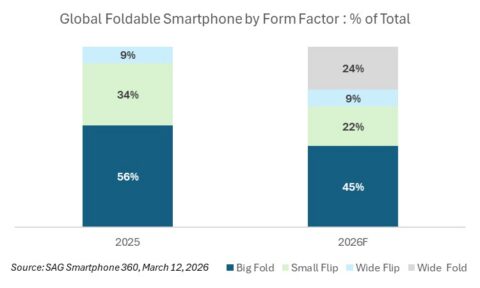
Wide fold devices are expected to experience the fastest growth, particularly as more manufacturers adopt the format.
Samsung Electronics is reportedly preparing to launch a wide fold model in 2H 2026, potentially ahead of Apple’s release.
Foldable Smartphone Vendor Landscape
Smart Analytics Global expects the competitive landscape to evolve alongside the emergence of new foldable form factors.
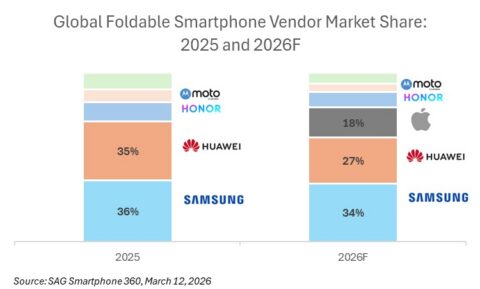
Samsung is projected to remain the largest foldable smartphone vendor in 2026, with an estimated 34% global market share, although this would represent a modest decline from approximately 36% share in 2025 as competition intensifies.
Huawei is expected to remain the second-largest player, holding roughly 27% market share in 2026, compared with around 35% in 2025.
Meanwhile, Apple is expected to become the third-largest foldable smartphone vendor immediately after entering the market, capturing an estimated 18% global market share in 2026 following the launch of its first foldable iPhone.
Smart Analytics Global believes Apple is well positioned to become the market leader by 2027, potentially reaching 36% global market share, as the company leverages its ecosystem advantages and premium positioning.
Exhibit 2: Foldable smartphone vendor market share forecast 2026 SAG
SAG View: Foldables Enter Their Second Design Cycle
The foldable smartphone market is entering what Smart Analytics Global describes as its second design cycle.
The first phase of development focused primarily on engineering challenges such as hinge durability and foldable display technology.
The next phase is likely to focus on display usability and aspect ratio optimization.
Smart Analytics Global believes wide fold and wide flip form factors are better aligned with real-world user behavior, particularly for multitasking and content consumption.
If manufacturers adopt these designs more broadly, foldable smartphones could evolve from a niche innovation category into a more mainstream premium device segment over the next several years.