
Motorola’s latest Razr foldable lineup marks one of its most ambitious pushes into the premium smartphone segment in recent years. However, the decision to raise prices across the portfolio introduces meaningful risks at a time when competition in foldables is intensifying and differentiation remains limited.
The new lineup (Razr, Razr+, Razr Ultra and Razr Fold) includes price increases of US$100 for the base Razr and Razr+, and a steeper US$200 increase for the Razr Ultra. In addition, Motorola introduced a new booklet-style device, the Razr Fold, starting at US$1,900, placing it firmly in ultra-premium territory. The pre-order of Razr Fold has started. The Razr 2026 lineup will become available on May 21.
From a strategic perspective, the move is understandable. Motorola is attempting to elevate its positioning in foldables ahead of the anticipated entry of Apple into the segment later this year. Establishing a broader and more premium portfolio before a major ecosystem player enters could help Motorola secure channel presence and consumer mindshare.
However, execution will be challenging.
Pricing Risk Outpaces Brand Strength
Motorola’s pricing strategy assumes that consumers will be willing to pay flagship-level prices for Razr devices. This is a significant shift from its historical positioning, where Razr foldables competed more on design and relative affordability.
From a consumer perspective, the higher price points may be difficult to justify. Motorola’s brand equity in the premium smartphone segment remains weaker than leading players, particularly Samsung and Apple. At price tiers approaching US$1,500–1,900, purchase decisions become increasingly driven by brand trust, ecosystem integration, and long-term product reliability where Motorola still faces perception gaps.
Limited Historical Scale Raises Questions
Motorola’s foldable track record also adds to the uncertainty.
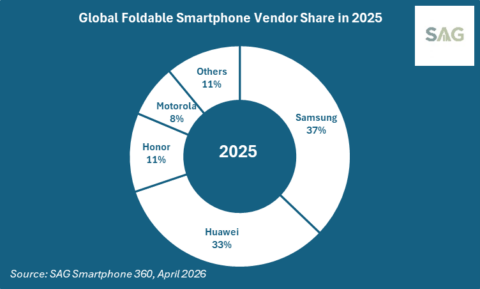
According to Smart Analytics Global (SAG) Smartphone 360 service, the Razr family shipped below 2 million units globally in 2025, accounting for roughly 8% of the total foldable market, ranking the fourth place after Samsung, Huawei and Honor. North America remained its largest region, supported by operator partnerships and brand familiarity.
Exhibit 1: Global Foldable Smartphone Vendor Market Share in 2025
While this establishes a foothold, it does not yet demonstrate the scale or momentum typically required to sustain premium pricing expansion.
Differentiation Remains Modest
Another challenge lies in product differentiation.
The new Razr lineup introduces iterative improvements, but it remains difficult to clearly distinguish these devices from competing foldables in a way that justifies the price increases. As the foldable market matures, incremental upgrades in design or specifications are becoming less effective as primary selling points.
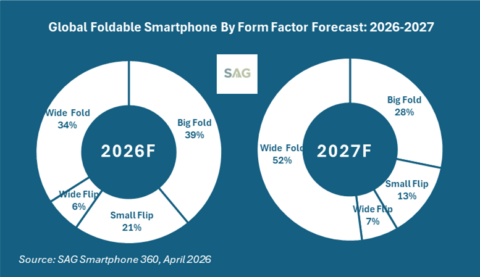
At the same time, the broader market is shifting toward new form factor preferences. SAG expects “wide fold” and “wide flip” designs to gain share, while traditional “big fold” and “small flip” formats gradually lose relevance. This transition could further limit the appeal of Motorola’s current lineup if it does not align closely with emerging usage patterns.
Exhibit 2: Global Foldable Smartphone by Form Factor Forecast
Apple Entry Will Reshape the Market
The timing of Motorola’s move is closely tied to the expected launch of Apple’s first foldable iPhone in September 2026.
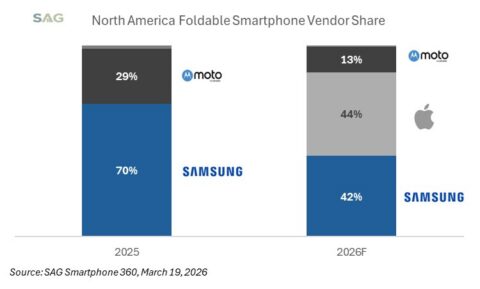
SAG expects Apple to rapidly become the largest foldable vendor in North America in 2026, driven by strong brand loyalty, ecosystem integration, and operator support. In this scenario, Samsung is projected to rank second, while Motorola is expected to decline to third place with approximately 12% market share, down from around 20% in 2025.
Exhibit 3: North America Foldable Smartphone Vendor Share Forecast
This shift highlights the growing importance of brand strength and channel execution in the foldable segment. As competition intensifies, mid-tier players may find it increasingly difficult to sustain share without clear differentiation or aggressive pricing.
Channel and Brand Will Define Outcomes
In the near term, Motorola’s performance will depend heavily on channel support and consumer recognition.
Operator promotions, retail visibility, and financing options will play a critical role in offsetting higher price points. At the same time, strengthening brand perception in the premium segment will be essential to improving conversion rates among high-value consumers.
SAG View: Cautious on Pricing Strategy
Smart Analytics Global (SAG) remains cautious on Motorola’s price hike strategy.
While the move reflects a logical attempt to reposition the brand ahead of a major market inflection point, the combination of limited differentiation, modest historical scale, and weaker premium brand equity creates a narrow margin for success.
In a market increasingly defined by ecosystem strength and form factor innovation, pricing alone is unlikely to drive sustainable growth. For Motorola, the challenge is about how to convince consumers why they are worth it.
SAG clients please click here to access foldable smartphone by vendor by form factor by region / country forecast report.