
Key Takeaways
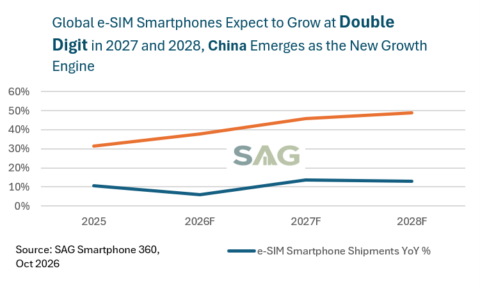
- Global eSIM smartphone shipments will outperform the overall smartphone market in 2026, growing 6% YoY despite a sharp TAM decline.
- Growth will accelerate to double digits in both 2027 and 2028, as eSIM adoption expands across more vendors, regions and price tiers.
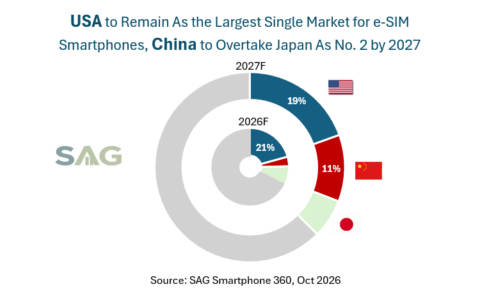
- China will emerge as the new growth engine, supported by regulatory approval, mobile operator initiatives, Apple’s push and growing adoption by Chinese OEMs.
- Apple and Samsung will remain the market leaders, but Chinese vendors will gain momentum and gradually diversify the competitive landscape.
- Hybrid eSIM will remain the dominant architecture, while Pure eSIM continues to play an important role, particularly in markets such as the U.S.
The global smartphone market is facing a challenging 2026, but eSIM is proving to be a clear bright spot. SAG forecasts global eSIM-enabled smartphone shipments will grow 6% YoY in 2026, significantly outperforming the overall smartphone market. Growth is expected to accelerate further to double-digit rates in both 2027 and 2028, as eSIM expands beyond its traditional strongholds in North America, Western Europe, Japan and South Korea.
Exhibit 1: Global e-SIM Smartphone YoY % and Penetration Rate: 2025-2028F
China Becomes the Biggest New Growth Engine
The biggest change in SAG’s latest forecast comes from China. eSIM smartphone penetration is expected to jump from virtually zero in 2025 to 6.7% in 2026, 22.9% in 2027 and 32.6% in 2028.
Several factors are coming together. Following regulatory approval for smartphone eSIM commercial trials, China Mobile, China Telecom and China Unicom have been expanding eSIM services and supported devices. Apple is playing an important role in pushing the ecosystem forward, while leading Chinese smartphone vendors including Huawei, Xiaomi, OPPO, vivo and Honor are following with their own eSIM-enabled products. SAG expects this combination of regulatory support, operator initiatives, Apple’s push and broader Chinese OEM participation to make China the most important incremental growth engine for eSIM smartphones over the next two years.
Exhibit 2: e-SIM Smartphone Forecast by Country: 2026F-2027F
Apple and Samsung Lead, but Chinese Vendors Are Catching Up
Apple and Samsung will remain the two dominant eSIM smartphone vendors through 2028. However, their combined share will gradually decline as the ecosystem broadens. Huawei, Xiaomi, OPPO, vivo and Honor are expected to accelerate their eSIM adoption from 2026 onward, initially through premium and flagship devices before gradually expanding into broader portfolios.
This shift is important beyond China. Greater adoption by Chinese OEMs should also accelerate eSIM availability in Southeast Asia, the Middle East, Latin America and other markets where these vendors have strong positions.
Hybrid eSIM Will Remain the Mainstream Architecture
The growth of eSIM does not mean physical SIM slots will disappear quickly. Hybrid eSIM will remain the dominant architecture, accounting for more than 80% of global eSIM smartphone shipments through 2028, while the share of Pure eSIM devices is expected to moderate after 2026.
Pure eSIM will remain particularly important in markets such as the United States, but hybrid physical SIM + eSIM solutions offer greater flexibility in China and many emerging markets, where dual-SIM usage remains deeply established.
Outlook
The eSIM smartphone market is entering a new phase. 2026 marks the transition, while 2027 and 2028 are expected to deliver double-digit growth. Mature markets will continue moving toward saturation, but China and broader Android adoption will open a much larger addressable market.
For the industry, the key story is how quickly vendors, operators and regulators can expand eSIM across different markets—and how the balance between Pure eSIM and Hybrid eSIM evolves along the way. Importantly, eSIM smartphone penetration measures hardware availability, not actual consumer usage. Actual eSIM activation and usage rates remain significantly lower than device penetration, highlighting that broader hardware support is only the first step toward full eSIM adoption.
Clients please click here to access the comprehensive e-SIM capable smartphone shipment outlook report, covering 10+ vendors and 15 regions / countries.