
Key Takeaways:
- Standout hinge in terms of holding positions: It holds position securely across a wide range of angles, a clear edge over Samsung’s slimmer Fold 8.
- Strong battery endurance: The dual-cell design comfortably supported a full day of light-to-moderate use, though heavier workloads still need testing.
- Premium but heavy: The titanium build and immersive inner display feel excellent, but weight and an asymmetrical cover screen leave room for refinement.
- Camera trade-offs: Day light shots are great, low-light and Night mode performance is decent and can be better, but the lack of a dedicated telephoto camera will matter to enthusiasts upgrading from Pro iPhones.
- Siri still lags: It handles simple tasks and visual recognition well, but multilingual voice recognition and proactive, cross-app task execution trail, especially when compared with Meta Muse.
- Outlook: Early demand is concentrated in the US and China, with broader international reach expected as supply constraints ease. Foldable iPhones should remain a premium niche in the near term.
After around a week with the device, our iPhone Duo review finds that Apple’s first foldable iPhone is a compelling first-generation device. The Duo is held back by some familiar first-generation compromises. Here is what stood out and what didn’t.
Hinge: Holds Acute, Obtuse Angles
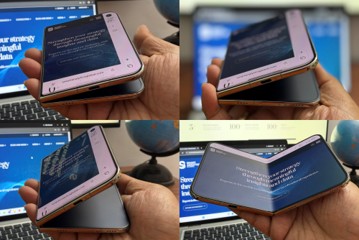
The hinge is arguably the Duo’s best feature. It feels robust and holds the device firmly at both acute and obtuse angles, so propping it up on a desk or using it half-open feels natural.
We have long liked the hinges on Samsung’s Galaxy Z Fold 5 and Z Fold 6. Samsung’s push for a slimmer design on the Fold 8 seems to have cost it some of that angle-holding ability. The Duo holds its position well across a wide range of angles, and Apple executed this part very well. Regarding the screen issue, we have talked briefly in the durability section.
Exhibit 1: iPhone Duo Hinge
Battery Life Impressed Us
Battery endurance was one of the biggest positives. After charging one evening and using the phone intermittently the next day under light-to-moderate conditions, 46% remained by the following evening. Reported capacity is based on regulatory documentation rather than Apple’s published specifications. The Duo uses two cells, one on each side of the fold. Heavier workloads still need testing, but early signs are encouraging.
Two Displays, One Quirk
The 7.6-inch inner display is beautiful, and that was our first impression. Unfolded, it gives a symmetrical canvas with Apple’s signature curved corners. The under-display selfie camera removes the punch-hole cutout, and the nano-texture matte finish adds a premium feel, though it can mute colors slightly. We didn’t find that a real drawback.
The 5.4-inch cover display is sharp, vivid and practical, with one odd design choice: its right corners are rounded and its left corners are comparatively square. Next to the more symmetrical cover screen on the Galaxy Z Fold 8, the difference shows.
Everyday Usability: Some Adjustment Required
Regular iPhone users will notice the absence of Face ID. Authentication moves to fingerprint recognition, which we found noticeably slower than on several other phones we’ve tested.
The volume buttons sit at the top when the phone is folded, which takes some getting used to. We would also have preferred an Action Button over the Camera Control button. Photography isn’t the Duo’s main selling point, and the Action Button’s quick Ring/Silent toggle suits the professional users Apple appears to be targeting.
Cameras: Strong in Low Light, No Telephoto
The Duo has two 48 MP rear cameras, a Fusion Main and a Fusion Ultra Wide, and they handle everyday photography well. Day light shots were great, we were also impressed by low-light and Night mode results, including shots of lunar halos. There is scope of improvement in night shots as the default Night mode can overexpose, but turning it off or adjusting exposure manually gives a more natural look.
Exhibit 2: Lunar Halos Photographs Taken by iPhone Duo

The gap is the lack of a dedicated telephoto camera. The Duo offers 2× optical-quality zoom through the main sensor, but anyone who regularly photographs distant subjects will feel the absence. This matters most for enthusiasts upgrading from a Pro iPhone and used to a triple-camera setup.
For selfies, the cover-display camera performs well. The under-display camera on the inner screen is weaker, but it’s adequate for video calls. We see this as a practical trade-off for an uninterrupted inner display.
Build and Durability
The Grade 5 titanium frame gives the Duo a premium feel that stands out even against the iPhone 18 Pro, 18 Pro Max and 17e. The cost is weight. At more than 250 g, it feels noticeably heavier than the Galaxy Z Fold 8 and is harder to use one-handed. With the magnetic case on, it passes 300 g.
The IP68 rating, with submersion up to 6 meters for 30 minutes under lab conditions, adds welcome reassurance for a foldable. It doesn’t cover every type of damage, and long-term hinge and display durability will only be proven over time.
We’ve also seen online reports of cracks near the hinge, green lines and damaged screens. Apple appears to be replacing affected units promptly, which is encouraging, but the scale and causes are still unclear. Quality control and after-sales support will matter a great deal for confidence in Apple’s first foldable.
Software: Polished, With Gaps
The open and close animations are polished and make the form factor feel well integrated with iOS 27. We did hit an intermittent bug where we couldn’t switch app pages on the cover display. It cleared after unfolding the phone. That is disappointing on a roughly US$2,000 device.
Apple’s own apps are well optimized. Third-party support is mixed: Netflix and Outlook are in good shape, while LinkedIn and X still need work. That isn’t entirely Apple’s responsibility, but it should work closely with developers to speed things up. A bigger screen should deliver real productivity gains, not just an enlarged phone interface.
Siri: Much Improved, But Behind in the AI Race
We tested the Apple Intelligence-based Siri beta on the Duo and the iPhone 18 Pro Max. Siri is good at visual recognition, pulling up context about what it sees, and opening apps like Maps. It also handles simple tasks well: summarizing news, searching the photo gallery and composing messages. Broader web research was less consistent.
Multilingual voice recognition was the weakest area. Once a default language is set, Siri generally fails to recognize commands in other languages unless you switch settings manually. Text input handles multiple languages better, but Type to Siri is less accessible than it should be, and voice isn’t practical in every setting.
In our experience, Meta Muse handled automatic multilingual voice recognition more smoothly and offered a more seamless blend of text and voice. In our family-travel planning test, Siri gave general information but couldn’t complete flight or hotel bookings without repeated manual intervention. Muse, in our separate evaluation, was more proactive. This is a qualitative comparison, not a controlled benchmark.
Apple’s ecosystem integration is a strong foundation for personal AI, but the next phase of competition will turn on how naturally assistants interact with people and how well they complete real-world tasks.
Market Outlook: Concentrated Start, Broader Reach Ahead
Our latest Smartphone 360 service forecast points to strong early demand for the Duo, with the US and China driving most initial shipments.
We expect geographic diversification to build next year. As supply constraints ease and international availability improves, the rest of the world should take a steadily larger share. An upgraded Duo anticipated in the second half of next year could further support international adoption, depending on availability, pricing and launch timing. Supply-driven backlogs also need to be separated from sustainable consumer demand. We expect foldable iPhones to remain a premium niche in the near term, with broader adoption depending on better supply, durability, affordability and everyday usability.
Our Verdict
The iPhone Duo is a strong first-generation foldable. Its head turning ability, aspirational value, hinge, battery life, inner display and premium build are clear strengths, and the cameras perform well in low light. Weight, the asymmetrical cover screen, the missing telephoto lens and uneven app optimization are the main areas to improve.
For future generations, we’d like a more symmetrical cover display, a lighter body, a dedicated telephoto camera and broader app support. Siri needs to evolve into a proactive, action-oriented assistant. Apple has laid solid foundations, and with refinement, later versions could be far more compelling. Our detailed review with latest iPhone Duo by country shipment forecast numbers is in the published report, authored by Linda and yours truly, for subscribing clients.
Disclosure: Apple provided the review unit. The opinions expressed are SAG’s own, and this review is not sponsored.