
Key Takeaways
- Apple Pay has entered India with security and privacy being the key focus.
- As of now, Apple Pay is limited to Axis Bank credit cards on payment networks of Visa and Mastercard, while debit cards, RuPay and UPI are not supported.
- Security and privacy remain the key proposition, with sensitive card information encrypted and stored in the Secure Element, along with Face ID or Touch ID authentication.
- In the short run, Apple Pay could help Axis Bank increase its credit card sales, as iPhone users who want to try Apple Pay may consider getting an Axis Bank credit card.
- The absence of UPI is a limitation for Apple Pay in India, given the very high adoption of UPI for everyday payments.
- Apple’s pull effect could help drive awareness and adoption of NFC-based payments among merchants and consumers in India.
- Apple Pay could also help Apple gain some incremental iPhone sales, particularly among users in the premium and ultra-premium segment who previously preferred Samsung because of Samsung Pay.
- As more banks and issuers join Apple Pay, the initial advantage for Axis Bank is likely to subside as consumers get more card options.
- Overall, Apple Pay could strengthen the iPhone ecosystem in India while giving NFC-based payments another push in the market.
Apple Pay has launched in India, bringing Apple’s payment service to a market where smartphone vendor-led payment solutions are not entirely new. Samsung, as a smartphone vendor, has already offered Samsung Pay in India. In that sense, Samsung Pay was the first major smartphone OEM-led payment service in the market, while Apple Pay becomes the second.
However, the Apple Pay story is not just about being number one or number two. Apple’s proposition is more focused on security and privacy, while its entry could also have a wider impact on adoption of NFC-based payments in India.
Exhibit 1: Apple Pay India, Image source: Apple
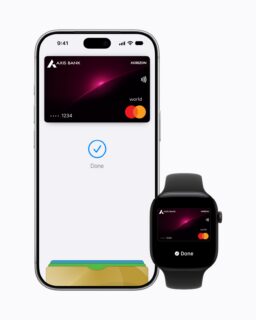
Apple Pay’s Global Presence, Limited Initial India Rollout
Apple Pay is already live in more than 80 countries, with more than 10,000 bank tie-ups worldwide.
In India, however, the initial rollout is limited. Apple Pay currently supports Axis Bank credit cards on Visa and Mastercard. Debit card as of now is not supported. UPI payments are also not an option right now. On the hardware part Apple Pay is supported by iPhones XR or higher running iOS 18 or later, Apple Watch Series 6 or higher running WatchOS 11 or later and iPads with Face ID or Touch ID for online transactions. Apple Pay support for Mac is coming soon.
But this is just the beginning, and we believe the service to gradually expand to other issuers and payment networks including RuPay as well as potentially to debit cards as well.
Security and Privacy Remain the Key Proposition
One of the key aspects of Apple Pay is how it handles sensitive card information.
According to Apple, when a card is added to Apple Pay, the sensitive information is encrypted and stored in the device’s Secure Element. When someone makes a transaction with a merchant the card details are not passed to him but stays on the secure element. Even Apple can not read these information as these are stored in encrypted manner.
When the merchant needs the required information to process a payment, the relevant security mechanism is used to authorize the transaction possibly by the issuer having a decryption key to approve the payment. The actual sensitive card information is not exposed to the merchant, helping keep the user’s payment information secure.
Face ID and Touch ID Add Another Layer of Security
Apple Pay can be accessed using Face ID or Touch ID, depending on the Apple device.
This becomes particularly important if a device is lost or stolen. Even if someone who has stolen the device knows the device passcode, additional authentication i.e the biometric authentication is required to access Apple Pay. If the biometrics are wrong, it gets locked and there is a cooling period for it to unlock. This gives owner the time to take action to wipe the data or take other measures.
How Does Apple Make Money from Apple Pay?
When a consumer makes a payment through Apple Pay using an Axis Bank credit card running on the Visa or Mastercard payment network, the transaction is processed through the respective payment ecosystem.
When the transaction is made, the merchant pays a small fee to the issuer. In this case, the issuer is Axis Bank, which makes money from the transaction.
Now, the question is: How does Apple make money from Apple Pay?
Out of the fee generated from the transaction, a small cut is passed on to Apple. This is how Apple makes money from Apple Pay.
So, in simple terms, Apple gets a small share of the transaction economics when consumers use Apple Pay with supported cards.
The Biggest Limitation: No UPI
So basically UPI is an instant real-time payment system developed in India. It’s full form is Unified Payment Interface and it uses mobile phone to transfer the money from one account to another without the need of bank account or bank code simply by using UPI ID or the phone number and is you want to transfer using bank account number, that is also an option
While security and privacy are important strengths of Apple Pay, there are also some limitations to the initial India rollout.
The biggest one is the absence of UPI support. At present, Apple Pay is limited to credit cards, with Axis Bank being the initial banking partner.
This could be a limitation in India because UPI adoption is already very high and has become an important part of everyday digital payments.
As a result, the absence of UPI could limit Apple Pay’s adoption among consumers who primarily rely on UPI for their daily transactions.
Having said that, we also believe it is the right time for Apple to launch Apple Pay given UPI transactions above INR 2000 (~USD 21) were recently announced to be charged.
Short-Term Advantage for Axis Bank Credit Card Business
In the short run, we think this could help Axis Bank credit card sales. The iPhone installed base in India has grown significantly over the past couple of years, and a significant portion of these iPhone users would likely want to try Apple Pay.
If they already have an Axis Bank credit card, then it is well and good. But if they do not have one, some users may consider getting an Axis Bank credit card specifically to use Apple Pay.
This could help Axis Bank credit card sales in a substantial way in the short term. Apple has that pull effect thanks to its brand image.
However, when other banks and issuers bring their credit cards to Apple Pay, this advantage for Axis Bank is likely to subside, as consumers will have more options to choose from.
Apple’s Pull Effect Could Help NFC Payments
The bigger story, however, could be Apple’s ability to influence the broader ecosystem.
Samsung Pay was already available in India and offered a convenient way to make NFC-based payments. However, the communication and awareness around NFC payments may not have been strong enough to drive adoption among merchants at a higher rate.
Apple has a strong pull effect in the market. When Apple introduces a technology or payment experience, the industry tends to pay close attention.
Apple Pay could therefore encourage more merchants to implement and promote NFC-based payment options.
Could Apple Pay Help Expand NFC Adoption in India?
Apple Pay’s initial rollout is still limited, particularly with support restricted to Axis Bank credit cards and no UPI option.
However, as Apple expands its banking partnerships and payment options, the service could become more relevant to a larger consumer base and hence Apple could increase awareness and adoption of NFC-based payments among both consumers and merchants.
For now, Apple Pay’s significance in India is not simply about launching another payment service. It is about bringing Apple’s security- and privacy-focused payment experience to India while potentially giving NFC-based payments another push in the market.
Could Apple Pay Help Apple Gain More iPhone Sales in India?
iPhone shipments have already been making waves in India for the past couple of years. As per SAG smartphone 360 service, Apple’s market share in the Indian smartphone market in Q2 2026 was 10%. It ranked 5th in terms of volume and 1st in terms of value.
Now, the real question is whether the presence of Apple Pay is going to help Apple gain more sales in the iPhone business or whether it is not going to have much impact.
We believe that the presence of Apple Pay in India is definitely going to help Apple win some more sales in the iPhone business.
The reason is that, in the premium and ultra-premium segment in India, there are two prominent players as of now, Apple and Samsung. People tend to stick to one of them for multiple reasons. One is the comfort with the operating system, and the second is the perceived aspirational value.
Then, there are still some people who would have wanted to move to an iPhone, but they were enjoying the comfort of Samsung Pay on Samsung phones, given there was no similar option in the iOS ecosystem in India.
But now the case has changed.
With Apple Pay coming to India, users who were sticking to Samsung because of the absence of Apple Pay and the presence of Samsung Pay might now have an alternative. These users can now consider switching to iOS without giving up the convenience of an OEM-led payment service.
This could therefore help Apple attract some additional users from the premium and ultra-premium smartphone segment in India.